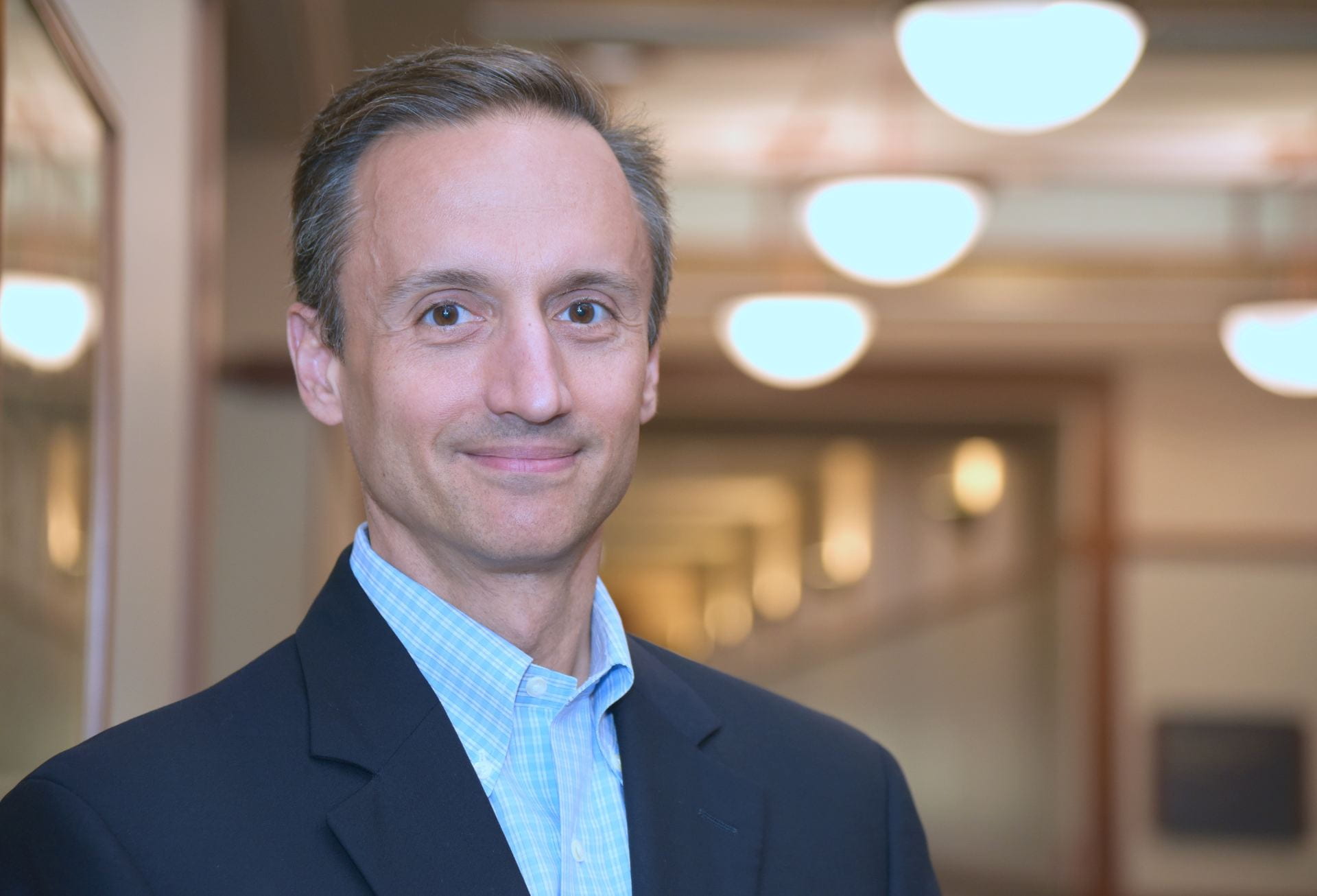
Professor of Economics Tony LoSasso | Photo by Kathy Hillegonds
I’ve been really fortunate to have people help me along the way. I certainly would not have found my own way.”
— Tony LoSasso (BUS ’91, MS ’93)
As a DePaul undergraduate student in business, Tony LoSasso (BUS ’91, MS ’93) never thought about getting a master’s degree. Then, the late Ashok Batavia, who served as a professor of economics at the Driehaus College of Business, encouraged LoSasso to pursue a master’s degree at DePaul.
“It all started with DePaul and having people like Ashok push me in this direction, showing me that there was this direction, because I didn’t even know it existed,” says LoSasso, who was the first in his family to attend college. “I’ve been really fortunate to have people help me along the way. I certainly would not have found my own way.”
LoSasso rejoined the DePaul community in 2019 as a professor of economics and Driehaus Fellow. “I’m really excited to be back. It’s a tremendous thrill,” he says. A nationally recognized expert in health economics, LoSasso teaches graduate and undergraduate health economics courses. His award-winning research spans several dimensions of health and labor economics, health policy and health services.
LoSasso’s interest in health economics was spurred by the federal health reform efforts of the 1990s, which occurred while he was earning a PhD from Indiana University Bloomington.
“I’m somebody who has always been interested in the policy side of things, and, of course, health economics is ripe with policy interest and relevance,” he says. “It was an untapped market for research, and then new and more data, and more powerful computers that could crunch data, became available.”
An area of particular interest for LoSasso is health insurance benefit design and the impact it has on health care utilization and health outcomes. One of his most recent research pieces, which he has yet to publish, utilized data to examine premiums within the health insurance market for small businesses.
In the classroom, LoSasso uses research to help students better understand the course material.
“I don’t think students often think that most of their faculty at DePaul are active researchers and scholars trying to push the boundaries of science,” he says. “So in addition to being informative about the subject matter, bringing my own research into the classroom can be of interest for students to get a sense of where research ideas come from, how they germinate and how they ultimately become published articles.”
The Chicago Food Depository adjusted its operations to meet both growing need and new pandemic safety measures.
We’re trying to obtain a variety of foods, but at the same time we’re also trying to make sure we’re continuously getting food out into the communities especially those that have been direly affected by the crisis.
— Sheila Creghin (MBA ’84, JD ’89)
Sheila Creghin (MBA ’84, JD ’89)
“If I’d had a crystal ball,” says Sheila Creghin (MBA ’84, JD ’89), reflecting on when the coronavirus pandemic erupted in the United States back in March, “I would have made sure we were extra stocked up on shelf-stable food items and hygiene supplies.”
But there is never a sure way to know when a crisis beyond your control is going to strike and rattle the way you run your business. As vice president of operations at the Greater Chicago Food Depository, Creghin found herself, like many leaders of organizations affected by COVID-19’s challenges, in a sink-or-swim situation.
The Greater Chicago Food Depository, dubbed “Chicago’s Food Bank,” distributes food to communities in need throughout Chicago and Cook County. Its large facility sits on a spacious lot on the South Side of Chicago, a hub that distributed more than 93 million pounds of food in the last year to a network of 700 community partners. “The demand for food has increased by upwards of 50% because of the pandemic,” Creghin says. “Many of the people we serve work in industries that were greatly impacted by the virus, like restaurants, so they were out of work and unable to buy food.”
Before COVID-19, the depository served as many as 800,000 people per year. Now, Creghin says, visits to local food pantries have more than doubled. By the time their fiscal year ended in June 2020, they had distributed 18 million pounds more food than the previous year because of COVID-19 and its economic impact.
“The crisis has disrupted so many aspects of our business model and operations. For instance, we’re big advocates of client choice, in respecting the dignity of people by allowing them to pick like they would at a grocery store what items they want to take home to their families,” Creghin explains. “COVID-19 has forced us to scrap that model to avoid a high-touch atmosphere and resort to distributing boxes of food that we have had to package ourselves.”
Food bank workers are packaging food under safety protocols.
Demand for food at the depository has increased about 50% since the pandemic hit.
Acquiring the food itself has been another challenge. “We’ve struggled with procuring nonperishable foods because of how much people have been buying off the shelves,” Creghin says. “We’re trying to obtain a variety of foods, but at the same time we’re also just trying to make sure we’re continuously getting food out into the communities, especially those that have been direly affected by this crisis.”
Creghin and her team of roughly 100 employees comprising drivers, warehouse workers and facilities staff have been working long hours throughout the pandemic to meet the increased needs of their clients. Implementing social-distancing guidelines and other protocols to keep employees safe has required adapting to new processes. Drivers who transport food to communities, for example, are no longer accompanied by an assistant who helps to unload the food. As a result, the depository has had to invest in equipment to help its drivers safely unload hundreds of pounds of food from trucks on their own.
“It’s been challenging, but a crisis also offers learning opportunities,” Creghin says. “It forces you to examine the systems you have in place and come up with new and creative ways to get the job done. I’ve empowered so many of my team members during this time, and it’s been inspiring to see them rise to the occasion with incredible leadership and dedication under such difficult circumstances.”
Creghin shared these tips for crisis leadership:
Listen and communicate. Communication during a crisis is critical, especially when you are managing people in different roles and at different levels. Listen and be empathetic to the needs and concerns of your employees so you can support them in their new working environment. Listen for feedback because some people may have access to data or information that can help drive better decisions. You also need to make sure everyone understands the plan on how to move forward. Sometimes you may feel like you are overcommunicating, but during a crisis, things can change quickly and frequently, so constant communication is important.
Be flexible. When you create your crisis management plan, realize that you may have to change that plan at any time depending on how the crisis evolves. Make sure your team also is ready to adjust course if the situation warrants it.
Stay calm. As a leader, if you overreact or appear overly stressed, you make your team nervous and stressed. Approach the crisis with a calm, level head and recognize that you set the tone for how your team handles the situation at hand. I always say, “Today we’re going to do our best and do as much as we can, and tomorrow is another day.” That’s all you can do during a crisis: face each day as it comes.
By Nadia Alfadel Coloma | Photos courtesy of Chicago Food Depository
Using the skills she learned as an undergraduate DePaul student, Miss Alex White has turned her band, White Mystery, into a sustainable music business through which she and her brother, Francis White (left), produce outdoor festivals, consult for artists and mentor music business students.
As industry leaders, it’s our responsibility to learn all of the Vincentian, ethical lessons that I feel DePaul does a really good job at emphasizing in the MBA program—that people in money decisions aren’t just data.”
— Miss Alex White (BUS ’07)
In 2008, Miss Alex White (BUS ’07) made a pact with her brother, Francis White, to commit full-time to their newly formed punk band, White Mystery, for the next 10 years.
Throughout the next decade, the sibling rock duo fulfilled that pact by living and breathing music 24 hours a day. To date, White Mystery has played more than 1,000 shows on three continents with music icons including Iggy Pop, Garbage, Mavis Staples, Patti Smith and even Sir Richard Branson; appeared in a national Levi’s Jeans ad campaign; performed live on the NBC late night TV show, “Last Call with Carson Daly”; and self-released 10 records – all without a manager or publicist. White partly credits her band’s success to lessons she learned in the DePaul class, Effective Business Communications, that she took as an undergraduate business student with Associate Professor of Marketing Joel Whalen — lessons that include how to properly introduce yourself and market your business to others.
“I use the lessons from Dr. Joel Whalen’s class every day,” White says. “So many times you’ll receive an email from somebody and it’s just a too-long-to-read autobiography about the person’s experience and the reality is that a lot of business people in music and beyond receive dozens and dozens of emails every day.”
Using these skills, White has turned White Mystery into a sustainable music business through which she and her brother produce outdoor festivals, consult for artists and mentor music business students.
Now, White has returned to DePaul to earn her MBA with a concentration in Real Estate Finance & Investment. She juggles school with a full-time job as the senior market and experience manager for Do312, a virtual Chicago network that helps people discover happenings in Chicago, and side gigs that consist of spinning records for clubs and parties, writing a column for High Times magazine and working on freelance consulting projects that have been featured in Forbes magazine.
Hitting the High Notes On and Off the Stage
Miss Alex White (right) made a pact with her brother, Francis White (left), to commit full-time to their band for 10 years.
Born and raised in Chicago, White and her brother grew up listening to rock ‘n roll classics on her parents’ vinyl collection – The Rolling Stones, Led Zepplin and The Who. She and her brother began playing musical instruments around 5 and 3 year’s old, respectively, and began jamming together at 13 and 11 year’s old.
As a high school student at Northside College Prep, White played in a number of bands. She also held a part-time job at Laurie’s Planet of Sound, a music store in the Lincoln Square neighborhood, where she developed an appreciation for vinyl records. She discovered she could manufacture seven-inch vinyl records – also known as 45s – from a record-pressing plant in Nashville. Under the name Missile X Records, White began producing 45 records and selling and releasing music through a one-page website.
“We took the punk approach where we Xeroxed black and white covers for these 45s and got a bunch of friends together, folded the covers and then we mail-ordered them all around the world,” she says.
Although White thought she might study art, she was exposed to the idea of being self-employed from a Chicago Tribune article that highlighted the Coleman Entrepreneurship Center at DePaul. “Jumping into entrepreneurship opened up a whole new world to me and a method of uniting my love of the arts with actually creating a career,” she says.
She enrolled in the Driehaus College of Business where she studied business management, sales leadership and entrepreneurship, later graduating with a bachelor’s in business cum laude. On the day of commencement, White was busy touring Europe under with her band, Miss Alex White & the Red Orchestra.
A year later, White, who added “Miss” to her given name to create her stage persona, and her brother started performing as White Mystery and playing up to 250 shows in one year. “My brother Francis and I started White Mystery as an all-encompassing band and brand, where it started as just a sibling rock duo and transformed into what it is today, where we produce outdoor festivals, and help brainstorm solutions to challenges in the entertainment industry,” she says.
Shaping the Future of Music Business
Miss Alex White (left) enrolled into the Driehaus College of Business to study entrepreneurship and later returned to DePaul to pursue an MBA.
I hope that in going through the DePaul MBA program that I become a better leader and help shape the culture of music and the arts to be a more diverse place for entrepreneurs to thrive.”
Today, White Mystery performs fewer shows while White continues to focus on her MBA. She served on the Coleman Entrepreneurship Center’s advisory board and helped form an alumni association, called eMerge, for emerging entrepreneurs. In the last 10 years, she’s mentored more than 30 college and high school students as well as the DePaul Blue Demons Men’s basketball team interested in entrepreneurship through guest-teaching, networking programs and consulting projects.
“Now that I am so overwhelmed by my workload from morning until night, I now am seeking mentorship,” she says. “Just because you mentor other people, it doesn’t mean you have it all figured out. It’s nice to actually have leadership from someone who is maybe a phase ahead of you but they can help you with the obstacles that you face.”
White also served as vice president of the Chicago Chapter of the Recording Academy, the organization responsible for the annual Grammy Awards. One of her proudest achievements while serving on the board of governors was successfully advocating for online streaming artists to be considered for nominations. The rule led to Chicago native Chance the Rapper winning multiple Grammy awards in 2017.
Following years of professional growth and experience, White says getting her MBA at this point in her career felt right, especially as the pandemic has impacted the music industry. She ultimately hopes to use her MBA to work in an executive leadership role and open doors for other musicians.
“I hope that in going through the DePaul MBA program that I become a better leader and help shape the culture of music and the arts to be a more diverse place for entrepreneurs to thrive and a place where women and people of color can also achieve leadership goals in creating environments that are more progressive,” she says.
“I feel that we, as industry leaders, have a responsibility to learn all of the Vincentian, ethical lessons that I feel DePaul does a really good job at emphasizing in the MBA program—(such as) that people in money decisions aren’t just data. There’s a very real human element that needs to be considered in decision-making and, as Blue Demons, we need to make sure we are the voice in the room that really emphasizes that.”
By Jaclyn Lansbery | Photos by Diane Alexander White
DePaul business student Lauren Pingad launched Fashion Masks, a high-quality protective mask venture, in April 2018 with her mother Hui Nye, a draper technician at DePaul’s Theatre School, to help people during the COVID-19 global pandemic. Pingad, who is studying management and entrepreneurship at the Driehaus College of Business, oversees the operations and marketing while Nye takes the lead on production.
Pingad credits DePaul’s Coleman Entrepreneurship Center Executive Director Bruce Leech with providing guidance for starting her business. The center also hosted a “hackathon” competition over the summer that challenged other DePaul students to create marketing ideas for Fashion Masks.
The business focuses on producing masks with premium cotton fabric, adjustability and fit, and has partnered with at least 15 different real estate businesses, apartment complexes, hotels and medical clinics throughout Chicago to provide masks.
Watch the full video to learn more about this startup:
Nov. 18 marks the U.S. release date for “Bella Vita,” a gypsy jazz CD that is the culmination of a unique musical collaboration between Dario Napoli, an Italian musician and DePaul MBA alumnus, and Steven Briggs, DePaul business professor emeritus and founder of Blue Night Records, a jazz/Americana music label.
In this Q&A, Napoli and Briggs talk about the origins and results of their musical partnership, which began 15 years ago when Napoli was a student at DePaul’s Kellstadt Graduate School of Business.
How did you first meet?
Napoli: So, in 2005 I began my MBA at DePaul and Steven taught a negotiations class that I took. I noticed right away that his approach to teaching was unconventional and creative and it truly was my favorite class even before I knew anything about Steven’s involvement in music. One of the assignments in the class was discussing our passions and our desires in life, and of course, that’s when Steven found out that music had been my No. 1 passion, ever since childhood. That prompted Steven to inquire more about me and so one day after class we chatted a bit and he invited me to bring my guitar so we could jam.
When did you start playing as musicians together?
Briggs: At my suggestion during our after-class discussion the first week, Dario brought his guitar to the second class session. Mine was in my office. We found a spot in the lobby after class and the notes began to fly. I was shocked at his musical knowledge and improvisational skills. We started jamming every Friday night until we got a few duet gigs here and there, sometimes on Chicago’s North Shore, and sometimes in my neck of the woods—Galena, Ill. My wife, Barbara, is a great singer, so she joined us for the Galena gigs. Collectively, we were called “Swing Shift” and we had a blast playing in various Galena venues.
Napoli: After that first post-class jam, we got a lot closer and the jams became more frequent. Then Steven invited me to his beautiful house in Galena and there was more jamming. Since we had so much fun, we then started playing regular shows at a beautiful local restaurant in Galena, One Eleven Main.
Dario, why did you decide to focus on music as a career?
Napoli: On and off, I had always been involved in music since my high school days, at times more seriously (like in college in Louisiana), at times more as a hobby. Nonetheless, I basically never took time off from music since about the age of 12. After I met Steven, the idea of dedicating my life entirely to music grew stronger and stronger in me, as a result of the activities in his class and then as our friendship developed. He was a huge reason I made the leap in that direction and don’t regret it to this day. Steven helped me realize that life is so much better when you’re truly spending time doing what you love. Everything in life requires a tremendous amount of work, sacrifice and dedication; it might as well be toward something you genuinely enjoy doing.
A huge aspect of music is also the business side of it. The MBA at DePaul helped me greatly in always looking at things not only with the musician hat on but also with the management, booking, promoting and marketing hats on as well, (which are) vital in sustaining a career.
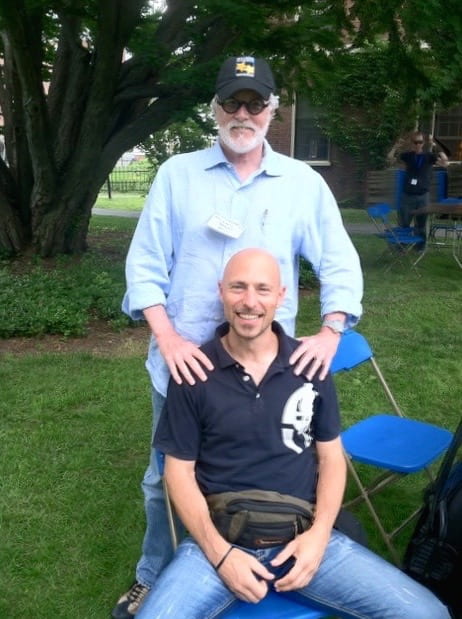
DePaul Professor Emeritus Steven Briggs and DePaul MBA alumnus Dario Napoli at a guitar seminar Napoli led in Boston.
From left to right: Dario Napoli and Barbara and Steven Briggs, known as Swing Shift, play at the One Eleven Main restaurant in Galena, Ill..
DePaul MBA alumnus Dario Napoli and his trio, Modern Manouche Project, released their CD, “Bella Vita,” on Emeritus Professor Steven Briggs’s Blue Night Records.
Steven, how did you found Blue Night Records?
Briggs: In 1996 I was the “arrangements chair” for the National Academy of Arbitrators’ 50th Anniversary Conference in Chicago. Part of my job was to hire musicians for several events. Among the cats I hired was Don Stiernberg, a Chicago jazz mandolinist and guitarist. He and I became friends and I offered to finance/produce a CD that featured him. The result was “About Time,” Blue Night Records’ first release, in 1998. “Bella Vita” by Dario and his trio, Modern Manouche Project, is our 16th CD release.
How did “Bella Vita” come about?
Briggs: Dario has been living in Italy for at least 10 years, and we’ve kept in touch the whole time. While he has a strong following across Europe and beyond, he had never released a record (yes, we still call them that) for the U.S. market. He sent me a nine-track demo he had recorded with Modern Manouche Project, and after some additional mastering and revised packaging it became “Bella Vita.”
Napoli: In January 2020 I recorded the demo with “Modern Manouche Project,” a trio I sometimes lead. As with all my previous recordings, one is always automatically reserved for Steven. A few weeks after I sent him a copy, Steven reached out and to let me know he was impressed with the work and wanted to release it as a CD, releasing it in the U.S. under the Blue Night Records mantle. The rest is history!
What’s next for each of you?
Briggs: Dario and I have already begun discussions about the next Blue Night Records’ release. I want to feature him again, but this time all of the tracks will be his original compositions.
Napoli: Before March and the advent of the coronavirus, we (Modern Manouche Project) had just completed a northern European tour. Things were really looking promising as we had a schedule full of exciting tours and concerts. That came to a bit of a halt, but we are still optimistic about being able to tour and present “Bella Vita” both here in Europe and in the U.S. I’m also writing new music and will look to record the new Blue Night Records album sometime in the next year, if the world returns to some semblance of normalcy.
Anything you would like to add?
Napoli: I suppose life grants you a certain number of crucial encounters, mentors or significant people that somehow inspire you and guide you toward a path you were likely bound to take. Steven was one of those people for me, someone whose integrity and personality just stood out for me. I’m honored to this day to have met him and more than once, listened to his advice and followed his example. And none of it would have likely happened without my experience at DePaul University.