From July 26th to August 18th, I was a part of a group of 9 DePaul undergrads and 6 DePaul graduate students who were assigned a consulting project for a special client, The Chicago Cubs. We were tasked with looking at the new Grab & Go concessions at Wrigley Field through both our own observations and data provided to us by the Cubs and making improvement recommendations based on those.
We started off our class at the DePaul Center in the Loop with Professor Clark, meeting on Zoom with three members of the Cubs Organization: Brad Johnson, Director of Hospitality and Retail, Brad Nagel, Director of Talent, and Vanessa Ward, former Project Manager. They gave us an overview of the Cubs as a business organization as well as a brief introduction as to what they were looking for from us in this project. We learned about how the Cubs are aiming for a “frictionless experience” from before a guest even arrives at the ballpark until the moment they arrive back home. That was going to be the goal moving forward with our projects, helping to make the Grab & Go concessions a frictionless experience.
One of the Grab & Go concession stands at Wrigley Field
We also met with Maria Sapienza, Assistant Director of Analysis and Planning Operations, over Zoom. Maria and Brad Johnson were our main points of contact during this project and who we would be presenting to at the end.
The next week we got to actually go to Wrigley Field, and before getting the official tour we learned more in-depth about what the Cubs were looking for from us, as well as a set of goals for the next couple steps in our process. First, we were going to be given data from post-game and in-game surveys completed by guests during this season. Our class had a dedicated three-person team to comb through all the data and pick out what they found was important from it. Next, we would each be attending a Cubs game over the weekend’s home stand and acting as secret shoppers. This gave us the opportunity to experience the Grab & Go concessions firsthand, along with all other aspects of the fan experience. Finally, we would be attending one more game as a class where we would be surveying the various Grab & Go stands in the park to collect more data.
A group meets with Brad Johnson, Director of Hospitality and Retail to share their ideas and get feedback
Students discuss the data they are finding during a survey
After that, we were into the home stretch with only a week left until presentations. Each of the three groups met with Brad and Maria to explain some of their initial ideas to see if they were both on the right track and within the realm of possibility for the organization to commit to.
Before we knew it, it was Thursday the 18th which meant it was presentation day. The class met at the Cubs’ Offices for the final time ready with our ideas and slideshows. The three groups got up and presented recommendations ranging from reconfiguring the set-up of the line and actual concession stand, to different types of signage, and lights similar to those you see at grocery store self-checkouts that indicate a machine is open for the next guest. We made these recommendations based on what we were able to glean from the data and our own observations we had being at the park.
Overall, this was an invaluable experience for myself and my classmates getting an inside look into the business operations of a professional team, as well as being challenged to give a consultation and recommendation on an area none of us were experts in and in a relatively short period of time. Not only that, but we got to connect and network with members of the Cubs organization, as well as our classmates who will end up in a wide variety of organizations and industries in the future.
Students in the undergraduate course “Business of Esports,” taught by Senior Instructor Andy Clark, worked directly with leading esports organization Evil Geniuses to develop partnership ideas for their new Rocket League team.
By Nadia Alfadel Coloma
If you ask Andy Clark, director of the new Bachelor in Business sports business major at the Driehaus College of Business, he’ll tell you that a career in sports isn’t just about working for a sport’s team. That’s one of the misconceptions, he says, that people have when they think about working in sports. In reality, there are many facets to the sports industry—marketing, management, hospitality, analytics—and a myriad of opportunities within it.
Sports is a business like any other, and it’s huge.
“I hear it all the time from people in the sports business community: recent grads know sports but not really business, or vice versa,” says Clark, who also teaches in the program, which launched in the fall. “What the industry needs is business-minded individuals who can apply their knowledge and skills to a sports setting.”
The new major aims to do just that. It prepares students for careers in sports by combining the college’s existing business core courses with experiential learning opportunities that leverage DePaul’s connections to the sports business community in Chicago.
Its three pillars are learning the inner workings of the sports industry; understanding how to apply business concepts and skills in a sports context; and learning how the business of sports relates to other industries and enterprises. The major expands upon a previously offered sports management concentration by encompassing all business disciplines. The result? A well-rounded business education that students can apply to a wide range of professional roles in the world of sports.
“We have alumni working at every sports organization in Chicago, including companies that have a sports function, like McDonalds, Wilson Sporting Goods and many sports marketing agencies,” Clark says. “So even though this program is new, we’re not new at teaching this stuff.”
Learning the Business of Sports
The course “Business of Esports” is taught in the new undergraduate sports business program and introduces students to a growing trend in the industry.
Another course that differentiates the program is the “Sports Sales Class,” taught by Associate Professor Rich Rocco in DePaul’s Center for Sales Leadership, as sales is often a key point of entry for working in a sports organization. And whether a student goes into sales, understanding the ticket sales and sponsorship process if vital if they’re going to work for a sports organization.
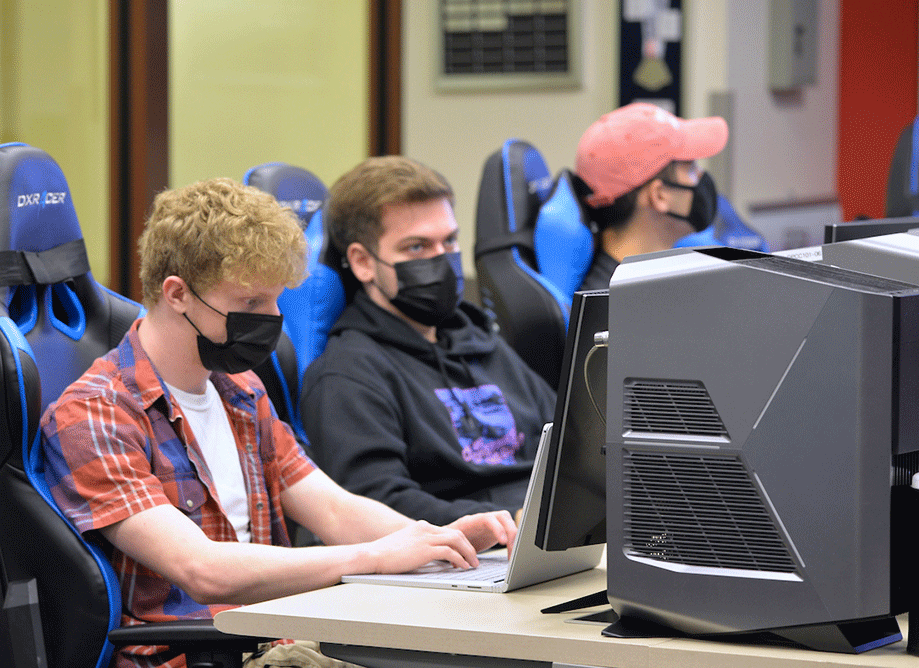
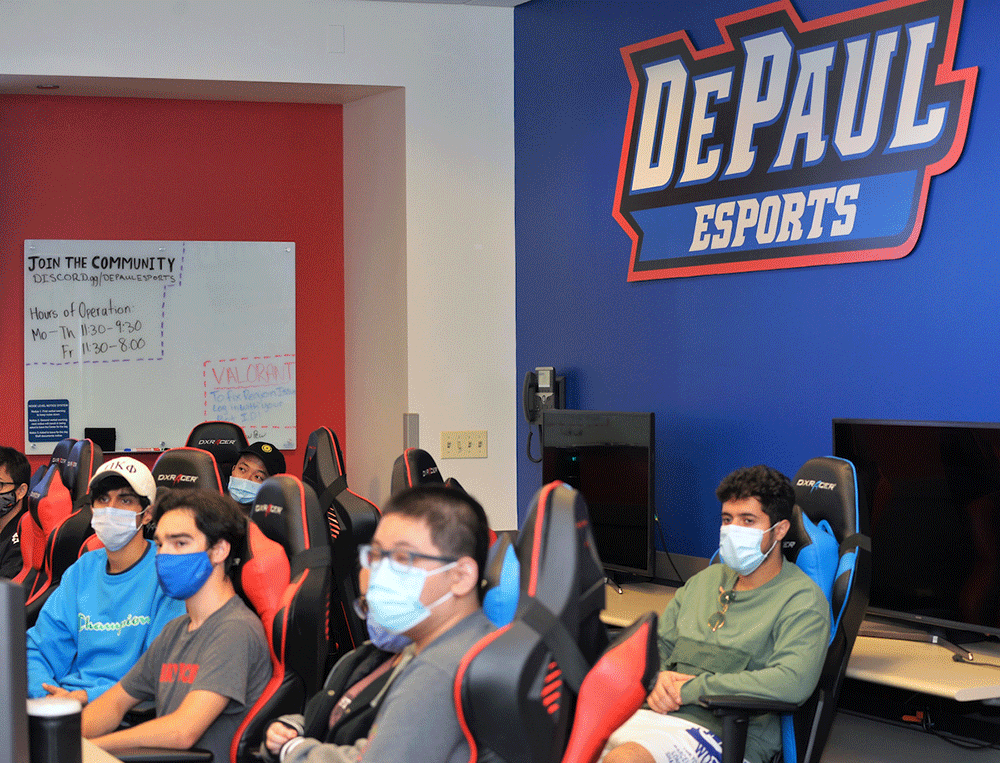
The newest course in the program is the “Business of Esports,” a growing trend in the industry that’s opening up many new opportunities for work. According to Clark, it’s important to understand how esports fits in the overall picture if you’re pursuing a career in sports. DePaul opened its first esports gaming center on the Loop Campus a few years ago, and competes against other Big East Conference schools in two games, League of Legends and Rocket League. So, beyond this class, students have the opportunity to learn more about esports or just enjoy it on campus.
Trends and Opportunities in Sports Business
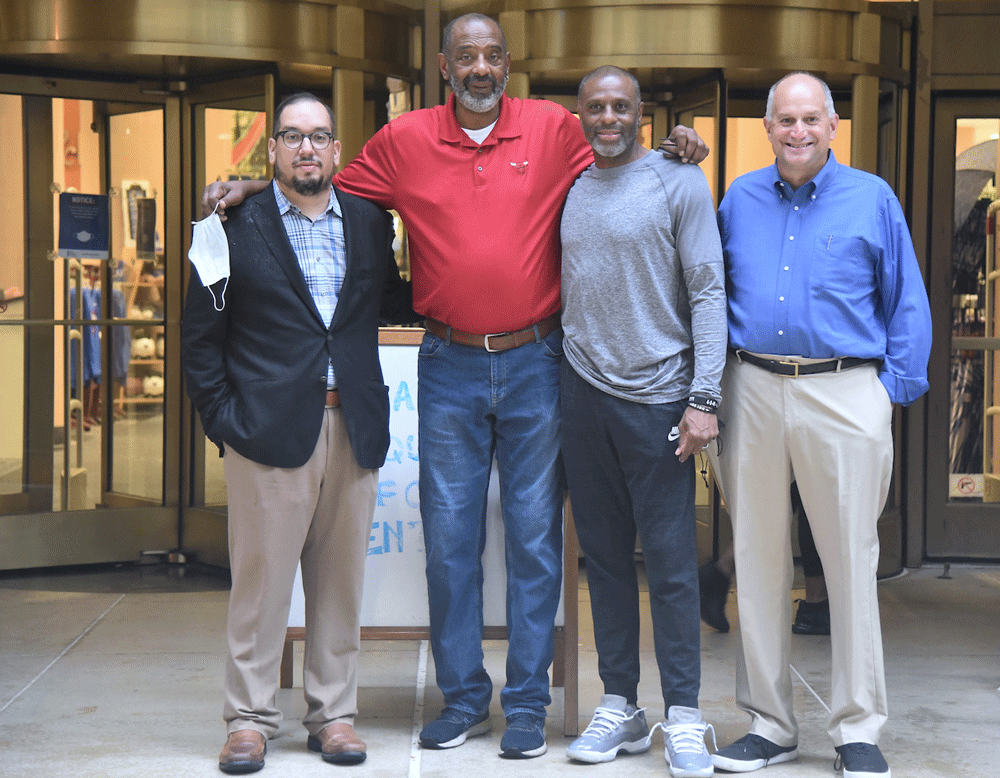
Clark invited two former Chicago Bulls players and a DePaul alumnus to speak in his class “Introduction to Sports Management” during the fall quarter. From left to right: Tony Rokita, director of alumni relations for the Bulls; Mickey Johnson (’74-’79); Randy Brown (’95-’00); and Clark.
There are many other areas of growth within the industry that makes studying sports business a lucrative decision, from the expansion of sports betting—popular in Europe and now growing in North America—to other trends such as community relations and social responsibility in sports, and business analytics and its application to the field.
“Teams, sports organizations and companies don’t necessarily want to hire sports fans. They don’t need more fans,” explains Clark. “They need students who understand a specific business discipline to help them in that space, and when you think about it that way, when you hone in on those skills and experiences, there are so many career opportunities to take advantage of.”
One alumnus who leveraged his degree to find success in the industry is Alex Teodosi, a 2016 graduate of the program (when it was a sports management concentration) who now works as the vice president of sponsorship for the 2021 WNBA Champion Chicago Sky. His degree provided the necessary launching point, he says, for working in professional sports. “Sports has always been a passion of mine, and for me, being a part of the on-field product is the next best thing to being on the field,” says Teodosi, who originally began at DePaul as a philosophy major and credits his eye-opening experience to Clark’s “Behind the Scenes with Chicago Sports Organizations” as the inspiration for his switching career goals.
“I was exposed to all facets of the business school when I was studying at DePaul, and that has been so useful in my career since my main responsibility at the Sky is to generate and retain our revenue streams,” Teodosi continues. “Another thing I really appreciated was how much emphasis Andy [Clark] placed on getting active professionals in the sports field in front of students. That paid off tremendously both for the connections that were made and for the experiences that were shared. Without these types of opportunities, I know my career path might have gone a different route.”
Originally published on the Driehaus College of Business & Kellstadt Graduate School of Business website.
DePaul business students spent five weeks working as “secret shoppers” with the Chicago Cubs to improve the organization’s customer service.
By Robin Florzak
How customer friendly are the “Friendly Confines” of Wrigley Field? Ten DePaul University students got a chance to explore this question during a class project they completed with the Chicago Cubs baseball organization.
The students spent five weeks as “secret shoppers” calling and emailing Cubs representatives to test the quality of customer service offered by the sports organization last fall. The project was part of a School of Hospitality Leadership course called “Event Sales, Service and Promotions” taught by Andy Clark, director of DePaul’s Sports Management Program and a lecturer at the hospitality school. Clark will lead another group of students in a similar project with the Cubs this summer.
Clark often incorporates behind-the-scenes projects and meetings with executives at Chicago professional sports teams and other businesses into his courses at DePaul’s Driehaus College of Business. In addition to working with the Cubs, students in his fall class completed another five-week project with United Entertainment Group by developing and presenting experiential event marketing ideas for their Doritos client.
For the Cubs project, Clark explains, students had three goals—“to test service quality by making standard fan requests by phone, email and social media; see how responsive the team’s service representatives were in the context of the organization’s expansion from baseball to a lifestyle brand; and provide insights into what millennial generation customers seek from the Cubs brand.”
Kenzie Mocogni
Posing as fans, the students called or wrote to the Cubs with a variety of questions, such as where to find parking near Wrigley Field and what food the venue offers for people with dietary restrictions. They also assessed service at several non-baseball events, including a yoga class and a farmer’s market, hosted by the Cubs at Gallagher Way, a grassy plaza that the baseball organization opened next to Wrigley Field last year. Finally, the students took the initiative to design and conduct their own general survey of millennials about their customer service preferences.
The students incorporated their data and analyses into a report that they presented to 25 members of the Cubs’ Service Excellence Program team in marketing, ticketing and other public-facing areas, as well as several team mid-level executives. The students were asked at the beginning of the project to keep their proprietary research confidential.
Project partner Bradley Nagel, Cubs assistant director of the Service Excellence Program and ticketing, says the students provided the team with valuable perspectives about the execution of service delivery during the five-week test period, which included several Cubs playoff games, as well as insights into “new segments of customers outside of the scope of baseball attendees.”
“Their team spent so much time, via both conference calls and in-person meetings, explaining to us how important it is to them that they provide excellent customer service to their fans,” Mocogni says. “Knowing that the work we were doing was going to be useful right away was highly motivating. We were grateful they trusted us with something so pertinent to their front-office operations.
“Working with a real client reminded us that what we are learning in the classroom at DePaul is preparing us for the business world,” she adds. “I think the best way to learn is through hands-on experience.”
Classmate Sarah Musaali sees the experience as useful preparation for her career. A senior, Musaali will earn a business bachelor’s degree in sports management in June. She has accepted a corporate partnerships and marketing position with the Dallas Cowboys. “This helps me to identify what will be important to my future clients, and how I can be successful in achieving service excellence in the future.”
For students who seek to enter sports hospitality and management, “the opportunity to work together and deliver real-time business solutions as a team is an invaluable experience,” Nagel says.
“It was a mutually beneficial partnership and we look forward to expanding the scope of this project and working with a new crop of DePaul students this summer.”
Students delivered their final presentation to Daniel Green, assistant director of creative & content in the Cubs marketing department, as part of the course Chicago Cubs Brand Insights.
By Robin Florzak
It was an unconventional summer for the Chicago Cubs and for a popular DePaul University business course that explores global branding and the professional baseball team’s marketing strategies.
The Cubs pandemic-shortened season began July 24 with fans watching from home. The course, Chicago Cubs Brand Insights, began the week before with students studying remotely via Zoom. But neither change in format stopped students from getting an insiders’ look at marketing strategies directly from Cubs marketing and sales managers.
Students in the five-week class met virtually with managers in the team’s marketing, fan insights, human resources and partnerships units to learn how the team’s brand has evolved. They also studied what makes global brands – both sports and non-sports – compelling and distinctive through online meetings with brand executives from Geometry Global and 4Front. Then, students formed mock consulting teams and applied what they learned to analyze various global brands. The students presented their insights via Zoom to the Cubs marketing managers, who provided their professional feedback.
Andy Clark, director of sports business programs at the Driehaus College of Business, who teaches the class, says the course provides practical experience that any business graduate can use, whether they work in sports business or not. “The final project is designed to give students a tangible, ‘real world’ business project that will stand out on a résumé and in an interview setting.”
The Cubs marketing team also gained insights from their interactions with the students, says Daniel Green, assistant director of creative & content in the Cubs marketing department. “As we continually strive to enhance our marketing and branding efforts, it’s important that we find opportunities to validate our direction,” he says. “The students, whom themselves represent an important subset of our target audience, were able to do just that. While developing critical research and presentation skills, they provided us with an invaluable set of findings that will allow us to continue down our path with confidence.”
Senior marketing student Jillian Hampston took the course because she’s interested in pursuing a sports marketing career. “This class not only offered the chance to learn from knowledgeable people in the industry, but we got to see how their insights apply first-hand through our consulting project.” she says. “Working directly with the Cubs was extremely valuable to me because it was a great way to get my foot in the door, as many teams cannot offer a hands-on experience like an internship right now. I was also able to gain an understanding of what a career in professional sports would look like, not just from a marketing perspective, but across all departments.
MBA student Jeremy Abramson | Photo by Kathy Hillegonds
“I think the biggest thing I took away from this project was confidence,” she adds. “My team and I successfully led conversations and pitched our ideas to the Cubs, which is something not every student can say.”
Her classmate, MBA student Jeremy Abramson, says the course provided him with a unique perspective. “Professor Clark does an amazing job of taking his classes and putting you in real business situations,” he says.
“I gained a lot from this experience. I gained knowledge about a first-class sports organization and how they try to stay ahead of the curve. I learned how organizations like the Cubs are trying to get out ahead of just being good on the field and how they try to maintain and grow their fan base for years to come. It was a very rare opportunity to get the chance to work with and present to an organization of the Cubs magnitude, and that will help me build confidence the next time I am in a business pitch or presenting to upper management.”
Hampston and Abramson said they are both big fans of the Cubs, which made the class even more appealing. “For me,” Abramson says, “it was so cool getting the chance to present my brand insights to my childhood favorite team, the Cubs.”
The Super Bowl is happening right in the middle of the winter Olympic games. While the pandemic has helped change watching habits, sports are still one of the reasons we watch live TV. Andy Clark, the director of the Sports Business Program at DePaul, joins the podcast to discuss these events, what they tell us about the power of sports, and the lessons they hold for business students.
ANDY CLARK: When you are a partner with the Olympics, you don’t get tickets, you don’t get advertising, right? You don’t get swag. You get access to the intellectual property, those five rings, and you get to use those, which very few people do.
LINDA BLAKLEY: Welcome to DePaul Download. I’m your host Linda Blakely.
The second pandemic-era Olympics is approaching. The Tokyo Games garnered a global audience estimated at 3 billion people. And in February, athletes are set to compete in ice skating, skiing, hockey, and more winter sports in Beijing, even as the Coronavirus and political tensions loom large over the games.
Meanwhile, in the U.S., sports fans are gearing up for the Super Bowl, which last year was watched by more than 96 million football fans.
We’re joined by Andy Clark, the director of the Sports Business Program at DePaul, to discuss these events, what they tell us about the power of sports and the lessons they hold for business students. Welcome, Andy.
ANDY CLARK: Hello, Linda. Great to be here on this cold January day.
LINDA BLAKLEY: Questions have persisted about whether the Winter Games this year should go on amid the pandemic. But many Olympics have faced challenges and controversies leading up to the opening ceremonies. What are some of the challenges in hosting the games?
ANDY CLARK: Well, Linda, challenges in hosting the games are many. This was accentuated by I bring a group of students to London each year and we meet with the CFO from the London 2012 games. And he does a terrific talk on what the impact is on the Olympics and the games. And he talks about how actually you’re basically building a city for two weeks, and building a city and is always fraught with issues, right. So there’s political issues, there’s social issues. There’s environmental issues, which are growing all the time, and certainly in terms of Beijing.
Beijing is actually the first city to host both the Summer and Winter Olympic Games. So that’s kind of unique. But when they went to Beijing in 2008, you know, the pollution, air quality was a huge component to it. Obviously, now, no one’s really talked about that but with the pandemic, and issues involving environmental are a really big deal.
But ultimately, going back to London, 150,000 contractors, 9,000 paid employees, 100,000 volunteers, 10,000 athletes, putting those people all together in one spot for two weeks, and then moving on is always a challenge. So yeah, there’s always something in a different city or different market. What’s cool about the Olympics, and many things are, usually, once the opening ceremonies hit, it pretty much happens that the focus turns to the competition in the games. Most cities figured out and make it work. And people celebrate and connect.
That happened certainly this summer in Tokyo, where there was stuff right up into the games about the pandemic. The game hit, it was things about the competition, right. And that’s what makes it cool. And the stats you mentioned early on people watching it. That’s why people continue to watch and enjoy it on a global scale in such a big way.
LINDA BLAKLEY: So one of the topics you teach is sports marketing. What opportunity does sponsoring the Olympics present for marketers? What makes this opportunity unique in the sports world?
ANDY CLARK: I teach a sports sponsorship marketing class right now, both undergraduate and graduate level in the winter quarter. And it’s great that it happens right now and right in the middle of sort of the Olympic Games. And I have a number of speakers and things that talk about the power of the Olympics. And it’s unique, right, because of the global scale. And those five Olympic rings are recognizable across any country, across any language. And they really stand out and you know what it means, you get an emotional connection when you see those rings.
From a sponsor perspective or a marketing partner perspective, it’s also a challenge, right? There’s only so many companies that have a platform that can use those rings on a global scale. Right. And actually, just in class last week we had a speaker Gordon Kane, who was the first director of marketing for the US Olympic Committee, was one of the leaders of the Chicago 2016 ill-fated Olympic bid, which is a topic for a whole other podcast. But he talks about a company we talk about a lot in class, Procter and Gamble. Procter and Gamble has been a top Olympic sponsor, I believe since 2010. And really what they use this as a platform, not to you know not to sell more paper towels and toothpaste and diapers and soap and everything in the home that they have. They use it to communicate their values and what they stand for as a company and to align themselves with their probably lead purchaser, which is moms. And they’ve developed a highly successful campaign called “P&G, Proud Sponsor of Moms.” Could P&G do that without being an Olympic sponsor? Sure. But what point what is that it’s a tagline, right? Proud sponsor moms.
What the Olympic platform does is enable them to have a wherewithal and the credibility to say, we’re here for you, right. And what they’ve done in their marketing and their advertising is link Olympic images, Olympic athletes, to moms, because every Olympic athlete has a mom, so they play have fun with that. But sports viewership, the Olympics are by far the most female audience, right? And their campaign this past year obviously focused on issues with a pandemic, and how athletes and things overcome that. So when you are a partner with the Olympics, you don’t get tickets, you don’t get advertising, right, you don’t get swag. You get access to the intellectual property, those five rings. And you get to use those, which very few people do. Right. So that’s what makes a difference for a company like Procter and Gamble.
LINDA BLAKLEY: I want to switch now to the Superbowl, another huge advertising event, which this year is happening right in the middle of the Olympic Games. The pandemic has helped change TV watching habits, but sports are still one of the reasons we watch live TV. What has that meant for the advertising potential of Superbowl Sunday?
ANDY CLARK: Superbowl Sunday, Linda is not just the biggest sporting event, you know, certainly United States, but it’s the biggest marketing event, right? It’s the biggest advertising event. People come together and like none other than watch the Superbowl and you’re exactly right. Sports Business Journal publication, we use it all our classes, just published the top 100 most-watched telecast the U.S. in 2021. Of the top 100 telecasts of any sort, 95 of those were sports, okay, 95 out of 100. So in a world where viewing habits have changed to where you’re not watching, you know, friends at 8 o’clock on Thursday night, right. You’re watching what you want to watch when you want to watch it. Great for us, bad for advertisers. So live sports, where you need to sit down and consume that live stand out. In the biggest context of that is the Super Bowl. People whether it be the pandemic or not, people continue to view and consume live sports. The Super Bowl stands out in a way because the advertisers in the marketing or become almost as important as the game itself.
I remember being at a Super Bowl party a few years ago, and we’re watching the game and cheering and there’s a wide range of folks there. And then you know, when the commercials come on, everybody goes, “Shh! Shh!” So you know, then when the game goes on, people are talking, eating and drinking. And so that’s really captures that. So this Super Bowl 30-second spots, which I would think went for $5.5 to $5.8 million for 30 seconds last year, are selling for as much as $6.5 million this year. Eyeballs are focused for a three-hour period, unlike anything else happening now. And that’s continued to grow. So that’s why the Superbowl continues to be the event, not just in the sports world but in our social world as well.
LINDA BLAKLEY: I know that the ads themselves are such an important part of viewing and they even have next day rankings for favorite ads. But tell me a little bit more about what students learn about Super Bowl ads in your classes.
ANDY CLARK: Yeah, the way students learn about Superbowl ads. And again, it’s a common theme, I guess, talking about what I’ve focused on in our chat here. They’re learning about how it’s not really a sports thing, right? If it’s a sports thing would have a much narrower audience? It’s reaching a core audience. And how do you use the power of eyeballs for 30 seconds to watch that? So for the past six or seven years, we’ve spent the Wednesday after the Super Bowl with FCB Chicago, one the leading ad market agencies in the world, kind of taking a real in-depth look into Superbowl advertising from one, the strategic direction. How does the strategy start?
Last year, we started with the brief that Bud Light gave the agency to develop something. And the brief really wasn’t that detailed; it was a couple paragraphs. How does that process work? We were able to hear from Bud Light’s (vice president) of communications, showing us the spots, showing some of the earlier alliterations of them, showing what they did with them in and around the game itself. Because one of the power of that investment of that, $6.5 million for 30 seconds isn’t just that, right? It’s the power you get before the game, the power during the game, you’re talking about the activation meter. So it’s not just about that.
From a student perspective, we have the students do is each take a spot of their choosing, and basically do a case history on that. What are the goals behind it? What is the objectives from a company perspective? What are they doing in the game? What is the rationale behind that? What are they doing on social media? What are they doing on premise? What are they doing all kinds of things to do that.
And then the cool part about this class that we do Super Bowl week is that the head of strategy, head of creative from the agency, and if we’re lucky enough, the client like Bud Light enjoy hearing what the students say because they’re a very key audience. Right? So what do they say? What do they like, what they don’t like, why they think things work. And it’s kind of cool in some ways, that some of the stuff they think worked, the other folks, they don’t say, hey, you don’t understand that from marketing perspective. They say, that’s an interesting take, right? We hadn’t thought about that. And you’re the core audience. So it’s a great way to blend kind of what the students see. And see beyond just watching a spot, right? It’s not a big commitment on their part to watch a spot. You don’t watch the game, watch 30 seconds, right? You can find the commercials, and then get expert kind of feedback, which where they really want to hear because it helps them do their job better. So it’s very symbiotic relationship. And it’s really, it’s one of my most enjoyable classes of the year that we do.
LINDA BLAKLEY: Sounds like a win-win to me. DePaul launched the Sports Business major, which you direct, just in the last couple of years. Chicago is consistently ranked as one of America’s top sports cities. Is that what makes Chicago a great city for students to study sports business?
ANDY CLARK: How much time do we have? No, so, in short, Chicago is the best city to study sports business, and DePaul is uniquely positioned to leverage that. And that’s not just for me. I had a leading person from an agency years ago, who was no longer in Chicago, who opened his talk, saying exactly what you just said, Chicago is the best city in the country to study sports, right. And in a short way to do that kind of a microcosm of how that fits together is a class we do in our December term. It’s called behind the scenes with Chicago sports organizations. And what we do is over the course of a week, we visit Chicago sports organizations, not just having them come into the classroom. We go out and see where they work, where they play, how they function in a business setting.
So to give you a quick example from this past year. We visited or met with — some came to DePaul — 22 different organizations. So Chicago sports teams, the Bulls, the Blackhawks, the Cubs, the White Sox, the Chicago Sky, who just won the WNBA championship. And their director of sponsorship, vice president of sponsorship actually, had been a student in this very class four years ago, and has done very well there. The Chicago fires, new officers are just up the block. And it’s not just about the sports teams, right? It’s about companies, right? We walk down the street to, I think it’s 500 or 550 West Monroe, Gatorade. What stands for sports marketing more than Gatorade? Wilson Sporting Goods (is) 200 East Randolph. McDonald’s Corporation in the West Loop. Different agencies, a lot of different Chicago sports agencies, Intersport, Revolution, Forefront, KemperLesnick (are) all within a walking distance. I tell people about this class and they say, “What do you do? Do you get a bus or whatever?” No, we walk or we take the El just like everywhere we go. The farthest north we go is Wrigley Field, the farther south is Guaranteed Rate Field and the furthest west we go is the United Center. And that is really played itself out.
As we talked about establishing and growing our program, we started this class eight years ago, in 2015. Many of the places we go — as I mentioned, Alex, who worked for The Sky — have our grads there, which says a lot about our program. I think this year we met with about 60 people overall, and 15 were DePaul grads. Chicago is just a great place from every perspective — teams, agencies and companies — to learn about the business of sports, not about being a fan, but learning how to leverage your business skills and business background in a sports business environment.
LINDA BLAKLEY: Andy, I’ll be keeping in mind, the ability of sports businesses to shape our culture and strengthen my attachment to Chicago, my favorite brands. The next time I catch a Bulls or Cubs game, and what I’ve learned from our conversations, as I watch the Olympics and Super Bowl. Thank you so much for joining us today.
ANDY CLARK: Thank you, Linda. I really enjoyed talking and I’m looking forward to a big February as you are.
LINDA BLAKLEY: I’m your host, Linda Blakely. Thank you for listening to the DePaul Download presented by DePaul’s Division of University Marketing and Communication.
Sports Management students at Wintrust Arena Women’s Basketball locker room, with Head Women’s Basketball Coach, Doug Bruno.
When we started planning our 8th annual Behind the Scenes with Chicago Sports Organizations course back in September, we didn’t know if visiting sports organizations this year would work…well it did.
Throughout the weeklong course students received an inside look to the business side of Chicago’s professional sports teams, college athletic programs, sports agencies and companies. Undergraduate and graduate students participated in tours of sports organizations and venues to gain first–hand insight into Chicago’s sports business landscape.
Participating organizations included the Chicago Bears, Blackhawks, Bulls, Cubs, Fire, Sky, rEvolution, 4Front, Gatorade, Chicago Sports Commission and DePaul Athletics.
Students met with leaders and DePaul graduates at these organizations toexplore sports business disciplines like sales, marketing, sponsorship, event management, hospitality, philanthropy, communications and business analytics.
Not every college student gets to gain the experience of the real world before graduating college. I learned plenty about what will make me competitive in the market, the different ways to break into the sports industry, and how I will be successful in my summer internship. The amount of knowledge I gained on the business side of sports from one week is quite impressive and something I will not be taking for granted as I enter the workforce. – Andrew Gambino (BUS ’22)
Sports Business student Olivia Solimene (BUS ’23) presenting with her team.
Highlights of the experience included:
A visit to the United Center with Chicago Bulls legendand2021 Hall of Fame inductee Toni Kukoc, and attending the Bulls – Hornets game as guests of the Bulls.
An exclusive behind the scenes tour of the Wrigley Field premier club spaces with Cubs VP’s Colin Faulkner and Andy Blackburn.
Lunch at the Chicago Fire’s Loop office with new Fire president, Ishwara Glassman Chrein.
A “master-class” talk from Chicago Dogs owner Shawn Hunter.
A Wintrust Arena tour with insights from Arena GM David Kennedy, DePaul Athletics leaders and Chicago Sky VP of Sponsorship Alex Teodosi (BUS ’16), who was a student in this same course as an undergraduate.
A networking session with seven DePaul sports business alumni led by Northwestern Sports Properties Mike Gordon (MBA ’95).
The course featured an action packed itinerary. The following is a look at the numbers:
26 undergraduate and graduate students
58 sports business contacts
12 DePaul alums
22 organizations
8 venues/headquarters
5 Days
3 Hall of Famers – Toni Kukoc, Doug Bruno, Jill Hollembeak
2 Basketball Games
1 Awesome Service Dog – Mr. Kim
A lot of pizza!
Bulls Legend and NBA Hall of Famer Toni Kukoc speaking with the class.
The course concluded with six student team presentations reflecting on their insights from the experience. One of the teams even wrote and performed their own song, “The Five Days of Sports Class” sung to the tune of the “12 Days of Christmas”.
Since 2015, this class has had a career changing impact on over 200 students. MBA student, Jake Mangerson summed up the impact of the course in this manner –
“Sports is a business and if you are going to make a living in sports, you have to treat it like a business, but you will also have the power to create memories and change lives.”
To learn more about DePaul’s Sports Business undergraduate degrees contact program director Andy Clark at aclark32@depaul.edu.
MAAFA graduate and current program manager Quentin Harris explains how the program changed his life
By Ashley Gimbel
Throughout the past Fall Quarter, I’ve had the fortune of working with the Chicago Bulls and the MAAFA Redemption Project, thanks to Professor Andy Clark’s Introduction to Sports Management course. Myself along with my classmates met with Marshall Hatch Jr., Executive Director and Coach at the MAAFA Redemption Project, DePaul alum and Chicago Bulls Director of Alumni Relations, Tony Rokita along with two former Chicago Bulls Players and a graduate of the MAAFA Redemption Project. Each meeting worked towards creating proposals that will help raise awareness for the MAAFA Redemption Project while utilizing the resources of the Chicago Bulls. This experience allowed me to work with surrounding Chicago area organizations, make meaningful connections after a fully virtual school year, brainstorm ways to better Chicago communities and gain meaningful perspective. Many thanks to the Chicago Bulls and the MAAFA Redemption Project for allowing us to collaborate with them this quarter.
The MAAFA Redemption Project is a faith-based organization in West Garfield Park to help at-risk young men ages 18-30. Half of MAAFA’s 26 students participate in a residential program and are required to wake up at 7:15 am to begin their daily program. The rigorous daily schedule includes participation in philosophy and self-identity courses, meditation, and job training in addition to other courses and activities. Quentin Harris, graduate of the program and current program manager and life coach at MAAFA, spoke to the class about MAAFA’s impact on his life. Harris told the class that the self-identity course was the most impactful part of MAAFA. In this course, Harris learned about African American culture, the Civil Rights Act, and the Atlantic Slave Trade. Prior to taking the course, Harris explained that he saw his neighbors as enemies. The course provided him with a different perspective, and Harris is now able to see people in a different light.
Teams present their final projects to Tony Rokita, Marshall Hatch Jr., and the class in Week 10
Marshall Hatch Jr., MAAFA’s executive director, elaborated that the young men in West Garfield Park need an opportunity and a space where they can put their talent and skills into the world. “It was very encouraging to partner with DePaul University and the Chicago Bulls on this critical project. Often our work at MAAFA feels isolated, but it was heartening to witness a diverse group of students become fellow thought-partners dedicated to grappling with one of the city’s seemingly intractable problems,” Hatch explained. “I remain optimistic about Chicago’s future because, yet another space has been created for the sharing of ideas, commitments, and hopes.”
The class also met with Tony Rokita, the Bulls’ director of alumni relations and a DePaul alum who has spent over 30 seasons with the Bulls. Rokita proudly spoke of the fact that since 1987, the Chicago Bulls have raised over $37 million for charitable organizations with an emphasis on education, health and wellness, and anti-violence.
During the first class meeting, Rokita brought along former Chicago Bulls players, Randy Brown (’95-’00) and Mickey Johnson (’74-’79). Brown and Johnson stressed the importance of education for all youth. The former players continue giving back to their communities. Additionally, the students learned about MAAFA and the goal of the project, which was to spread MAAFA’s mission while utilizing the resources of and including the Bulls. The class was split into seven teams consisting of five students each. Teams began brainstorming ideas that would work towards this goal.
Former Chicago Bulls player, Mickey Johnson stressed the importance of education for all
At the next meeting, teams pitched one to two ideas to Hatch and Harris, and the duo offered constructive ideas and pivoting points in return.
The third meeting for the class was a Zoom session with Rokita. Each team provided a short description of its idea and potential sponsors. Rokita’s feedback for all teams included that each team project must have specific metrics to measure success, have a specific plan to incorporate the Bulls’ unique assets, have defined goals to make the community better and explain how to specifically engage people with this project.
After four weeks of work, each team had 10-15 minutes to pitch its idea, which included a crosstown basketball tournament, a sports complex, partnering with the LaSalle Network to start a job search and mentorship program, a basketball summer camp, mental health programs, and other unique ideas. Rokita and Hatch watched all the presentations, asked questions, and delivered detailed feedback.
While reflecting on the presentations, Rokita explained that “it’s been incredibly inspiring to see all the DePaul students in both classes come up with innovative, impactful ideas about how to support MAAFA and increase opportunities to work together with the Chicago Bulls. I’ve been working together with Professor Clark for over four years, and this was one of the best class presentations I’ve been involved with.”
From left, DePaul alumnus Tony Rokita, Mickey Johnson (Chicago Bulls ’74-’79), Randy Brown (Chicago Bulls (’94-’00) and Andy Clark outside of the DePaul Center on the Loop Campus
Students in the course not only had the opportunity to work with the professional business community but also learned how to work in teams, challenged themselves, and were able to see tangible outputs on MAAFA and the Bulls from this project.
Ashley Gimbel is a senior at DePaul double majoring in Sports Communication and Communication Studies. She works for DePaul Athletics in the Sports Information office as a communication assistant. You can reach Ashley on LinkedIn.
For the fifth year this summer, DePaul undergrad and grad students worked directly with the Chicago Cubs on a business-consulting project focused on the Cubs rollout of a new cashless mobile ordering platform. Students conducted concessions transaction time studies, monitored fan behaviors and analyzed historical fan sentiment data. One of the biggest highlights? They put their studies to the test at two Cubs games, timing the concessions lines for mobile ordering and credit card purchases.
All 24 students did a tremendous job and accomplished so much in less than five weeks. This couldn’t have happened without the leadership and support of the Cubs Director of Hospitality and Retail, Brad Johnson. As an added bonus, the class was fortunate to interact and learn with the following Cubs leaders throughout the course: Chase Carpenter, Diego Chahda, Steve Inman, Brad Nagel, Maria Sapienza and Vanessa Ward.
Your research and input will materially change the type of conversations we will have going into the off-season, 2022 and beyond. Thank you so incredibly much. – Chase Carpenter, Chicago Cubs, Director of Strategy & Analytics
This has been one of the coolest and most rewarding classes I’ve taken at DePaul. This project allowed me to put into practice my skills and knowledge to deliver a data analysis with an actionable recommendation to the Cubs. – George Castellanos, MS Marketing student
Cubs Director of Hospitality and Retail Brad Johnson preps the class prior to the game
Students Courtney Kearschner and Michael Durand in action for the concessions research
Students gather in the Wrigley Field concourse for instructions
Following the conclusion of their research for the day, the students enjoy a Cubs victory
The course culminated with five student team presentations to the Cubs
The Driehaus College of Business recently launched a series highlighting the consulting and project management experiences of students at the college. Read on to learn about the lessons learned from a sports business consulting project with the Premier League that alumna Maggie Specht (BUS ’21) worked on while she was a student.
Maggie Specht (BUS ’21)
Driehaus College of Business
About my consulting project:
During my spring break this past year, I had the amazing opportunity to take part in a consulting project with the Premier League (the top English football league) as part of (Sports Business Program Director) Andy Clark’s ICS 395: Business of Sports in London virtual study abroad program. Even though the program was in a remote format with the continued travel restrictions due to the pandemic, this was still an extremely valuable experience.
The Premier League asked us to research companies that are making strides in the areas of diversity and inclusion efforts and to outline actionable steps that the league could implement to achieve these goals. The Premier League has recently made a push for their executive employees to reflect the same diverse backgrounds that their players represent. Each group in our class researched anywhere from four to six companies that have established plans for integrating more diverse employees at an executive level. My group researched JP Morgan Chase, Target, the NFL, the NHL, and the Chicago Blackhawks. Our group found that anti-racism training, top-down integration initiatives, and education opportunities were the most beneficial in creating diverse workforces.
What I learned from my project experience:
This project was extremely relevant and timely because of the continued dialogue in the U.S. about diversity and inclusion in our workforce as well. It also meant a lot to me personally as I look to enter the sports sector which is a typically male-dominated field. It is important to me to find a team or sports organization that is committed to including both women and minorities like the Premier League is.
To become a better project manager, you need to have a clear understanding of what your client needs; that you offer them a detailed plan to get to their end goal; and that you spend extra time going in-depth in the necessary research for the project. In my consulting projects for Professor Clark’s class, all of my various teams spent a lot of time making sure that we understood what our client was looking for from us. Whether that was research on other brands, information on what comparable companies were doing to solve a specific problem, or well-thought-out action plans, our team always made sure that we were meeting the needs that our client had set forth. Once we understood where our client wanted to go with the project, it was important to us that we offered a detailed plan of how to get to their end goal.
By writing out the steps on how to get to the goal, the client has a better idea of how to implement the research or ideas that we are providing for them. This helps the client see how they are going to achieve their goal and it puts their ideas into actionable steps.
Why project management skills matter:
Project management/consulting skills are extremely important for my field of sports management. This is a field where you are going to be working with various clients, customers and coworkers, and it is important to gain experience being in situations where you are working for someone else and trying to help them achieve their goal. If you are going into the field of sports, all of these experiences are crucial to understanding how various sports organizations work and what issues that they are currently trying to manage or change about their current landscape. I had the opportunity to help various teams with brand awareness, diversity and inclusion efforts, and marketing ideas for future events.
These experiences gave me a great idea of what to expect when working in the sports sector. As a graduating college student, I feel like I have some real-world experience that stands out on my résumé and that gives me a leg up on other applicants. These experiences give me the confidence to walk into an interview with the knowledge that I have gotten a taste of the areas that sports teams are trying to stay competitive in.
The rise of Esports has seen tremendous growth in terms of viewership and revenue, leaving a huge impact on the sports and entertainment landscape all over the world.
Within the DePaul community, Esports has taken an even bigger role through the pandemic since it was one of the only safe ways to continue doing sports.
As it continues to grow exponentially, it’s best for students to get in on the business of Esports now rather than later.
This upcoming Autumn quarter, DePaul is offering MGT 344 “The Business of Esports,” a course to educate students on the numerous aspects of the industry.
The class will be held Tuesdays from 1:30-4:45 p.m.
Some of the areas of focus will be revenue streams, role of publishers and game developers, key stakeholders game genres, tournaments and events, media, marketing, sponsorship, diversity and inclusion.
Students will get the opportunity to work on a “real world” Esports business project that will shine on a resume, rather than just reading textbook information on the topic.
Esports has redefined how managers, marketers and event producers connect with their target audience. Students will learn to apply their transferrable business skills to the business.
Athletes and teams are marketed differently in Esports compared to other traditional sports, so students will look at how different platforms like Twitch have redefined sports viewing and the interaction between athletes and fans.
There will be numerous guest lecturers that students can gain experience from and leverage for their own careers, including DePaul alumni who are now working in the industry.
Students are not required to have deep prior knowledge of eSports or traditional sports.
If interested in this course, contact Andy Clark, the director of sports business programs at DePaul’s Driehaus College of Business or directly enroll on Campus Connect.
“The Esports ecosystem is about more than just gaming,” said Kevin O’Brien (Bus ’20). “There are opportunities in management, marketing, sponsorship, communication, events and more. You will gain access to experts in the industry and competitions that will expand your knowledge in this booming industry.”




 “Their team spent so much time, via both conference calls and in-person meetings, explaining to us how important it is to them that they provide excellent customer service to their fans,” Mocogni says. “Knowing that the work we were doing was going to be useful right away was highly motivating. We were grateful they trusted us with something so pertinent to their front-office operations.