This past Wednesday, September 18th, students studying sports business had quite the exciting day. For starters, Professor Andy Clark’s Sports Tourism class was joined by Julie Giese, President of the NASCAR Chicago Street Race, for both a presentation and brainstorming session.

Julie began the first half of the class with a presentation on both the 2023 and 2024 street races, including slides on on-site partner activations, community impact, and much more. Giese stated that the annual event is “more than a race, it’s about being a part of the community 365 days a year,” explaining that it’s almost more important what the NASCAR team is doing all-year round leading up to the event, specifically working with local businesses and charities to create a greater impact within the community, and leveraging what they learn each year to continue improving their operations.
Surprisingly, the race weekend is much more than just the race itself. With various events like NASCAR Day at the Chicago Cubs and an on-site music festival, many attendees come for more than just the race. In fact, about 40% attend primarily for the music! Julie explained that these activations, including the music festival, aim to “[create] additional interest and curiosity surrounding the event” which is essential for “appealing to a new audience and adding diversity to the event.” From pre-race marketing events to on-site activities, each element enhances the race weekend, offering an interactive experience for attendees.
Following Julie’s presentation, students collaborated in teams, brainstorming strategies in which NASCAR could boost interest and engagement around the street race, while aiming to attract both tourists and locals. Each group then presented their proposals (pictured below) to Julie, Professor Clark, and Dr. Lisa Young, the Director of the School of Hospitality and Sports Business. Both a first place and a runner-up team were selected, with each winning team taking home prizes!

After class, Professor Clark and his students, as well as Julie Giese and Dr. Young, made their way across the street to attend an event hosted by the Sports Business Club and the School of Hospitality and Sports Business. At the “Kick Off The Year” event in the Marriott Lounge (3rd floor, 14 East Jackson), students were greeted with refreshments and games, and even had the opportunity to network with DePaul Sports Business Alumni! The Sports Business Club executive board spoke as well, introducing themselves and their roles, along with discussing exciting upcoming events for the club. The event had a great turnout and was an exciting way to ring in the new school year!

Between Julie Giese’s presentation, and the welcome back event (more pictures below!), students certainly had a well-rounded day learning about sports tourism, while even networking with industry professionals who were once in their shoes!


This Fall Quarter is sure to be a promising one for any student studying Sports Business at DePaul. For starters, the new School of Hospitality and Sports Business is kicking off the 2024-25 school year with new opportunities and classes, study abroad trips, and much more!

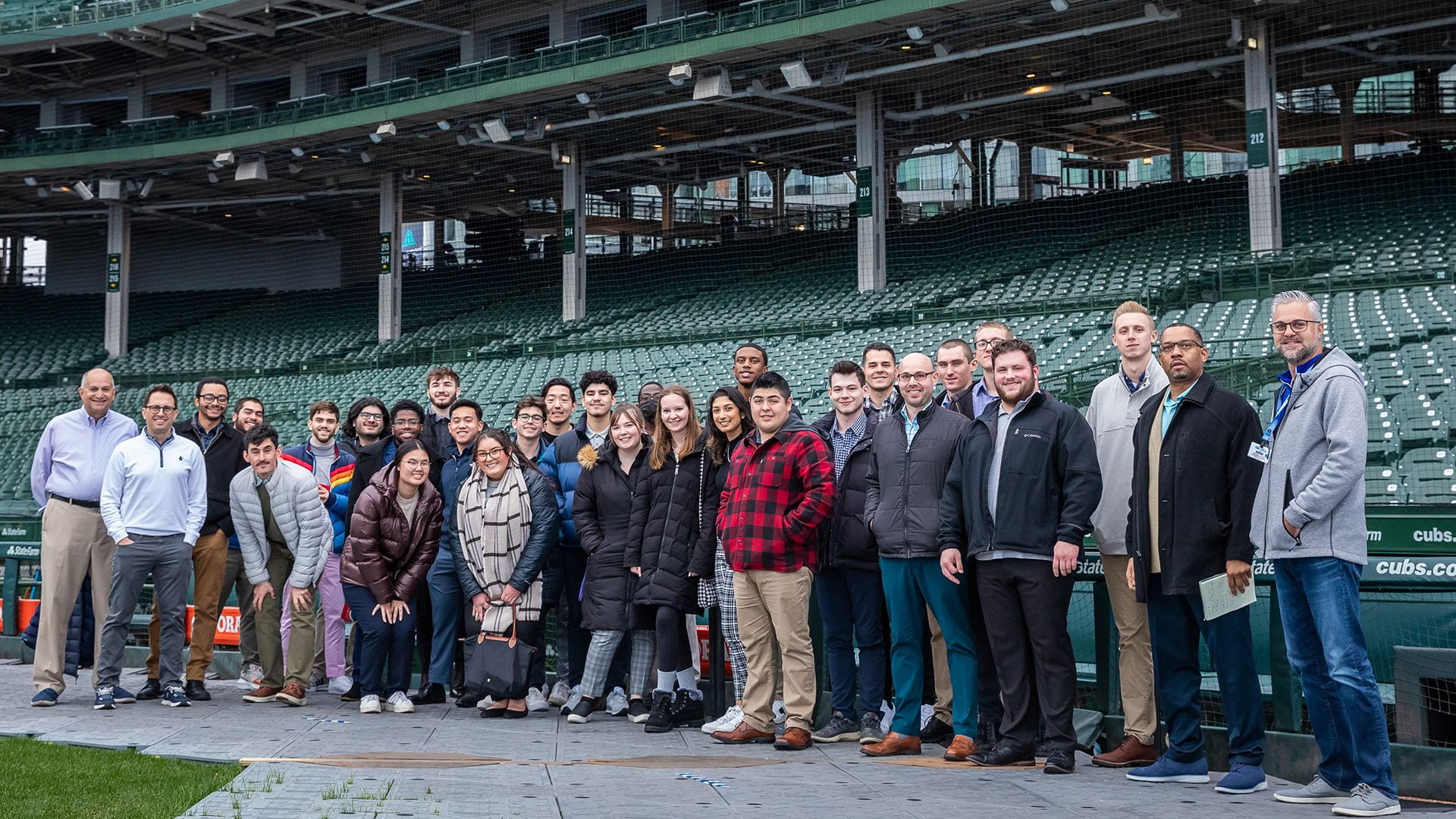
One new class in particular, HSB 398 (Sports Tourism), is being offered as a result of the new school. Within this class, taught by Professor Andy Clark, students delve into the effects that tourism has on the sports industry, and how it is especially prevalent right here in Chicago, even getting to work with the Chicago Marathon in a hands-on project. Just this week, students traveled off-site to visit Marquee Development at the Cubs corporate offices, meeting with Marquee Development’s Managing Principal, Eric Nordness, and their Development Manager, Daniel Cogan; the class even had the opportunity to tour the office, The Hotel Zachary, and the field itself!


As far as Professor Andy Clark’s classes go, it is no secret that they stand above your average lecture. Between the many classes he teaches, students are immersed into the sports industry with weekly guest speakers, off-site visits across the city, and so much more. Not only does he have quite the impressive network of colleagues and friends that are more than happy to help his students, Professor Clark also encourages both current students and alumni to share their wins and experiences.
Just this past summer, DePaul Alumni Olivia Homan (BUS ‘19, MS ‘20) had the amazing opportunity to travel to Paris for the 2024 Summer Games. Homan, a double demon herself, has come back to DePaul many times to share her role as a Social Media Manager for NBC Universal with current students. In this article written by Meredith Carroll, Olivia explains that she was able to combine her passion for both sports and fashion at NBC Universal, even interning there while still an undergrad, and how working in social media has brought her many “pinch me” moments, like getting to attend the Olympics, the US Open, and the Super Bowl… just to name a few! Olivia reflects back on her time studying at DePaul, and even her sports business classes, as truly invaluable, explaining that she “made the most of being [here]” by using the amazing resources at DePaul, as well as living in such a big city, to her full advantage.

Many active alumni, as detailed in this article from DePaul Magazine, are eager to help current students, and even bring real-world consulting projects to the table. Within Professor Andy Clark’s Intro to Sports Management class, students work alongside Julie Giese and DePaul Double Demon Alex Bialek (BUS ’21, MS ’22) at NASCAR to bring new and exciting ideas to the table for the 2024 Chicago Street Race, with a final presentation centered around increasing awareness and engagement for the race weekend. Students are given constructive feedback throughout the quarter and after final presentations with Julie and Alex. Also from DePaul Magazine, even more DePaul Alum within the sports industry share career insights and explain what they most enjoy within their jobs, along with how DePaul has impacted their careers.

Two other DePaul Alumni, Molly Byrne (BUS ’24) and Angela Hernandez (CMN ’24), also contributed to the Street Race this past July, both of whom interned with NASCAR and had hands-on experience with the event. In this article for DePaul Newsline, written by Kenneth Adusah, Byrne and Hernandez explain that they learned of the Chicago Street Race in Professor Clark’s Sports Management class, and both alumni were able to turn an opportunity that was first presented in class to an actual role within the company. Between working in partnerships and event experiences, both Byrne and Hernandez are a true testament to the grit and determination that DePaul students have, and how a passion for sports business extends much further than the classroom.

The Sports Business program at DePaul, especially classes with Professor Andy Clark, offers students unparalleled opportunities to engage directly with the sports industry. Through hands-on projects, networking with alumni, and learning from industry professionals, students gain real-world experience that extends far beyond the classroom. With new and exciting offerings and opportunities from The School of Hospitality and Sports Business, DePaul ultimately continues to shape future leaders in the sports business world.
Director of Sports Business program and Senior Instructor Andy Clark.
Andy Clark is the director of the sports business program at DePaul’s Driehaus College of Business. In 2023, he was one of two faculty selected by graduating seniors in business to win the Lawrence W. Ryan Distinguished Teaching Award at Driehaus.
When he was his students’ age, he didn’t know a career like this existed.
He recalls one moment when it all came together.
It was a basketball game: DePaul vs. Northwestern. It was the early ’80s: the height of Ray Meyer’s tenure as DePaul men’s basketball head coach. The stadium was packed: a sea of blue on one side and purple on the other, Clark recalls.
“DePaul won on a last-second shot,” Clark says. “To be there for that — to be a small part of that — was amazing.”
At the time, Clark was an intern for DePaul Athletics, after graduating from Fordham University. It was a position he’d heard about through a friend from Fordham.
“A hundred bucks a week, a room in McCabe,” he recalls of the arrangement. The flight to Chicago, he says, was his first time on a plane.
The internship gave him a glimpse into what was possible at the nexus of management, marketing and the sports world he loved so much. After his internship, he got hired as the manager of DePaul Athletics ticket sales. Eventually, he decided to earn his MBA from DePaul.
Forty years and an extensive career in sports management and marketing later, Clark has returned to where he started.
Getting work done, Clark says, is all about “making relationships and keeping them.” This is the central message he hopes to impart to his students.
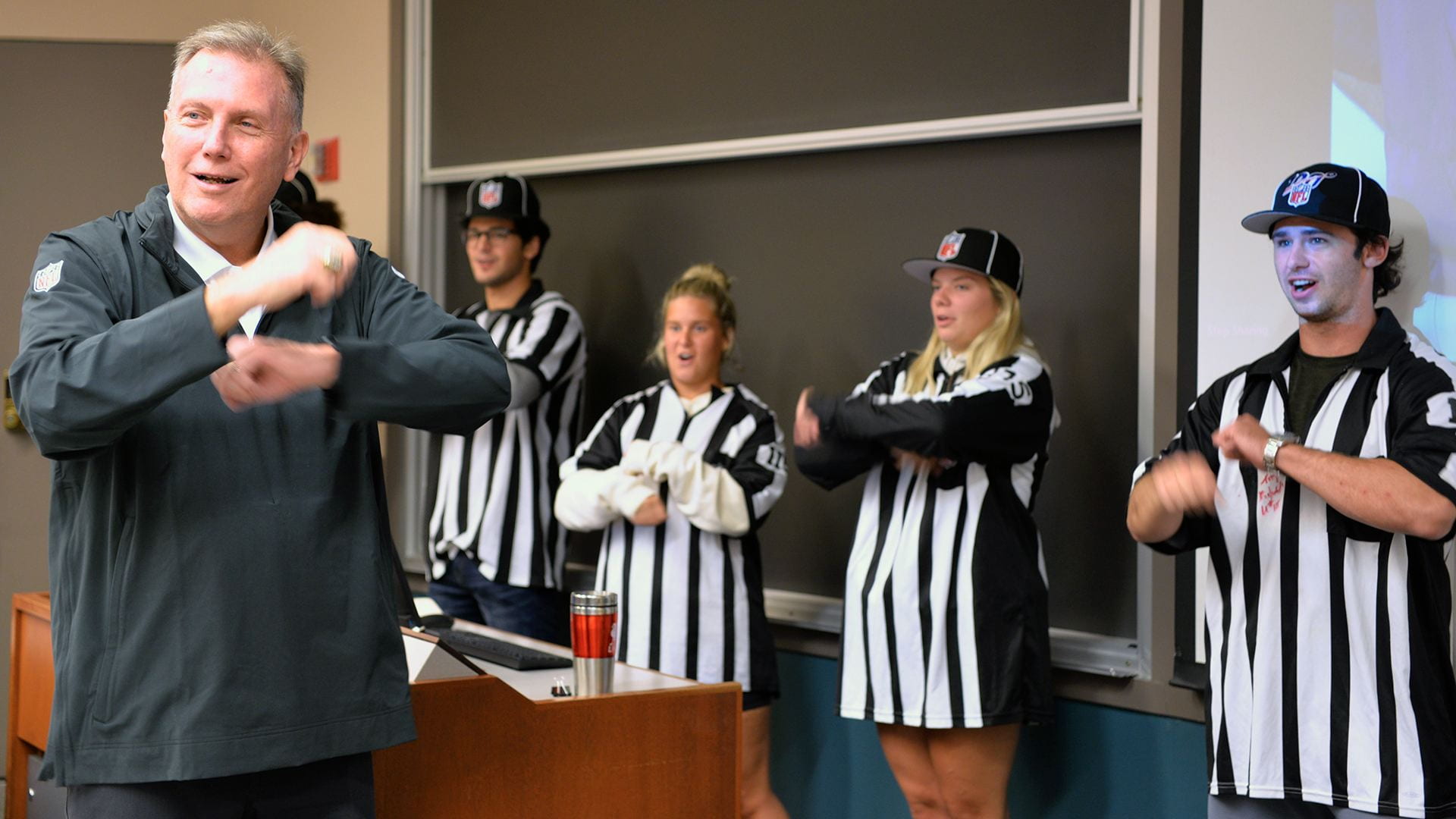
Gridiron in the Classroom: Referee Tony Michalek helps Clark’s class make the right calls.
Clark has cultivated connections with an impressive roster of guest speakers. There’s an NFL referee and an NHL player agent. There’s an Olympic silver medalist who started a nonprofit to empower girls in swimming. There are DePaul alumni, many of them Clark’s former students, hailing from every corner of the sports world.
Clark has also forged partnerships with Chicago’s top sports organizations. He’s worked especially closely with the Chicago Cubs, where a number of alumni hold posts in senior leadership. Every so often, Cubs chairman Tom Ricketts makes an appearance to speak to Clark’s students.
Clark has two criteria for each guest speaker he invites: Can they keep students — and Clark — engaged? (He “never gets bored” of site visits, he says.) And can they discuss their career in a way that imparts lessons relevant to any field, not just sports business?
“What I like about teaching,” reflects Clark, “is being a connector: connecting experts to our students, so they can learn how their skills apply to the workplace.”
In this regard, taking a class with Andy Clark is like getting a master class in networking. He schools students in crafting thoughtful, well-researched questions for speakers. He teaches them how to dress for site visits (a suit and tie are no longer required). And as part of his final exam, he tasks each student with writing thank-you notes to three guest speakers — by hand.
In Clark’s courses, students aren’t only learning from the sports business world, they’re also contributing to it by partnering with leading sports organizations to carry out real-world research.
Andy Clark’s classes visit where the action all happens.
Projects for the Chicago Cubs have included an analysis of their customer service and a study on their rollout of a mobile ordering platform.
“Knowing that the work we were doing was going to be useful right away was highly motivating,” says Kenzie Mocogni (BUS ’19), who worked on the Cubs customer service study. “Working with a real client reminded us that what we are learning in the classroom at DePaul is preparing us for the business world.”
The Cubs aren’t the only team with close ties to Clark and to DePaul.
“It’s been incredibly inspiring to see DePaul students come up with innovative, impactful ideas,” says Tony Rokita, a onetime DePaul student and the former director of alumni relations for the Chicago Bulls, regarding a project that worked on a Bulls community partnership in Chicago’s West Garfield Park neighborhood.
For Clark and his students, there’s a direct line between theory and practice and between classroom and career.
“I’m not a teacher by training,” he’s quick to say. “With most of the stuff I do, no one told me I had to do it this way. For me, teaching feels like an evolution of what I was doing before [in the business field].”
As Clark reflects on teaching, he says the best part has been seeing how students’ careers unfold, outside sports as much as within it.
“It’s almost more gratifying,” he says, “when I hear from former students who don’t work in sports that they apply things from my class to their jobs now. That’s what this is all about: helping students apply what they learn.”
Teaching has taught Clark a lot, too.
“Every day,” he says, “is an education in empathy.”
—
On the first day of his Introduction to Sports Management course, Clark has one question for his students. It’s perhaps the best summary of what Clark accomplishes in his courses — and how Driehaus overall approaches preparing students for their careers.
“When do you think your career in sports is going to start?” Clark asks.
Clark’s answer? “If you’re in this class, it already started.”
By Rachel Bradshaw

On Tuesday September 27th, Professor Andy Clark invited Kurt Melcher, Executive Director of Esports & Gaming of Intersport to The Business of Esports class. Kurt showed a video from Robert Morris University, which talked about esports growth. Some still have stereotypes of esports as being played in your basement and assuming that you’re just playing all day and night. Even though esports has grown to have similarities with traditional sports because of tournaments; teams practice, have a coach to discuss strategies with during a game, etc. He then showed a graph that shows Formal University Esports Program Growth, which showed that back in 2016 there were only 38 programs and now in 2022 there are 654 programs. Due to the pandemic in 2020, the desire to play esports grew exponentially, helping with the expansion of programs in universities.
Kurt then presented 2 other charts that stood out. The first showed the growth of Twitch from a viewer and channel standpoint. From 2019 to 2021 people viewing Twitch went from about 1 million to around 3 million viewers, since traditional sports were suspended at this time most people turned to esports to watch. Not everyone is good at playing, so watching can be interesting to do. The second chart showed the Global Sales of gaming compared to other media and in 2020 gaming hit 159 billion dollars while other media including professional leagues, music, and cinema only hit 66 billion dollars. It’s fascinating to see how much more sales esports were gaining during the pandemic while everything else was shut down.
To end his presentation, Kurt showed a video about what Intersport does and its five main categories. The categories include: Consulting, Tournament Ops, Experiences, Content Marketing, and Property Creation. Intersport helps with sponsorship for games and creators. One example that Kurt discussed was Nathan’s Famous partnering with JoshOG. They found Josh because he would wear a hot dog costume just for fun during his live streams, so they decided to make a partnership out of it. He would wear a Nathan’s Famous hat and eat hot dogs during his livestream, which got people more involved and created an interest in wanting to buy Nathan’s Famous. Overall, it was interesting to learn about everything that goes behind the scenes of sponsorships with esports.
Photo Credit: Rachel Bradshaw

By Nadia Alfadel Coloma
If you ask Andy Clark, director of the new Bachelor in Business sports business major at the Driehaus College of Business, he’ll tell you that a career in sports isn’t just about working for a sport’s team. That’s one of the misconceptions, he says, that people have when they think about working in sports. In reality, there are many facets to the sports industry—marketing, management, hospitality, analytics—and a myriad of opportunities within it.
Sports is a business like any other, and it’s huge.
“I hear it all the time from people in the sports business community: recent grads know sports but not really business, or vice versa,” says Clark, who also teaches in the program, which launched in the fall. “What the industry needs is business-minded individuals who can apply their knowledge and skills to a sports setting.”
The new major aims to do just that. It prepares students for careers in sports by combining the college’s existing business core courses with experiential learning opportunities that leverage DePaul’s connections to the sports business community in Chicago.
Its three pillars are learning the inner workings of the sports industry; understanding how to apply business concepts and skills in a sports context; and learning how the business of sports relates to other industries and enterprises. The major expands upon a previously offered sports management concentration by encompassing all business disciplines. The result? A well-rounded business education that students can apply to a wide range of professional roles in the world of sports.
“We have alumni working at every sports organization in Chicago, including companies that have a sports function, like McDonalds, Wilson Sporting Goods and many sports marketing agencies,” Clark says. “So even though this program is new, we’re not new at teaching this stuff.”
Learning the Business of Sports

Understanding the unique challenges and opportunities within the sports industry requires a deep dive into it. Popular courses like “Behind the Scenes with Chicago Sports Organizations” and the “Chicago Cubs Summer Consulting Project” expose students to different career paths and provide hands-on learning through real-world projects.
Another course that differentiates the program is the “Sports Sales Class,” taught by Associate Professor Rich Rocco in DePaul’s Center for Sales Leadership, as sales is often a key point of entry for working in a sports organization. And whether a student goes into sales, understanding the ticket sales and sponsorship process if vital if they’re going to work for a sports organization.
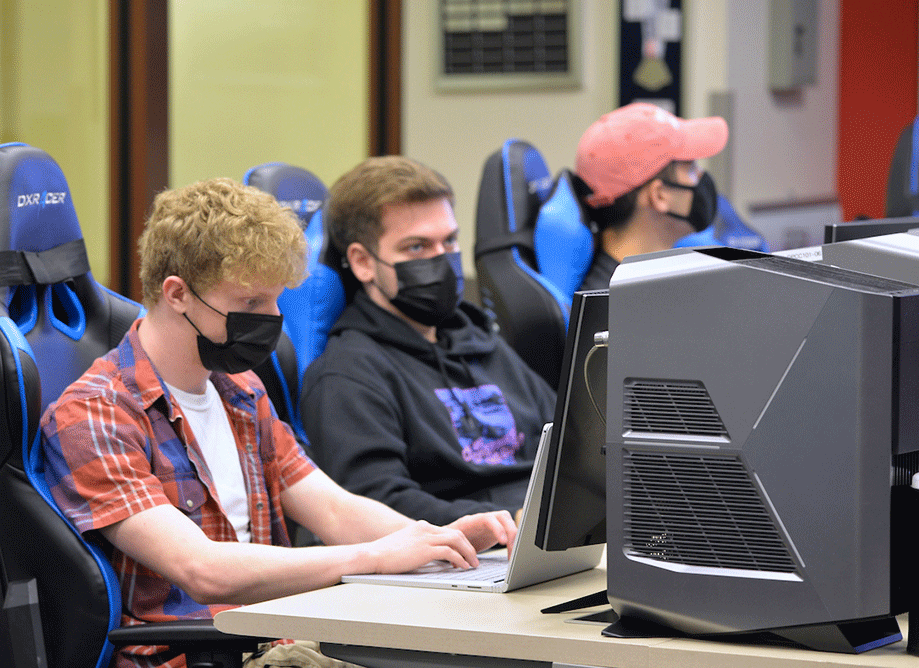
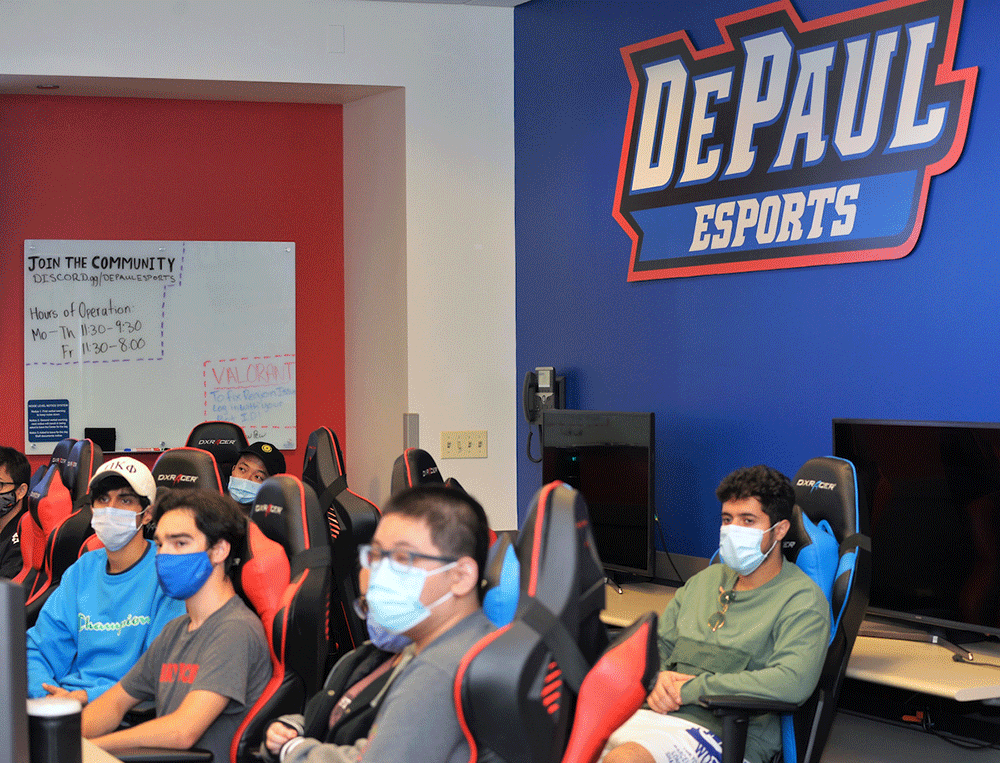
The newest course in the program is the “Business of Esports,” a growing trend in the industry that’s opening up many new opportunities for work. According to Clark, it’s important to understand how esports fits in the overall picture if you’re pursuing a career in sports. DePaul opened its first esports gaming center on the Loop Campus a few years ago, and competes against other Big East Conference schools in two games, League of Legends and Rocket League. So, beyond this class, students have the opportunity to learn more about esports or just enjoy it on campus.
Trends and Opportunities in Sports Business

There are many other areas of growth within the industry that makes studying sports business a lucrative decision, from the expansion of sports betting—popular in Europe and now growing in North America—to other trends such as community relations and social responsibility in sports, and business analytics and its application to the field.
“Teams, sports organizations and companies don’t necessarily want to hire sports fans. They don’t need more fans,” explains Clark. “They need students who understand a specific business discipline to help them in that space, and when you think about it that way, when you hone in on those skills and experiences, there are so many career opportunities to take advantage of.”
One alumnus who leveraged his degree to find success in the industry is Alex Teodosi, a 2016 graduate of the program (when it was a sports management concentration) who now works as the vice president of sponsorship for the 2021 WNBA Champion Chicago Sky. His degree provided the necessary launching point, he says, for working in professional sports. “Sports has always been a passion of mine, and for me, being a part of the on-field product is the next best thing to being on the field,” says Teodosi, who originally began at DePaul as a philosophy major and credits his eye-opening experience to Clark’s “Behind the Scenes with Chicago Sports Organizations” as the inspiration for his switching career goals.
“I was exposed to all facets of the business school when I was studying at DePaul, and that has been so useful in my career since my main responsibility at the Sky is to generate and retain our revenue streams,” Teodosi continues. “Another thing I really appreciated was how much emphasis Andy [Clark] placed on getting active professionals in the sports field in front of students. That paid off tremendously both for the connections that were made and for the experiences that were shared. Without these types of opportunities, I know my career path might have gone a different route.”
Originally published on the Driehaus College of Business & Kellstadt Graduate School of Business website.

When we started planning our 8th annual Behind the Scenes with Chicago Sports Organizations course back in September, we didn’t know if visiting sports organizations this year would work…well it did.
Throughout the weeklong course students received an inside look to the business side of Chicago’s professional sports teams, college athletic programs, sports agencies and companies. Undergraduate and graduate students participated in tours of sports organizations and venues to gain first–hand insight into Chicago’s sports business landscape.

Participating organizations included the Chicago Bears, Blackhawks, Bulls, Cubs, Fire, Sky, rEvolution, 4Front, Gatorade, Chicago Sports Commission and DePaul Athletics.
Students met with leaders and DePaul graduates at these organizations to explore sports business disciplines like sales, marketing, sponsorship, event management, hospitality, philanthropy, communications and business analytics.
Not every college student gets to gain the experience of the real world before graduating college. I learned plenty about what will make me competitive in the market, the different ways to break into the sports industry, and how I will be successful in my summer internship. The amount of knowledge I gained on the business side of sports from one week is quite impressive and something I will not be taking for granted as I enter the workforce. – Andrew Gambino (BUS ’22)

Highlights of the experience included:
The course featured an action packed itinerary. The following is a look at the numbers:

The course concluded with six student team presentations reflecting on their insights from the experience. One of the teams even wrote and performed their own song, “The Five Days of Sports Class” sung to the tune of the “12 Days of Christmas”.
Since 2015, this class has had a career changing impact on over 200 students. MBA student, Jake Mangerson summed up the impact of the course in this manner –
“Sports is a business and if you are going to make a living in sports, you have to treat it like a business, but you will also have the power to create memories and change lives.”
To learn more about DePaul’s Sports Business undergraduate degrees contact program director Andy Clark at aclark32@depaul.edu.

By Bella Michaels
The rise of Esports has seen tremendous growth in terms of viewership and revenue, leaving a huge impact on the sports and entertainment landscape all over the world.
Within the DePaul community, Esports has taken an even bigger role through the pandemic since it was one of the only safe ways to continue doing sports.
As it continues to grow exponentially, it’s best for students to get in on the business of Esports now rather than later.
This upcoming Autumn quarter, DePaul is offering MGT 344 “The Business of Esports,” a course to educate students on the numerous aspects of the industry.
The class will be held Tuesdays from 1:30-4:45 p.m.
Some of the areas of focus will be revenue streams, role of publishers and game developers, key stakeholders game genres, tournaments and events, media, marketing, sponsorship, diversity and inclusion.
Students will get the opportunity to work on a “real world” Esports business project that will shine on a resume, rather than just reading textbook information on the topic.
The Global Esports audience reached 397.8 million people in 2019 and is expected to increase to 577.2 million by 2021.

Esports has redefined how managers, marketers and event producers connect with their target audience. Students will learn to apply their transferrable business skills to the business.
Athletes and teams are marketed differently in Esports compared to other traditional sports, so students will look at how different platforms like Twitch have redefined sports viewing and the interaction between athletes and fans.
There will be numerous guest lecturers that students can gain experience from and leverage for their own careers, including DePaul alumni who are now working in the industry.
Students are not required to have deep prior knowledge of eSports or traditional sports.
If interested in this course, contact Andy Clark, the director of sports business programs at DePaul’s Driehaus College of Business or directly enroll on Campus Connect.
“The Esports ecosystem is about more than just gaming,” said Kevin O’Brien (Bus ’20). “There are opportunities in management, marketing, sponsorship, communication, events and more. You will gain access to experts in the industry and competitions that will expand your knowledge in this booming industry.”
By Larissa Gojdycz | Photos by Kathy Hillegonds and Randall Spriggs
When I first read about the “Behind the Scenes with Chicago Sports Organizations” course, the only thing I could think of was sign me up. Then I realized that the class was one week long, Monday through Friday, so would require me to take time off from work.

Being employed full-time while attending the MBA program at the Kellstadt Graduate School of Business is not uncommon for many students. Balancing work with graduate school is not easy. But after thinking it over, and realizing I could complete an otherwise 10-week course in a one-week time frame, I knew it would be worth it.
The week-long course ended up offering so much more than what I had expected. It was jam-packed with events ranging from speaking to a panel of DePaul alumni who work in sports to watching the Blue Demons men’s basketball team beat Texas Tech in overtime. When coworkers questioned why I took time off from work to go to class, I questioned why they wouldn’t take the time for a class like this.
Here are some highlights from the week:
Meeting Chicago Sports Teams

Our class met and visited five major Chicago sports teams. That’s right, we went to the Bears, Blackhawks, Bulls, Cubs and White Sox offices and stadiums, where we met with the employees of each team and received tours of the facilities. One of my favorite tours was of the American Airlines 1914 Club at Wrigley Field, led by Cubs Senior Vice President of Sales & Marketing Colin Faulkner. A few years ago when the Cubs wanted to increase revenue without being able to add seats, they dug out the dirt from under the seats in the stadium and created three premier clubs. The 1914 Club was a sight to see. The Cubs designed the room to replicate the era of the 1910/1920s, with gold and sleek accents. The Chicago Cubs offers the 1914 Club to ticket holders in the section behind home plate, where they can access drinks and food and buy exclusive Cubs gear only available to that suite. It was amazing to see how a company was able to think out of the box to increase revenue without adding seats to a stadium.
Visiting Sports Agencies and Companies

Another component of the sports industry we learned about was sports agencies and companies. Our class visited three agencies that deal directly with sports teams or companies that have sports sponsorships and/or relationships, like Gatorade, which was one of the companies we visited. We got to see the behind-the-scenes of how these agencies execute marketing campaigns for brands that want a sports integration or experience. Our class ended the week with a brainstorming session with the agency 4FRONT, which gave us some hands-on experience with the work they do and some interesting insights on how they do it.
Networking
Whether it was with the sports teams, agencies, brands or even fellow students in the class, meeting and networking with people was a definite highlight of this course. Over the week we met with more than 70 professionals in the sports space and were able to talk one-on-one with whomever we wanted to. It was invaluable being able to connect and chat with everyone. At the end of the week we had a round-table discussion panel with DePaul alumni who currently work in sports: Kacie Dohrmann of Northwestern Athletics; Mike Gordon of Learfield/Northwestern Sports Properties; Nick Bennett of the Blackhawks and Tim Weaver of the Wolves. We also met with three Kellstadt Graduate School of Business alumni, who were once students in this course: Max McNutt of Marketing Werks, Roger Uy of DePaul Athletics, and Graeme Jones of 4Front.
On top of making connections with people during the site visits, I made many connections with students in the class. Many of us were in the same boat with our careers, so we were all very excited to be exposed to the number of people we got to meet as well as make connections among ourselves.

These highlights are just a small peek into the amazing and productive week I had with the “Behind the Scenes with Chicago Sports Organizations” course with Andy Clark, director of the sports management program at the Driehaus College of Business. The days were filled to the brim and we were always on the go, but the experience is something that will stick with me for the rest of my MBA journey, as well as career.
Larissa Gojdycz graduated from Marist College in New York with a bachelor’s degree in advertising. She works full-time as a media manager for a large retail company and is pursuing her MBA, with a focus on entrepreneurship, at the Kellstadt Graduate School of Business. Originally from northern New Jersey, she is still adjusting to Chicago winters, even though she’s lived in Chicago for five years.
Originally posted on the Inside Kellstadt blog.