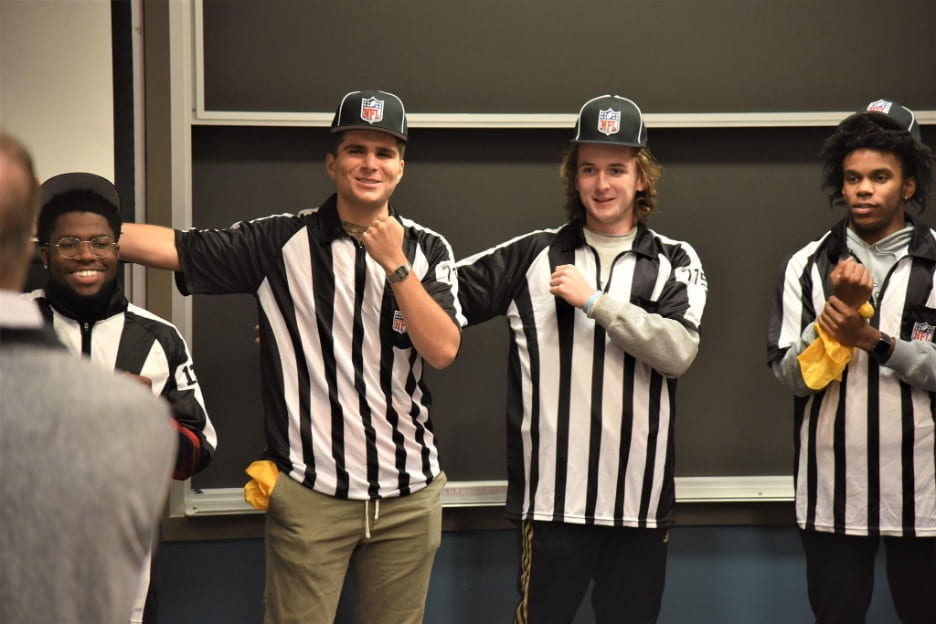
Life Lessons from a NFL Referee: DePaul Students Chat with Tony Michalek

By Erin Henze

Most people watching or attending a football game don’t fully understand one of the most important and complex positions on the field: the referee.

On Wednesday, Oct. 12, students in Andy Clark’s Introduction to Sports Management class and Bruce Leech’s Intro to Entrepreneurship course had the opportunity to hear from longtime NFL umpire Tony Michalek about his journey from high school officiating to refereeing the Super Bowl. 

“When you put the stripes on you know you’re gonna be catching grief,” Michalek said when asked by a student how he keeps his composure during games. “It can be really hard but it’s what you have to do.” 
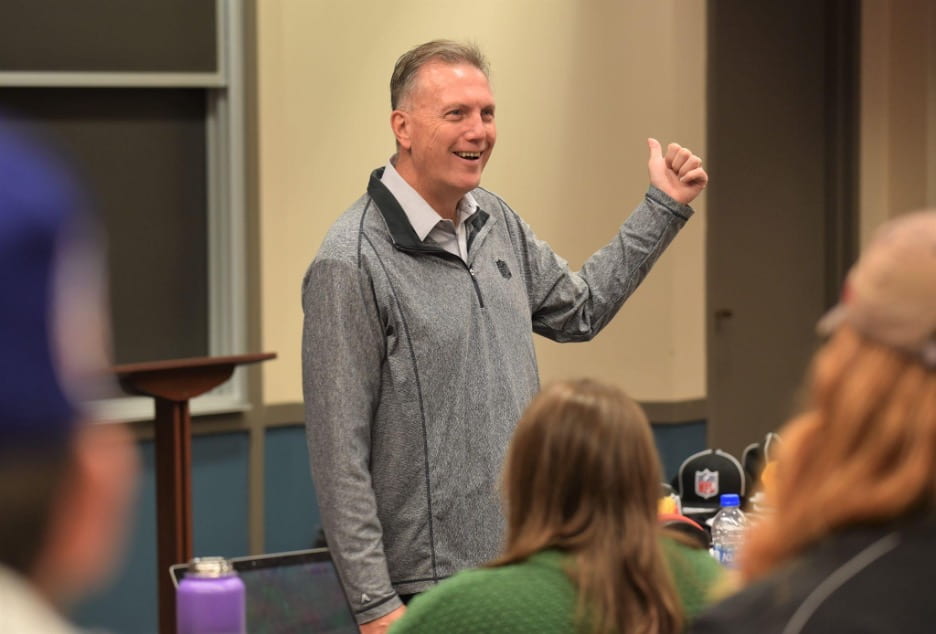
Michalek has been an NFL umpire for over 20 years, officiating a Super Bowl and forming relationships with football legends like Tom Brady and Bill Belichick

Michalek began the class by giving students some background information on his life- he attended Indiana University after high school where he played football. After graduating, Tony worked as a floor trader at the Chicago Mercantile Exchange- a position he would hold for over 20 years. During that time, he began to officiate various sporting events on weekends and evenings, including high school football games. Eventually, Michalek entered the world of collegiate refereeing where he was able to make a name for himself and work his way up to the NFL.

“You’d be surprised at how small the sports world is,” Michalek told the class. “Everybody’s connected, so once you’re in it may not be long before you’re making your way to the top.” 

Tony also impressed upon the class the benefits of refereeing, especially once you get to high levels. In 2019, the average NFL referee salary was set at just over $200,000- a job that only requires three to four days of work each week. If we’re looking at this from a business perspective, refereeing is a great use of your time that has a high payout and a high reward, even if you’re just officiating a middle or high school basketball game. The job also has another obvious perk- you get to be on the field for some of the best games in sports history. 
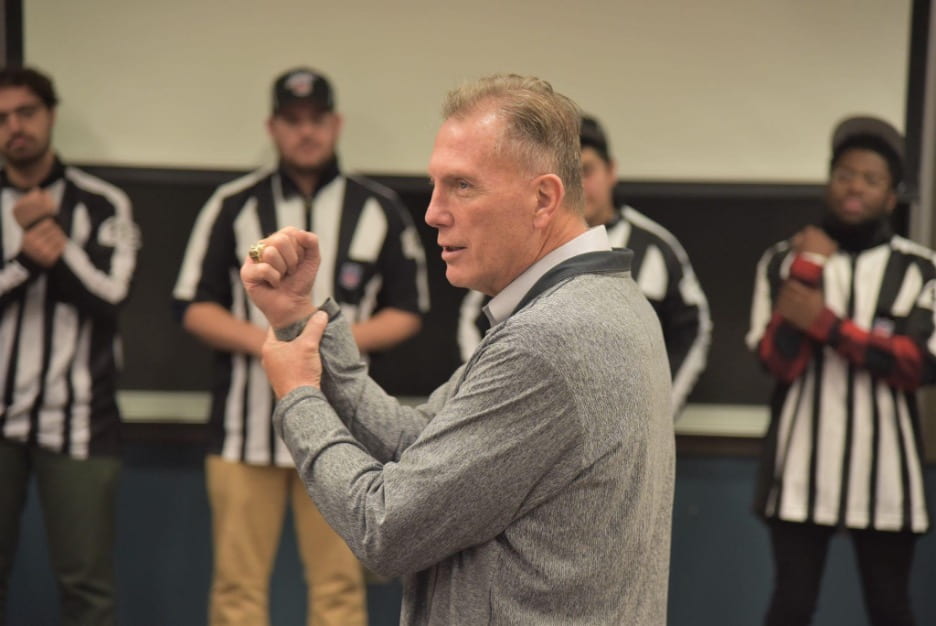
Michalek was the umpire for the 2008 Super Bowl that pitted the New York Giants against the New England Patriots. To this day, the game is considered one of the greatest upsets in the history of professional sports as the Giants took down the undefeated Patriots by a score of 17-14. Not only did Michalek get to be on the field for that historic game, he also got his very own championship ring. 

“You’d think it’s just the players who get one of these, but no, referees get one too,” Michalek told the class as he showed off the shiny ring on his finger. 

In addition to the hearty paycheck and athletic glory comes the lasting relationships a referee can make with players and coaches. Because he officiates such high-pressure games, Michalek tries to keep the atmosphere light and humorous. He told the class a story about how, during a Bears game he officiated, he asked the linemen in between plays to not embarrass him because his mom, wife, and daughters were all in the stands watching him ref. 

“You have to try and have fun with it and use humor to keep your composure,” Michalek explained to the class. “I’ve never had a brawl in one of my games because we never get that buildup of tension.” 

Michalek also explained how referring at any level helps to build character skills such as conflict resolution, communication, teamwork, and networking. 

“When you get into something like this, the people around you remember you and they want to work with you,” Michalek said. “Once they see that you commit to doing something like officiating they respect you and you become a part of the community.”

Networking also plays a huge role in working your way to the top of the refereeing chain, a fact that we can translate into the everyday world of business. No matter the occupation you choose, getting to know people, making connections, and showcasing yourself as a hardworking and dedicated individual to those around you will pay off in the end. 

Whether you’re officiating a middle school soccer game or an NBA championship, the principle of refereeing remains the same: keep your composure and the personal payout will be worth it. 

“You have to train yourself to keep composure,” Michalek told the class. “Remember that it’s not personal- it’s just because you’re wearing the stripes.”

Michalek brought along some of his referee shirts so that students could roleplay and get a feel for what it’s like to throw flags during an actual NFL game.

After nearly 21 years in the NFL, Michalek is just as passionate about what he does as he was when he first started all those years ago. And with the sports world experiencing a massive referee shortage, it needs people like Tony Michalek to instill a passion for the occupation into young people around the world. 

Photo Credits: Kathy Hillegonds

A Look Into Intersport With Kurt Melcher

By Rachel Bradshaw

On Tuesday September 27th, Professor Andy Clark invited Kurt Melcher, Executive Director of Esports & Gaming of Intersport to The Business of Esports class. Kurt showed a video from Robert Morris University, which talked about esports growth. Some still have stereotypes of esports as being played in your basement and assuming that you’re just playing all day and night. Even though esports has grown to have similarities with traditional sports because of tournaments; teams practice, have a coach to discuss strategies with during a game, etc. He then showed a graph that shows Formal University Esports Program Growth, which showed that back in 2016 there were only 38 programs and now in 2022 there are 654 programs. Due to the pandemic in 2020, the desire to play esports grew exponentially, helping with  the expansion of programs in universities.  

Kurt then presented 2 other charts that stood out. The first showed the growth of Twitch from a viewer and channel standpoint. From 2019 to 2021 people viewing Twitch went from about 1 million to around 3 million viewers, since traditional sports were suspended at this time most people turned to esports to watch. Not everyone is good at playing, so watching can be interesting to do. The second chart showed the Global Sales of gaming compared to other media and in 2020 gaming hit 159 billion dollars while other media including professional leagues, music, and cinema only hit 66 billion dollars. It’s fascinating to see how much more sales esports were gaining during the pandemic while everything else was shut down.  

To end his presentation, Kurt showed a video about what Intersport does and its five main categories. The categories include: Consulting, Tournament Ops, Experiences, Content Marketing, and Property Creation. Intersport helps with sponsorship for games and creators. One example that Kurt discussed was Nathan’s Famous partnering with JoshOG. They found Josh because he would wear a hot dog costume just for fun during his live streams, so they decided to make a partnership out of it. He would wear a Nathan’s Famous hat and eat hot dogs during his livestream, which got people more involved and created an interest in wanting  to buy Nathan’s Famous. Overall, it was interesting to learn about everything that goes behind the scenes of sponsorships with esports.  

Photo Credit: Rachel Bradshaw 

DePaul Students Consult on Chicago Cubs Grab & Go Concessions

By Alyssa Gillespie

From July 26th to August 18th, I was a part of a group of 9 DePaul undergrads and 6 DePaul graduate students who were assigned a consulting project for a special client, The Chicago Cubs. We were tasked with looking at the new Grab & Go concessions at Wrigley Field through both our own observations and data provided to us by the Cubs and making improvement recommendations based on those.

We started off our class at the DePaul Center in the Loop with Professor Clark, meeting on Zoom with three members of the Cubs Organization: Brad Johnson, Director of Hospitality and Retail, Brad Nagel, Director of Talent, and Vanessa Ward, former Project Manager.  They gave us an overview of the Cubs as a business organization as well as a brief introduction as to what they were looking for from us in this project. We learned about how the Cubs are aiming for a “frictionless experience” from before a guest even arrives at the ballpark until the moment they arrive back home. That was going to be the goal moving forward with our projects, helping to make the Grab & Go concessions a frictionless experience.

One of the Grab & Go concession stands at Wrigley Field

We also met with Maria Sapienza, Assistant Director of Analysis and Planning Operations, over Zoom. Maria and Brad Johnson were our main points of contact during this project and who we would be presenting to at the end.

The next week we got to actually go to Wrigley Field, and before getting the official tour we learned more in-depth about what the Cubs were looking for from us, as well as a set of goals for the next couple steps in our process. First, we were going to be given data from post-game and in-game surveys completed by guests during this season. Our class had a dedicated three-person team to comb through all the data and pick out what they found was important from it.  Next, we would each be attending a Cubs game over the weekend’s home stand and acting as secret shoppers. This gave us the opportunity to experience the Grab & Go concessions firsthand, along with all other aspects of the fan experience. Finally, we would be attending one more game as a class where we would be surveying the various Grab & Go stands in the park to collect more data.

After that, we were into the home stretch with only a week left until presentations. Each of the three groups met with Brad and Maria to explain some of their initial ideas to see if they were both on the right track and within the realm of possibility for the organization to commit to.

Before we knew it, it was Thursday the 18th which meant it was presentation day. The class met at the Cubs’ Offices for the final time ready with our ideas and slideshows. The three groups got up and presented recommendations ranging from reconfiguring the set-up of the line and actual concession stand, to different types of signage, and lights similar to those you see at grocery store self-checkouts that indicate a machine is open for the next guest. We made these recommendations based on what we were able to glean from the data and our own observations we had being at the park.

Overall, this was an invaluable experience for myself and my classmates getting an inside look into the business operations of a professional team, as well as being challenged to give a consultation and recommendation on an area none of us were experts in and in a relatively short period of time. Not only that, but we got to connect and network with members of the Cubs organization, as well as our classmates who will end up in a wide variety of organizations and industries in the future.

Photo Credits: Kathy Hillegonds