A Whirlwind Week: Recapping The 9th Annual Behind the Scenes with Chicago Sports Organizations Class

By Rachel Bradshaw and Erin Henze

When we signed up to be part of DePaul’s ninth annual Behind the Scenes with Chicago Sports Organizations Class (BTSWCSO) led by Andy Clark, director of the Sports Business program, we knew it would be an exciting course that introduced us to the world of Chicago sports. We were right. This week-long intersession course was all of that and so much more. In just six days, we networked with 64 contacts in the sports industry, visited 15 different organizations, stepped foot inside 10 venues/offices and attended an NHL game.

Monday

On Monday morning, we found ourselves at the Coleman Entrepreneurship Center. There, we were introduced to the course and each other before hearing from Publisher Chris Hartweg from Team Marketing Report.

Chris set the stage for what our week was going to look like and gave us excellent advice for our professional lives. His main piece of advice was to “get as much writing experience as you can” because it’s likely that any job will require you to write in some form. We also learned about the Fan Cost Index (FCI) that Team Marketing Report uses to help teams understand the average ticket prices of four adults going to a game.

From there, we traveled to Guaranteed Rate Field and met with a panel of directors who talked about their careers within the Chicago White Sox organization including, Director of Ticket Sales and Retention Rich Kuchar, Senior Director of Corporate Partnership Sales Development George McDoniel, Vice President of Community Relations/Executive Director of Chicago White Sox Charities Christine O’Reilly-Riordan, Senior Director of Broadcasting Cris Quintana, Vice President of Finance Bill Waters, and Vice President of Sales and Service Jim Willits.

After meeting with the panel of White Sox executives, the class was able to step onto Guaranteed Rate Field and tour some of the facilities.

Most of the panelists have been a part of the White Sox for at least more than 10 years, which shows the culture and relationships that exist within the franchise. Following the panel, Client Services Manager Maryssa Cladis took us onto the field for pictures and a taste of the gameday experience.

Tuesday

Students hear from Senior Director of Marketing Communications Mike Hormuth and Professor Andy Clark at rEvolution Marketing Agency, a creative company that focuses on developing brands in the sports world and beyond.

On Tuesday morning, we arrived at rEvolution, an integrated sports marketing agency, to learn about the inner workings of the company and what makes them unique. We met with Partner Larry Mann, Senior Director of Marketing Communications Mike Hormuth and Director of Hospitality Jennifer Andrus. We also heard from Client Services Associate Theodore Gwyn, Client Services Manager and DePaul alum Celine Soto, Supervisor of Client Services Michael Begel, and Senior Supervisor of Client Services Celsea Herzog. They are involved with a variety of brands and come up with creative ways to promote their clients’ goals. Jennifer talked about how her team helps create “bucket list experiences” as a way of making everyone’s time with rEvolution memorable. It was intriguing to learn about everything that goes into not only creating and planning events, but also producing content to make products look good from a different standpoint.

In the afternoon, we traveled to Wrigley Field and the Chicago Cubs offices. We started off the afternoon speaking to the Chief Commercial Officer and Executive Vice President of Sales and Marketing, Colin Faulkner, who talked to us about his career journey. One piece of advice he shared was “do a good job at the job that you have because you never know where you will go from there.”

From there, Colin took us down to the 30,000 square foot Clubhouse where we were able to take pictures and check out where the players go before and after games. Then, we headed to the American Airlines 1914 Club and the Maker’s Mark Barrel Room where Colin talked about the background of the design concepts for those two specific premier spaces. The last stop on the tour was the field, which was set up for the Winter Wonderland.

Colin Faulkner gives the class a sneak peek of the renovated Cubs’ clubhouse during their tour of the stadium.

After the tour, the class got a one-on-one opportunity to sit down and speak with a range of Cubs managers about work/life balance and their careers including DePaul alumni and Account Executive of Premier Sales Diego Chahda, Talent Acquisition and HR Operations Coordinator Claribel Diaz, Ticket Sales Representative Megh Babikian, Executive Assistant Mary Rossi, Director of Hospitality and Retail Brad Johnson and Manager of Ticket Sales Aaron Klein.

Wednesday

Wednesday was a loaded day filled with a ton of insights from three different organizations, starting with Wilson Sporting Goods. When we first arrived, the class received a detailed tour of the beautiful office space. Following the tour, we sat down for some lunch with Global Supply Planning Manager Oliva Vargas, Social Media Strategy Manager Jonathan Lau, Global Marketing and Partnerships Senior Director of Team Sports Amanda Lamb, Digital Marketing Director Aviva Jorstad and Global Commercial Senior Director of Baseball/Softball Michael Markovich. They all spoke about their lives and how they ended up at Wilson. Jonathan Lau discussed the importance of developing trust and a good relationship with consumers, saying “It’s not what we say our brand is – it’s what our community says our brand is.”

It was also interesting to see firsthand how Wilson conducts business. In an adjacent conference room, there were executives from Dick’s Sporting Goods meeting about buying Wilson products.

Following this, we ventured off to the Bulls’ corporate offices to start the afternoon speaking to a wide range of Chicago Bulls managers including Community Relations Senior Coordinator Josh Clark, Community Relations Coordinator Kola Adebola, Integrated Marketing Coordinator Haley Zahn, Digital Partnership Coordinator Ivan Hudson, Manager of Corporate Communications Denae Wilkins, HR Coordinator Mary Clare Crue, Senior Manager of Season Ticket Sales Zayna Ibrahim, Business Analyst David Hu, and Manager of Digital Content Nikko Tan.

Following the panel with the Bulls, the class was given an exclusive tour of their United Center Offices.

Everyone gave great advice, but one in particular was Denae, who told us, “Don’t let not knowing about the sport stop you from applying or interviewing.” Denae’s insight highlights the idea that when applying for a job, your expertise in a certain discipline is more important than a deep knowledge of the sport.

Nikko shared his journey from just overseeing social media to now being one of the team’s photographers. He talked about how during the pandemic, he wanted to try something new, so he tried photographing his high school’s football team as practice. With a ton of practice, he kept improving and told us, “you can gain experience in different areas.”

Next up, we went down to the Blackhawks’ corporate offices to speak with Manager of Development Marisela Rodriguez, Manager of Analytics Elena Kelsh, Corporate Partnership Account Specialist Shilpa Rupani, Marketing Coordinator Sarah Ortman, and DePaul Alum and Account Executive of New Business Erik Lagunas. There, they each separately took time to speak with us about what they do before, during and after gamedays. Erik gave great advice about what it is like when working in sports saying, “sports is a lot of time, but if you’re passionate about it, then it’ll be okay. It’s rewarding.” It just goes to show that sports can be an exhausting industry to work in, but the payout makes it all worth it.

Following, we met with Manager of Premium Membership, Kevin LeClair, who gave us a tour of the United Center’s new features. This included checking out the ice, the CIBC seats lounge, and the new FanDuel Sportsbook (which was newly opened back in October).

After the tour, we were treated to a pizza dinner and got a surprise visit from the Blackhawks In-Game Content Host Genna Rose, who talked about her journey from broadcasting to being a part of the organization. As a recent college graduate, it was intriguing to hear what she has accomplished and her journey to the position that she has now.

The class was able to attend the Blackhawks vs. Oilers game Wednesday night as guests of the Blackhawks. Pictured here (L-R) are students Molly Byrne, Erin Henze, Kiaralyn Tardi, and Rachel Bradshaw.

To conclude this eventful day, we were able to attend the Chicago Blackhawks vs Edmonton Oilers game as guests of the Blackhawks in great seats. There, we got closer as a class while enjoying the game after absorbing all the information we had gotten throughout the day.

Thursday

Thursday morning featured a trip to the Chicago Bears’ loop offices for a panel discussion with a variety of the team’s managers, including Manager of Employee Experience Kristin Rogers, DePaul Alum and Partnership Activation Specialist Rachel Chessky, Partnership Activation Assistant Victoria O’Connor, Corporate Communications Assistant Miguel Lemus, Manager of Brand Creative Matt Dunlap and Marketing Project Manager Joann Kowalski. There, we all received important pieces of advice that will serve us well as we transition into our professional lives over the next couple of years.

Rachel, who was in this same class, told us that “no job is too small” when trying to break into the sports industry. Rachel completed an internship with the Bears after graduating, which eventually helped her secure a full-time job with the football team. Victoria also urged the class to believe in themselves, saying “don’t tell yourself ‘no’ before anyone else does.” We also learned a great deal about leadership and what it means to manage people within a business. Joann highlighted the importance of finding what works for different projects as well as what leadership and working styles work for different people.

DePaul Alum and Chicago Bears’ Partnership Activation Specialist Rachel Chessky answers a question during the panel discussions in the Bears’ offices on Thursday.

After our visit with the Bears, the class headed over to Paragon Marketing Group’s new offices in the West Loop. We met with Senior Vice President Matt Waitz, Senior Account Supervisor Michael Miller, Senior Account Coordinator Talia Petrosino, and Account Supervisors Jim Perry and Michael Socks. They gave the class a presentation highlighting Paragon’s history, what the company is currently working on, and some of the projects they’re looking forward to in the future.

Paragon’s slogan is, “We ignite remarkable journeys,” a concept that is evident in the way they conduct business and collaborate with brands.

One of the most interesting aspects of Paragon’s history as a marketing agency is their involvement with LeBron James and the televised broadcast of his high school basketball game against Oak Hill. Now, Paragon is fully immersed in the world of highlighting high school talent in a wide variety of sports, including men’s and women’s basketball, soccer, and men’s and women’s volleyball.

After the presentation, students received tips on building a solid resume and were encouraged to apply for Paragon’s “Road Warrior” summer student internship position. We concluded our time at Paragon with a tour of their brand-new offices, located right across from Union Station.

Friday

Friday was a day packed full of school pride! We started the day at Wintrust Arena, where we received a tour of the facilities from arena manager David Kennedy, as well as some additional insight into what goes on behind-the-scenes for games and concerts.

Wintrust Arena Manager David Kennedy gives the class a tour and brief history of the stadium and the events it hosts.

After that, we visited the DePaul Athletics facilities located at Wintrust, including the men’s and women’s basketball locker rooms, the film room, several conference rooms, and a state-of-the-art weight room. We talked with Executive Associate Athletic Director Taylor Stapleton about DePaul’s role at Wintrust, and everything that has to happen before and after a game there to make it a success.

We concluded our time at Wintrust with a Q&A discussion with DePaul Alum and Chicago Sky VP of Sponsorship Alex Teodosi, who is also a former student of this class. Alex talked to us about the importance of prioritizing women’s athletics and how the WNBA is evolving, as well as his role within the organization.

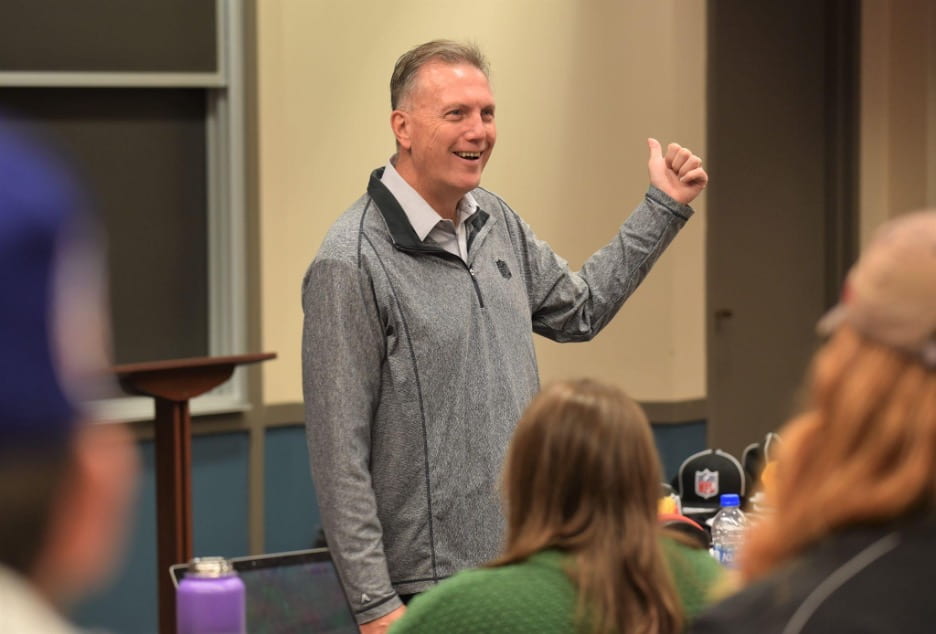
Mike Gordon stopped by to give the class some advice on how to set yourself apart when applying for jobs in the sports industry.


Later, the class headed back to the Coleman Center in the Loop campus, where we met with DePaul alum Mike Gordon, who is the General Manager of Northwestern Sports Properties. The whole class really enjoyed Mike’s engaging presentation about succeeding in the sports world, setting yourself apart from your competition when applying for jobs, and building a strong resume that compliments your skills and experiences. One of our favorite insights from Mike was his explanation of why the sports industry is different and how it brings people together. He told us, “for three hours, we are uniting people under one common cause,” which allows people to set aside their differences and come together to cheer for their team.

To conclude the day, the class was able to sit down with a team of DePaul alums led by Mike, Alex Teodosi, Partnership Strategy Coordinator for the Chicago Fire Olivia Solimene (who took this class just last year), Marketing Manager at Life Fitness Jen Enright, and DePaul Athletics, Account Executive, Tamas Zador.

One of the coolest things about the class was getting to hear about the career paths of former DePaul students and the mark they’ve made on the sports industry thus far. Professor Andy Clark reiterated this idea, saying, “A cool part of doing this class for several years now is that we are meeting with DePaul alums who were in this same course and now work at these organizations, including the Bears, Cubs, Blackhawks, Fire, Sky and Wilson.”

From our roundtable discussions, we learned how to use our connections with our classmates and professors at DePaul and how to leverage our experiences and knowledge when trying to break into the sports industry.

On Friday evening, the class was able to have a roundtable discussion with a variety of DePaul alumni now working in the sports industry, including Life Fitness Marketing Manager Jen Enright.


To wrap up this incredible week of networking and learning, the class met for one final session and gave group presentations. The presentations highlighted what we all learned from the week, what impacted us the most, and what lessons we will take from the class.

Each presentation was unique and creative, and every student showcased their passion for sports and gratitude for everything they gained from this class in the way they spoke.

At the end of the day, this course brought all of us together and allowed us to create memorable connections and experiences that won’t soon be forgotten.

From classmates to executives, we met so many amazing people this week. Their knowledge is something we will carry with us wherever we go in our careers, and we hope to one day share our own experiences as well as the incredible advice and knowledge we got from everyone here with students just like us.

To view more photos from the experience, check out this DePaul Newsline feature.

Rachel Bradshaw is a Junior studying Sports Business at DePaul.

Erin Henze is a Junior studying Journalism & Sports Communication at DePaul.

Journey to the United Center: DePaul Students Present Their Ideas to the Chicago Bulls

By Erin Henze

It’s not often that students have the opportunity to step inside the corporate offices of their favorite NBA team- much less give a presentation to the organization’s executives.

But, on November 2nd, Andy Clark’s Introduction to Sports Management class was able to do just that.

Several weeks previously, students in the class were put into teams and tasked with creating an innovative presentation to give a the Bulls Offices.

Students smile in front of the Bulls’ “Basketball Wall” during their behind-the-scenes tour of the offices.

The focus of the presentations? Brainstorming and fleshing out creative ways for the Chicago Bulls to increase interest and boost community engagement in the Bulls vs. Pistons game taking place in Paris on Jan. 19 of next year.

Because the game is taking place on a different continent and in the middle of the afternoon due to time zones, the Bulls organization is looking for ways to get the Chicago community excited about watching the game and supporting the team. The franchise is also looking to take advantage of the Bulls’ international popularity and notoriety to expand its brand and fan base globally.

Over the course of three weeks, each group met outside of class to come up with ideas and design methods intended to meet these goals. Two Bulls executives, the VP of Community Engagement, Adrienne Scherenzel-Curry, and the Director of Community Relations, Erica Bauer, were available resources for students from the beginning of the process. They visited our class in-person and via zoom several times to answer questions and give feedback on potential ideas.

Junior Justin Espinosa shares visuals from his team’s idea to collaborate with Don C and design vintage clothing to promote the Paris game.

Erica and Adrienne were very receptive of the ideas presented and appreciative of the creative work that went into the projects.

“Some of these things I never even thought about doing,” Bauer said after the presentations were given inside a Bulls conference room. “You guys did a great job of brainstorming new and realistic ideas.”

Some of the most popular concepts among the group included hosting a United Center Watch Party during the live airing of the game overseas, complete with a French food buffet, games and giveaways, alumni interaction, and much more. Another group suggested that the Bulls host a G-League game at the United Center on the morning of the Paris game, to both give the G-league Bulls team exposure and get the community excited about coming to the United Center.

There were also various intriguing ideas shared in terms of activating the Bulls brand in Paris, including a Parisian street art showcase, a day with former Bulls player Joakim Noah, and frequent social media updates with behind-the-scenes insight into player activities while in Paris.

Additionally, a lot of emphasis on promoting the Paris game was put on the fashion side of things. Parisian culture has a rich history of unique fashion, and the week the Bulls will be in Paris is also Men’s Fashion Week. So, students were eager to brainstorm ideas that could combine popular Paris fashion with American sports. Some ideas thrown around included collaborating with Off-White to design a jacket for the players to wear to the arena, creating a custom designer jersey for Bulls players to wear during the game, and utilizing Bulls’ Creative Strategy and Design Advisor Don C to bring back vintage designs that highlight Bulls history as well as current fashion trends.

A lot of the ideas included donating proceeds to Bulls’ charity partners, much to the delight of Adrienne and Erica as they work with the Bulls Charities organizations frequently. “I love how you guys are thinking about and trying to incorporate our charities into your ideas,” Adrienne told the class. “That’s our thing, so we’re always excited about that.”

Cesar Vizcarrondo, Director of Brand & Fan Development for the Bulls, gives creative feedback after listening to a presentation.

The Director of Brand & Fan Development, Cesar Vizcarrondo, also stopped by to listen into the presentations and share his thoughts. “This is what we look for,” Vizcarrondo said. “New, fresh, and creative ideas from your generation that we may not come up with ourselves.”

After the presentations, students were invited to eat lunch with the other employees and receive an exclusive behind-the-scenes tour of the offices.

Later that evening, students were able to attend the Bulls home game against the Charlotte Hornets courtesy of the Bulls organization and witness a Chicago victory.

The students attended the Bulls vs. Hornets game later that night as guests of the Bulls.

As a whole, the experience was an amazing one that gave students insight into one of the most popular and successful sports franchises in the entire world. It allowed students to make connections, develop their interests and experiences in the sports world, and improve their confidence, teamwork and presentation skills all at the same time.

Erin Henze is a third-year Sports Communication & Journalism student at DePaul University.

Chicago Sports Executives Give Students Inside View

By Ovetta Sampson / January 13, 2015

At first glance, a course offering visits to some of Chicago’s most famous sports-focused organizations may seem like one big field trip. A sneak peak at the Chicago Cubs front office here, a swing by the Chicago Bears locker room there.

But as the 25 students enrolled in DePaul University’s sports management course “Behind the Scenes with Chicago Sports Organizations” soon discovered, the class wasn’t just fun and games.


In five days, students visited the headquarters of 14 Chicago sports-focused organizations, from the Chicago Bulls, Bears, Cubs and Blackhawks to Gatorade. Students were given extraordinary access to front offices and even inside looks at new facilities, products and services.

For example, DePaul students received an exclusive tour of the Advocate Center, the new downtown practice facility for the Chicago Bulls. At the Cubs organization, they saw the architectural scale model for planned Wrigley Field complex renovations, a model not-widely shown.

But students say it was the people, not the places, that made the course worth taking.

“It was a great chance to meet people who are important in the industry,” says Ryan O’Neill, a DePaul MBA student. “We really got to know them and network with them.”

During the weeklong December course, students met with 75 executives, many of them DePaul alumni, who work at major sports franchises and high-power sports agencies and companies. The list included:

  • Kara Bachman, executive director, Chicago Sports Commission
  • Charlie Besser, CEO, Intersport
  • Meghan Bower & Leah Hendrickson, public relations managers, Chicago Blackhawks
  • Neil Buethe, director of media relations, US Soccer Federation
  • Molly Carter, Sr. Director, Marketing Communications, The Gatorade Company
  • Grant DePorter, CEO, Harry Caray’s Restaurant Group
  • Danny Ecker, Sports Reporter/Producer, Crain’s Chicago Business
  • Susan Goodenow, vice president marketing and branding, Chicago Bulls
  • Mike Gordon, president, Chicago Wolves
  • Jennifer Heppel, Associate Commissioner, Big Ten Conference
  • Chris Hibbs, vice president sales and marketing, Chicago Bears
  • Josh Kritzler & Dan Migala, founding partners, Property Consulting Group
  • AJ Maestas, president, Navigate Research
  • Bryan Robinson, vice president, Human Resources, Chicago Cubs

During their visits, students had opportunities for lunch and coffee meetings and one-on-one talks with these industry leaders. The class also featured a roundtable discussion with DePaul alumni working in sports management.

“It was impressive to meet a cross-section of sports professionals, from CEOs and VPs to recent college graduates in their first or second jobs who resonated with our students,” says Andy Clark, who taught the class and directs sports management programs at DePaul’s Driehaus College of Business. “The ability for the students to mix and mingle and network was far greater than I thought it would be.”

“It was life changing.”

Rebecca Regalado, a television sales and marketing professional who took the sports management course as an elective, says the course absolutely blew her mind.

“It was life-changing,” says Regalado. “In my 13 years at television stations here in Chicago, I never had the experience with top executives in the sports industry that I had in that one week. To meet them, have them give us advice and to hear their stories of how they got into the industry… it was priceless.

While at The Gatorade Company in downtown Chicago, Regalado listened intently as Carter, a top-level executive in marketing and a DePaul alumna, told her personal story of how she landed at Gatorade. The story included a few curves, including a time when Carter left a major sports franchise because it just wasn’t the right fit.

“When she said that, I got goose bumps,” says Regalado, who left her job in November 2013 after she, too, felt it was no longer a right fit for her. “I know now that I’m on the right path. I like the sports industry, and I saw through this class that I want to go into the business of sports.”

The World Is Out There

Clark says he created the class after seeing Ron Culp, a DePaul communications professor, do a similar tour for students to New York public relations agencies.

Clark says the three-fold purpose of his class was to:

  • give students an inside look at the what the sports business looks like from those in the industry;
  • offer them insights on how to break into the sports business;
  • show them that skills learned in sports management are applicable to a variety of businesses beyond sports.

The class was another distinguishing aspect of DePaul’s sports management program and its emphasis on real-world, practical lessons for students. Nearly all of the organizations visited were within a short distance of DePaul’s Loop Campus, and about a quarter of the executives featured were DePaul alumni.

“The real world is out there, not just inside the walls of DePaul,” Clark said. “There may be other sports management programs, but our distinction is that we’re right down the street from major sports organizations and we have great relationships through our alumni with major sports industry corporate headquarters and agencies.”

The class yielded even more connections as several students scored job leads, internship interviews and informational meetings with personnel from at least five of the organizations visited.

“It was an intense week,” says O’Neill, who landed a meeting with a sports executive. “It flew by. If you’re interested in the sports industry and really looking to learn more about that industry, this course is a great experience.”

Read more about DePaul’s MBA concentration in Sports Management and Undergraduate BSB in Management (Sports Management).

Life Lessons from a NFL Referee: DePaul Students Chat with Tony Michalek

By Erin Henze

Most people watching or attending a football game don’t fully understand one of the most important and complex positions on the field: the referee.

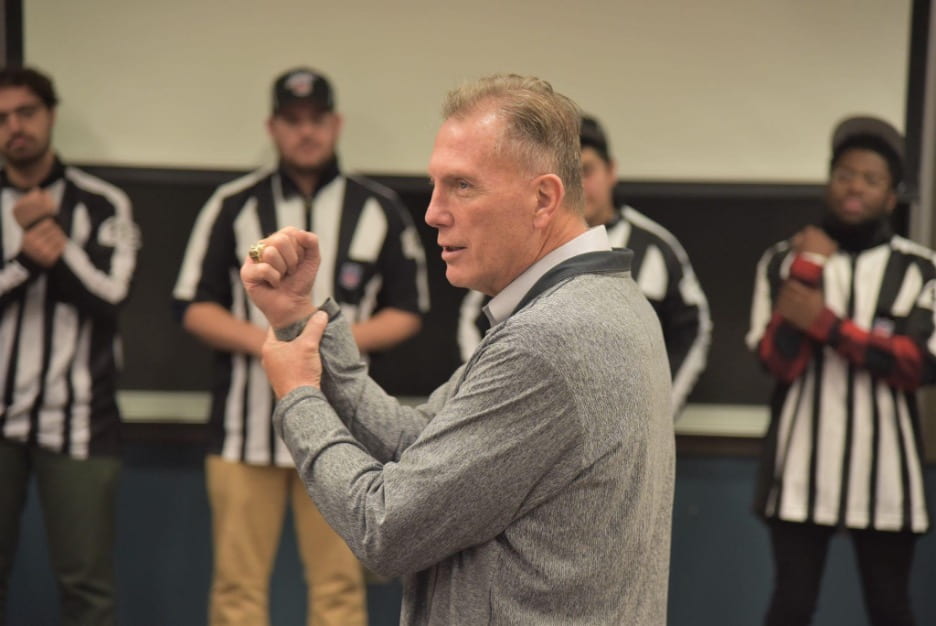
On Wednesday, Oct. 12, students in Andy Clark’s Introduction to Sports Management class and Bruce Leech’s Intro to Entrepreneurship course had the opportunity to hear from longtime NFL umpire Tony Michalek about his journey from high school officiating to refereeing the Super Bowl. 

“When you put the stripes on you know you’re gonna be catching grief,” Michalek said when asked by a student how he keeps his composure during games. “It can be really hard but it’s what you have to do.” 

Michalek has been an NFL umpire for over 20 years, officiating a Super Bowl and forming relationships with football legends like Tom Brady and Bill Belichick

Michalek began the class by giving students some background information on his life- he attended Indiana University after high school where he played football. After graduating, Tony worked as a floor trader at the Chicago Mercantile Exchange- a position he would hold for over 20 years. During that time, he began to officiate various sporting events on weekends and evenings, including high school football games. Eventually, Michalek entered the world of collegiate refereeing where he was able to make a name for himself and work his way up to the NFL.

“You’d be surprised at how small the sports world is,” Michalek told the class. “Everybody’s connected, so once you’re in it may not be long before you’re making your way to the top.” 

Tony also impressed upon the class the benefits of refereeing, especially once you get to high levels. In 2019, the average NFL referee salary was set at just over $200,000- a job that only requires three to four days of work each week. If we’re looking at this from a business perspective, refereeing is a great use of your time that has a high payout and a high reward, even if you’re just officiating a middle or high school basketball game. The job also has another obvious perk- you get to be on the field for some of the best games in sports history. 

Michalek was the umpire for the 2008 Super Bowl that pitted the New York Giants against the New England Patriots. To this day, the game is considered one of the greatest upsets in the history of professional sports as the Giants took down the undefeated Patriots by a score of 17-14. Not only did Michalek get to be on the field for that historic game, he also got his very own championship ring. 

“You’d think it’s just the players who get one of these, but no, referees get one too,” Michalek told the class as he showed off the shiny ring on his finger. 

In addition to the hearty paycheck and athletic glory comes the lasting relationships a referee can make with players and coaches. Because he officiates such high-pressure games, Michalek tries to keep the atmosphere light and humorous. He told the class a story about how, during a Bears game he officiated, he asked the linemen in between plays to not embarrass him because his mom, wife, and daughters were all in the stands watching him ref. 

“You have to try and have fun with it and use humor to keep your composure,” Michalek explained to the class. “I’ve never had a brawl in one of my games because we never get that buildup of tension.” 

Michalek also explained how referring at any level helps to build character skills such as conflict resolution, communication, teamwork, and networking. 

“When you get into something like this, the people around you remember you and they want to work with you,” Michalek said. “Once they see that you commit to doing something like officiating they respect you and you become a part of the community.”

Networking also plays a huge role in working your way to the top of the refereeing chain, a fact that we can translate into the everyday world of business. No matter the occupation you choose, getting to know people, making connections, and showcasing yourself as a hardworking and dedicated individual to those around you will pay off in the end. 

Whether you’re officiating a middle school soccer game or an NBA championship, the principle of refereeing remains the same: keep your composure and the personal payout will be worth it. 

“You have to train yourself to keep composure,” Michalek told the class. “Remember that it’s not personal- it’s just because you’re wearing the stripes.”

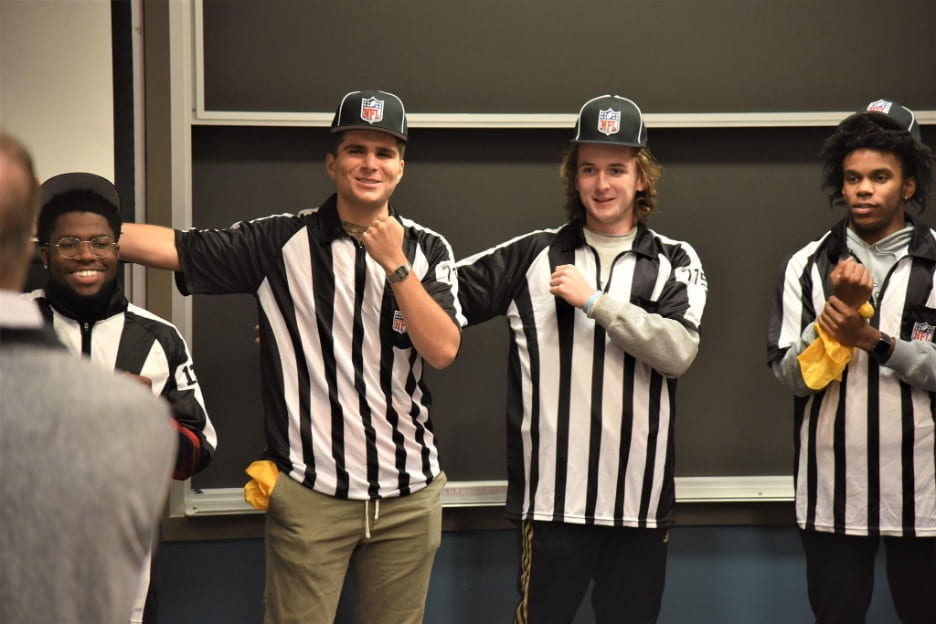
Michalek brought along some of his referee shirts so that students could roleplay and get a feel for what it’s like to throw flags during an actual NFL game.

After nearly 21 years in the NFL, Michalek is just as passionate about what he does as he was when he first started all those years ago. And with the sports world experiencing a massive referee shortage, it needs people like Tony Michalek to instill a passion for the occupation into young people around the world. 

Photo Credits: Kathy Hillegonds

A Look Into Intersport With Kurt Melcher

By Rachel Bradshaw

On Tuesday September 27th, Professor Andy Clark invited Kurt Melcher, Executive Director of Esports & Gaming of Intersport to The Business of Esports class. Kurt showed a video from Robert Morris University, which talked about esports growth. Some still have stereotypes of esports as being played in your basement and assuming that you’re just playing all day and night. Even though esports has grown to have similarities with traditional sports because of tournaments; teams practice, have a coach to discuss strategies with during a game, etc. He then showed a graph that shows Formal University Esports Program Growth, which showed that back in 2016 there were only 38 programs and now in 2022 there are 654 programs. Due to the pandemic in 2020, the desire to play esports grew exponentially, helping with  the expansion of programs in universities.  

Kurt then presented 2 other charts that stood out. The first showed the growth of Twitch from a viewer and channel standpoint. From 2019 to 2021 people viewing Twitch went from about 1 million to around 3 million viewers, since traditional sports were suspended at this time most people turned to esports to watch. Not everyone is good at playing, so watching can be interesting to do. The second chart showed the Global Sales of gaming compared to other media and in 2020 gaming hit 159 billion dollars while other media including professional leagues, music, and cinema only hit 66 billion dollars. It’s fascinating to see how much more sales esports were gaining during the pandemic while everything else was shut down.  

To end his presentation, Kurt showed a video about what Intersport does and its five main categories. The categories include: Consulting, Tournament Ops, Experiences, Content Marketing, and Property Creation. Intersport helps with sponsorship for games and creators. One example that Kurt discussed was Nathan’s Famous partnering with JoshOG. They found Josh because he would wear a hot dog costume just for fun during his live streams, so they decided to make a partnership out of it. He would wear a Nathan’s Famous hat and eat hot dogs during his livestream, which got people more involved and created an interest in wanting  to buy Nathan’s Famous. Overall, it was interesting to learn about everything that goes behind the scenes of sponsorships with esports.  

Photo Credit: Rachel Bradshaw 

DePaul Students Consult on Chicago Cubs Grab & Go Concessions

By Alyssa Gillespie

From July 26th to August 18th, I was a part of a group of 9 DePaul undergrads and 6 DePaul graduate students who were assigned a consulting project for a special client, The Chicago Cubs. We were tasked with looking at the new Grab & Go concessions at Wrigley Field through both our own observations and data provided to us by the Cubs and making improvement recommendations based on those.

We started off our class at the DePaul Center in the Loop with Professor Clark, meeting on Zoom with three members of the Cubs Organization: Brad Johnson, Director of Hospitality and Retail, Brad Nagel, Director of Talent, and Vanessa Ward, former Project Manager.  They gave us an overview of the Cubs as a business organization as well as a brief introduction as to what they were looking for from us in this project. We learned about how the Cubs are aiming for a “frictionless experience” from before a guest even arrives at the ballpark until the moment they arrive back home. That was going to be the goal moving forward with our projects, helping to make the Grab & Go concessions a frictionless experience.

One of the Grab & Go concession stands at Wrigley Field

We also met with Maria Sapienza, Assistant Director of Analysis and Planning Operations, over Zoom. Maria and Brad Johnson were our main points of contact during this project and who we would be presenting to at the end.

The next week we got to actually go to Wrigley Field, and before getting the official tour we learned more in-depth about what the Cubs were looking for from us, as well as a set of goals for the next couple steps in our process. First, we were going to be given data from post-game and in-game surveys completed by guests during this season. Our class had a dedicated three-person team to comb through all the data and pick out what they found was important from it.  Next, we would each be attending a Cubs game over the weekend’s home stand and acting as secret shoppers. This gave us the opportunity to experience the Grab & Go concessions firsthand, along with all other aspects of the fan experience. Finally, we would be attending one more game as a class where we would be surveying the various Grab & Go stands in the park to collect more data.

After that, we were into the home stretch with only a week left until presentations. Each of the three groups met with Brad and Maria to explain some of their initial ideas to see if they were both on the right track and within the realm of possibility for the organization to commit to.

Before we knew it, it was Thursday the 18th which meant it was presentation day. The class met at the Cubs’ Offices for the final time ready with our ideas and slideshows. The three groups got up and presented recommendations ranging from reconfiguring the set-up of the line and actual concession stand, to different types of signage, and lights similar to those you see at grocery store self-checkouts that indicate a machine is open for the next guest. We made these recommendations based on what we were able to glean from the data and our own observations we had being at the park.

Overall, this was an invaluable experience for myself and my classmates getting an inside look into the business operations of a professional team, as well as being challenged to give a consultation and recommendation on an area none of us were experts in and in a relatively short period of time. Not only that, but we got to connect and network with members of the Cubs organization, as well as our classmates who will end up in a wide variety of organizations and industries in the future.

Photo Credits: Kathy Hillegonds

New Sports Business Major Supports Many Career Paths

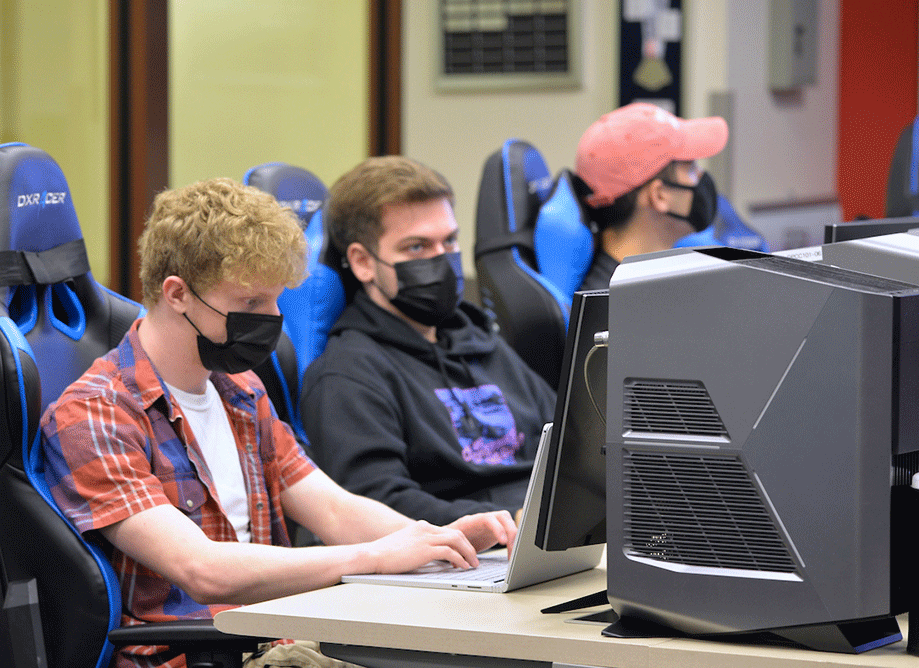
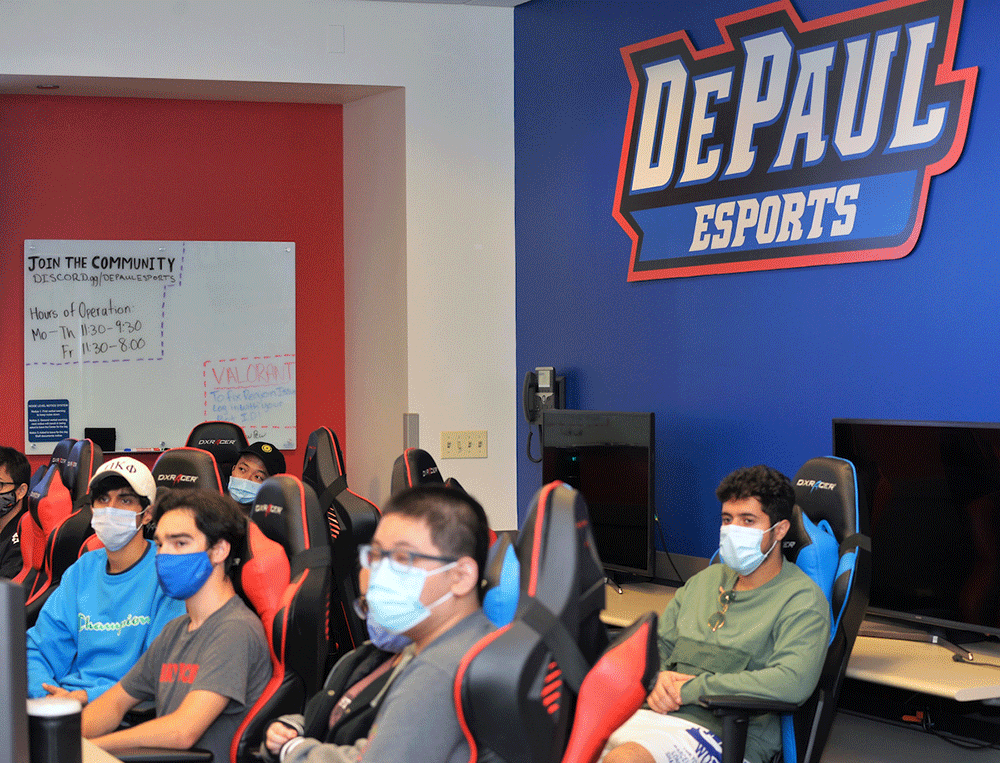
Andy Clark's esports class which met in the DePaul Center esports lounge. Students in this class worked directly with a leading esports organization, Evil Geniuses, in the fall quarter to develop partnership ideas for their new Rocket League team
Students in the undergraduate course “Business of Esports,” taught by Senior Instructor Andy Clark, worked directly with leading esports organization Evil Geniuses to develop partnership ideas for their new Rocket League team.

By Nadia Alfadel Coloma

If you ask Andy Clark, director of the new Bachelor in Business sports business major at the Driehaus College of Business, he’ll tell you that a career in sports isn’t just about working for a sport’s team. That’s one of the misconceptions, he says, that people have when they think about working in sports. In reality, there are many facets to the sports industry—marketing, management, hospitality, analytics—and a myriad of opportunities within it.

Sports is a business like any other, and it’s huge.

“I hear it all the time from people in the sports business community: recent grads know sports but not really business, or vice versa,” says Clark, who also teaches in the program, which launched in the fall. “What the industry needs is business-minded individuals who can apply their knowledge and skills to a sports setting.”

The new major aims to do just that. It prepares students for careers in sports by combining the college’s existing business core courses with experiential learning opportunities that leverage DePaul’s connections to the sports business community in Chicago.

Its three pillars are learning the inner workings of the sports industry; understanding how to apply business concepts and skills in a sports context; and learning how the business of sports relates to other industries and enterprises. The major expands upon a previously offered sports management concentration by encompassing all business disciplines. The result? A well-rounded business education that students can apply to a wide range of professional roles in the world of sports.

“We have alumni working at every sports organization in Chicago, including companies that have a sports function, like McDonalds, Wilson Sporting Goods and many sports marketing agencies,” Clark says. “So even though this program is new, we’re not new at teaching this stuff.”

Learning the Business of Sports

Andy Clark's esports class which met in the DePaul Center esports lounge. Students in this class worked directly with a leading esports organization, Evil Geniuses, in the fall quarter to develop partnership ideas for their new Rocket League team
The course “Business of Esports” is taught in the new undergraduate sports business program and introduces students to a growing trend in the industry.

Understanding the unique challenges and opportunities within the sports industry requires a deep dive into it. Popular courses like “Behind the Scenes with Chicago Sports Organizations” and the “Chicago Cubs Summer Consulting Project” expose students to different career paths and provide hands-on learning through real-world projects.

Another course that differentiates the program is the “Sports Sales Class,” taught by Associate Professor Rich Rocco in DePaul’s Center for Sales Leadership, as sales is often a key point of entry for working in a sports organization. And whether a student goes into sales, understanding the ticket sales and sponsorship process if vital if they’re going to work for a sports organization.

The newest course in the program is the “Business of Esports,” a growing trend in the industry that’s opening up many new opportunities for work. According to Clark, it’s important to understand how esports fits in the overall picture if you’re pursuing a career in sports. DePaul opened its first esports gaming center on the Loop Campus a few years ago, and competes against other Big East Conference schools in two games, League of Legends and Rocket League. So, beyond this class, students have the opportunity to learn more about esports or just enjoy it on campus.

Trends and Opportunities in Sports Business

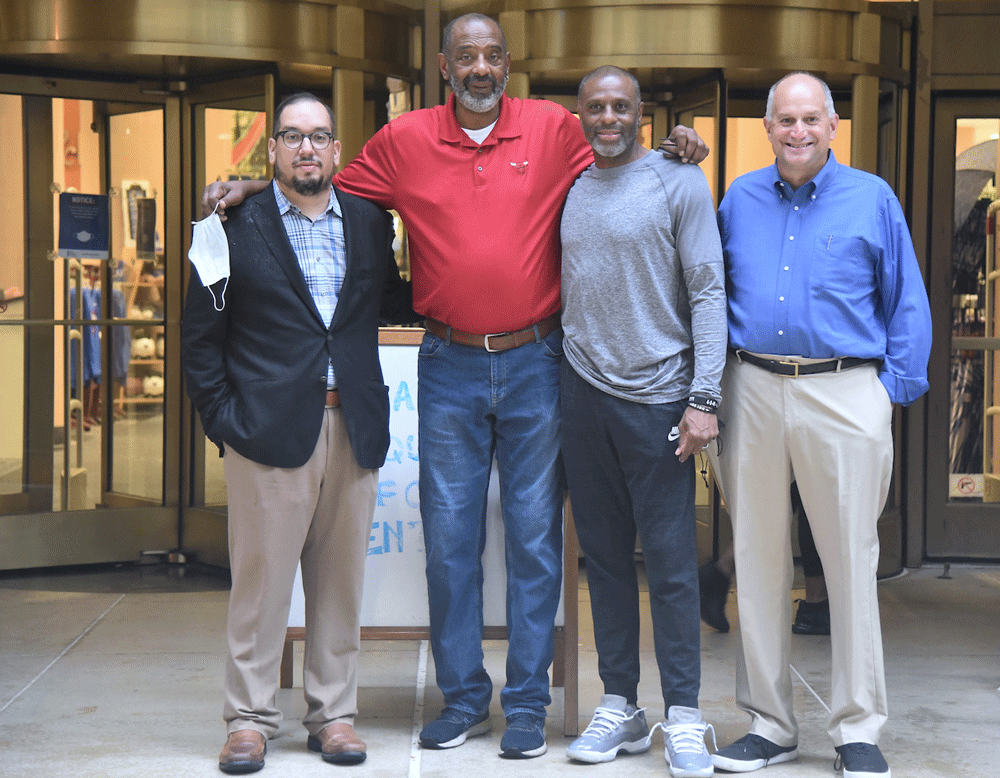
Two former Chicago Bulls players and a DePaul alumnus spoke with students in Introduction to Sports Management, an undergraduate course taught by Senior Instructor and Director of the Sports Management Program Andy Clark. Former Chicago Bulls players Randy Brown (’95-’00) and Mickey Johnson (’74-’79, in red shirt), and Tony Rokita, director of alumni relations for the Bulls, shared their stories on how they got involved with the Chicago team.
Clark invited two former Chicago Bulls players and a DePaul alumnus to speak in his class “Introduction to Sports Management” during the fall quarter. From left to right: Tony Rokita, director of alumni relations for the Bulls; Mickey Johnson (’74-’79); Randy Brown (’95-’00); and Clark.

There are many other areas of growth within the industry that makes studying sports business a lucrative decision, from the expansion of sports betting—popular in Europe and now growing in North America—to other trends such as community relations and social responsibility in sports, and business analytics and its application to the field.

“Teams, sports organizations and companies don’t necessarily want to hire sports fans. They don’t need more fans,” explains Clark. “They need students who understand a specific business discipline to help them in that space, and when you think about it that way, when you hone in on those skills and experiences, there are so many career opportunities to take advantage of.”

One alumnus who leveraged his degree to find success in the industry is Alex Teodosi, a 2016 graduate of the program (when it was a sports management concentration) who now works as the vice president of sponsorship for the 2021 WNBA Champion Chicago Sky. His degree provided the necessary launching point, he says, for working in professional sports. “Sports has always been a passion of mine, and for me, being a part of the on-field product is the next best thing to being on the field,” says Teodosi, who originally began at DePaul as a philosophy major and credits his eye-opening experience to Clark’s “Behind the Scenes with Chicago Sports Organizations” as the inspiration for his switching career goals.

“I was exposed to all facets of the business school when I was studying at DePaul, and that has been so useful in my career since my main responsibility at the Sky is to generate and retain our revenue streams,” Teodosi continues. “Another thing I really appreciated was how much emphasis Andy [Clark] placed on getting active professionals in the sports field in front of students. That paid off tremendously both for the connections that were made and for the experiences that were shared. Without these types of opportunities, I know my career path might have gone a different route.”

Originally published on the Driehaus College of Business & Kellstadt Graduate School of Business website.

DePaul Students Test Cubs Customer Service

DePaul business students spent five weeks working as “secret shoppers” with the Chicago Cubs to improve the organization’s customer service.


By Robin Florzak

How customer friendly are the “Friendly Confines” of Wrigley Field? Ten DePaul University students got a chance to explore this question during a class project they completed with the Chicago Cubs baseball organization.

The students spent five weeks as “secret shoppers” calling and emailing Cubs representatives to test the quality of customer service offered by the sports organization last fall. The project was part of a School of Hospitality Leadership course called “Event Sales, Service and Promotions” taught by Andy Clark, director of DePaul’s Sports Management Program and a lecturer at the hospitality school.  Clark will lead another group of students in a similar project with the Cubs this summer.

Clark often incorporates behind-the-scenes projects and meetings with executives at Chicago professional sports teams and other businesses into his courses at DePaul’s Driehaus College of Business. In addition to working with the Cubs, students in his fall class completed another five-week project with United Entertainment Group by developing and presenting experiential event marketing ideas for their Doritos client.

For the Cubs project, Clark explains, students had three goals—“to test service quality by making standard fan requests by phone, email and social media; see how responsive the team’s service representatives were in the context of the organization’s expansion from baseball to a lifestyle brand; and provide insights into what millennial generation customers seek from the Cubs brand.”

Kenzie Mocogni

Posing as fans, the students called or wrote to the Cubs with a variety of questions, such as where to find parking near Wrigley Field and what food the venue offers for people with dietary restrictions. They also assessed service at several non-baseball events, including a yoga class and a farmer’s market, hosted by the Cubs at Gallagher Way, a grassy plaza that the baseball organization opened next to Wrigley Field last year. Finally, the students took the initiative to design and conduct their own general survey of millennials about their customer service preferences.

The students incorporated their data and analyses into a report that they presented to 25 members of the Cubs’ Service Excellence Program team in marketing, ticketing and other public-facing areas, as well as several team mid-level executives. The students were asked at the beginning of the project to keep their proprietary research confidential.

Project partner Bradley Nagel, Cubs assistant director of the Service Excellence Program and ticketing, says the students provided the team with valuable perspectives about the execution of service delivery during the five-week test period, which included several Cubs playoff games, as well as insights into “new segments of customers outside of the scope of baseball attendees.”

Hospitality leadership major Kenzie Mocogni describes working with the Cubs as “incredible.”

“Their team spent so much time, via both conference calls and in-person meetings, explaining to us how important it is to them that they provide excellent customer service to their fans,” Mocogni says. “Knowing that the work we were doing was going to be useful right away was highly motivating. We were grateful they trusted us with something so pertinent to their front-office operations.

“Working with a real client reminded us that what we are learning in the classroom at DePaul is preparing us for the business world,” she adds. “I think the best way to learn is through hands-on experience.”

Classmate Sarah Musaali sees the experience as useful preparation for her career. A senior, Musaali will earn a business bachelor’s degree in sports management in June. She has accepted a corporate partnerships and marketing position with the Dallas Cowboys. “This helps me to identify what will be important to my future clients, and how I can be successful in achieving service excellence in the future.”

For students who seek to enter sports hospitality and management, “the opportunity to work together and deliver real-time business solutions as a team is an invaluable experience,” Nagel says.

“It was a mutually beneficial partnership and we look forward to expanding the scope of this project and working with a new crop of DePaul students this summer.”​

Originally posted on the Driehaus College of Business & Kellstadt Graduate School of Business website.

Students Explore Global Branding Through Insider’s Look at Chicago Cubs Marketing

Students delivered their final presentation to Daniel Green, assistant director of creative & content in the Cubs marketing department, as part of the course Chicago Cubs Brand Insights.


By Robin Florzak

It was an unconventional summer for the Chicago Cubs and for a popular DePaul University business course that explores global branding and the professional baseball team’s marketing strategies.

The Cubs pandemic-shortened season began July 24 with fans watching from home. The course, Chicago Cubs Brand Insights, began the week before with students studying remotely via Zoom. But neither change in format stopped students from getting an insiders’ look at marketing strategies directly from Cubs marketing and sales managers.

Students in the five-week class met virtually with managers in the team’s marketing, fan insights, human resources and partnerships units to learn how the team’s brand has evolved. They also studied what makes global brands – both sports and non-sports – compelling and distinctive through online meetings with brand executives from Geometry Global and 4Front. Then, students formed mock consulting teams and applied what they learned to analyze various global brands. The students presented their insights via Zoom to the Cubs marketing managers, who provided their professional feedback.

Andy Clark, director of sports business programs at the Driehaus College of Business, who teaches the class, says the course provides practical experience that any business graduate can use, whether they work in sports business or not. “The final project is designed to give students a tangible, ‘real world’ business project that will stand out on a résumé and in an interview setting.”

The Cubs marketing team also gained insights from their interactions with the students, says Daniel Green, assistant director of creative & content in the Cubs marketing department. “As we continually strive to enhance our marketing and branding efforts, it’s important that we find opportunities to validate our direction,” he says. “The students, whom themselves represent an important subset of our target audience, were able to do just that. While developing critical research and presentation skills, they provided us with an invaluable set of findings that will allow us to continue down our path with confidence.”

Senior marketing student Jillian Hampston took the course because she’s interested in pursuing a sports marketing career. “This class not only offered the chance to learn from knowledgeable people in the industry, but we got to see how their insights apply first-hand through our consulting project.” she says. “Working directly with the Cubs was extremely valuable to me because it was a great way to get my foot in the door, as many teams cannot offer a hands-on experience like an internship right now. I was also able to gain an understanding of what a career in professional sports would look like, not just from a marketing perspective, but across all departments.

MBA student Jeremy Abramson | Photo by Kathy Hillegonds

“I think the biggest thing I took away from this project was confidence,” she adds. “My team and I successfully led conversations and pitched our ideas to the Cubs, which is something not every student can say.”

Her classmate, MBA student Jeremy Abramson, says the course provided him with a unique perspective. “Professor Clark does an amazing job of taking his classes and putting you in real business situations,” he says.

“I gained a lot from this experience. I gained knowledge about a first-class sports organization and how they try to stay ahead of the curve. I learned how organizations like the Cubs are trying to get out ahead of just being good on the field and how they try to maintain and grow their fan base for years to come. It was a very rare opportunity to get the chance to work with and present to an organization of the Cubs magnitude, and that will help me build confidence the next time I am in a business pitch or presenting to upper management.”

Hampston and Abramson said they are both big fans of the Cubs, which made the class even more appealing. “For me,” Abramson says, “it was so cool getting the chance to present my brand insights to my childhood favorite team, the Cubs.”

Originally posted on the Driehaus College of Business & Kellstadt Graduate School of Business website.

Sports Marketing 101: What We Can Learn From the Upcoming Olympics and Super Bowl

The Super Bowl is happening right in the middle of the winter Olympic games. While the pandemic has helped change watching habits, sports are still one of the reasons we watch live TV. Andy Clark, the director of the Sports Business Program at DePaul, joins the podcast to discuss these events, what they tell us about the power of sports, and the lessons they hold for business students.

ANDY CLARK: When you are a partner with the Olympics, you don’t get tickets, you don’t get advertising, right? You don’t get swag. You get access to the intellectual property, those five rings, and you get to use those, which very few people do.

LINDA BLAKLEY: Welcome to DePaul Download. I’m your host Linda Blakely.

The second pandemic-era Olympics is approaching. The Tokyo Games garnered a global audience estimated at 3 billion people. And in February, athletes are set to compete in ice skating, skiing, hockey, and more winter sports in Beijing, even as the Coronavirus and political tensions loom large over the games.

Meanwhile, in the U.S., sports fans are gearing up for the Super Bowl, which last year was watched by more than 96 million football fans.

We’re joined by Andy Clark, the director of the Sports Business Program at DePaul, to discuss these events, what they tell us about the power of sports and the lessons they hold for business students. Welcome, Andy.

ANDY CLARK: Hello, Linda. Great to be here on this cold January day.

LINDA BLAKLEY: Questions have persisted about whether the Winter Games this year should go on amid the pandemic. But many Olympics have faced challenges and controversies leading up to the opening ceremonies. What are some of the challenges in hosting the games?

ANDY CLARK: Well, Linda, challenges in hosting the games are many. This was accentuated by I bring a group of students to London each year and we meet with the CFO from the London 2012 games. And he does a terrific talk on what the impact is on the Olympics and the games. And he talks about how actually you’re basically building a city for two weeks, and building a city and is always fraught with issues, right. So there’s political issues, there’s social issues. There’s environmental issues, which are growing all the time, and certainly in terms of Beijing.

Beijing is actually the first city to host both the Summer and Winter Olympic Games. So that’s kind of unique. But when they went to Beijing in 2008, you know, the pollution, air quality was a huge component to it. Obviously, now, no one’s really talked about that but with the pandemic, and issues involving environmental are a really big deal.

But ultimately, going back to London, 150,000 contractors, 9,000 paid employees, 100,000 volunteers, 10,000 athletes, putting those people all together in one spot for two weeks, and then moving on is always a challenge. So yeah, there’s always something in a different city or different market. What’s cool about the Olympics, and many things are, usually, once the opening ceremonies hit, it pretty much happens that the focus turns to the competition in the games. Most cities figured out and make it work. And people celebrate and connect.

That happened certainly this summer in Tokyo, where there was stuff right up into the games about the pandemic. The game hit, it was things about the competition, right. And that’s what makes it cool. And the stats you mentioned early on people watching it. That’s why people continue to watch and enjoy it on a global scale in such a big way.

LINDA BLAKLEY: So one of the topics you teach is sports marketing. What opportunity does sponsoring the Olympics present for marketers? What makes this opportunity unique in the sports world?

ANDY CLARK: I teach a sports sponsorship marketing class right now, both undergraduate and graduate level in the winter quarter. And it’s great that it happens right now and right in the middle of sort of the Olympic Games. And I have a number of speakers and things that talk about the power of the Olympics. And it’s unique, right, because of the global scale. And those five Olympic rings are recognizable across any country, across any language. And they really stand out and you know what it means, you get an emotional connection when you see those rings.

From a sponsor perspective or a marketing partner perspective, it’s also a challenge, right? There’s only so many companies that have a platform that can use those rings on a global scale. Right. And actually, just in class last week we had a speaker Gordon Kane, who was the first director of marketing for the US Olympic Committee, was one of the leaders of the Chicago 2016 ill-fated Olympic bid, which is a topic for a whole other podcast. But he talks about a company we talk about a lot in class, Procter and Gamble. Procter and Gamble has been a top Olympic sponsor, I believe since 2010. And really what they use this as a platform, not to you know not to sell more paper towels and toothpaste and diapers and soap and everything in the home that they have. They use it to communicate their values and what they stand for as a company and to align themselves with their probably lead purchaser, which is moms. And they’ve developed a highly successful campaign called “P&G, Proud Sponsor of Moms.” Could P&G do that without being an Olympic sponsor? Sure. But what point what is that it’s a tagline, right? Proud sponsor moms.

What the Olympic platform does is enable them to have a wherewithal and the credibility to say, we’re here for you, right. And what they’ve done in their marketing and their advertising is link Olympic images, Olympic athletes, to moms, because every Olympic athlete has a mom, so they play have fun with that. But sports viewership, the Olympics are by far the most female audience, right? And their campaign this past year obviously focused on issues with a pandemic, and how athletes and things overcome that. So when you are a partner with the Olympics, you don’t get tickets, you don’t get advertising, right, you don’t get swag. You get access to the intellectual property, those five rings. And you get to use those, which very few people do. Right. So that’s what makes a difference for a company like Procter and Gamble.

LINDA BLAKLEY: I want to switch now to the Superbowl, another huge advertising event, which this year is happening right in the middle of the Olympic Games. The pandemic has helped change TV watching habits, but sports are still one of the reasons we watch live TV. What has that meant for the advertising potential of Superbowl Sunday?

ANDY CLARK: Superbowl Sunday, Linda is not just the biggest sporting event, you know, certainly United States, but it’s the biggest marketing event, right? It’s the biggest advertising event. People come together and like none other than watch the Superbowl and you’re exactly right. Sports Business Journal publication, we use it all our classes, just published the top 100 most-watched telecast the U.S. in 2021. Of the top 100 telecasts of any sort, 95 of those were sports, okay, 95 out of 100. So in a world where viewing habits have changed to where you’re not watching, you know, friends at 8 o’clock on Thursday night, right. You’re watching what you want to watch when you want to watch it. Great for us, bad for advertisers. So live sports, where you need to sit down and consume that live stand out. In the biggest context of that is the Super Bowl. People whether it be the pandemic or not, people continue to view and consume live sports. The Super Bowl stands out in a way because the advertisers in the marketing or become almost as important as the game itself.

I remember being at a Super Bowl party a few years ago, and we’re watching the game and cheering and there’s a wide range of folks there. And then you know, when the commercials come on, everybody goes, “Shh! Shh!” So you know, then when the game goes on, people are talking, eating and drinking. And so that’s really captures that. So this Super Bowl 30-second spots, which I would think went for $5.5 to $5.8 million for 30 seconds last year, are selling for as much as $6.5 million this year. Eyeballs are focused for a three-hour period, unlike anything else happening now. And that’s continued to grow. So that’s why the Superbowl continues to be the event, not just in the sports world but in our social world as well.

LINDA BLAKLEY: I know that the ads themselves are such an important part of viewing and they even have next day rankings for favorite ads. But tell me a little bit more about what students learn about Super Bowl ads in your classes.

ANDY CLARK: Yeah, the way students learn about Superbowl ads. And again, it’s a common theme, I guess, talking about what I’ve focused on in our chat here. They’re learning about how it’s not really a sports thing, right? If it’s a sports thing would have a much narrower audience? It’s reaching a core audience. And how do you use the power of eyeballs for 30 seconds to watch that? So for the past six or seven years, we’ve spent the Wednesday after the Super Bowl with FCB Chicago, one the leading ad market agencies in the world, kind of taking a real in-depth look into Superbowl advertising from one, the strategic direction. How does the strategy start?

Last year, we started with the brief that Bud Light gave the agency to develop something. And the brief really wasn’t that detailed; it was a couple paragraphs. How does that process work? We were able to hear from Bud Light’s (vice president) of communications, showing us the spots, showing some of the earlier alliterations of them, showing what they did with them in and around the game itself. Because one of the power of that investment of that, $6.5 million for 30 seconds isn’t just that, right? It’s the power you get before the game, the power during the game, you’re talking about the activation meter. So it’s not just about that.

From a student perspective, we have the students do is each take a spot of their choosing, and basically do a case history on that. What are the goals behind it? What is the objectives from a company perspective? What are they doing in the game? What is the rationale behind that? What are they doing on social media? What are they doing on premise? What are they doing all kinds of things to do that.

And then the cool part about this class that we do Super Bowl week is that the head of strategy, head of creative from the agency, and if we’re lucky enough, the client like Bud Light enjoy hearing what the students say because they’re a very key audience. Right? So what do they say? What do they like, what they don’t like, why they think things work. And it’s kind of cool in some ways, that some of the stuff they think worked, the other folks, they don’t say, hey, you don’t understand that from marketing perspective. They say, that’s an interesting take, right? We hadn’t thought about that. And you’re the core audience. So it’s a great way to blend kind of what the students see. And see beyond just watching a spot, right? It’s not a big commitment on their part to watch a spot. You don’t watch the game, watch 30 seconds, right? You can find the commercials, and then get expert kind of feedback, which where they really want to hear because it helps them do their job better. So it’s very symbiotic relationship. And it’s really, it’s one of my most enjoyable classes of the year that we do.

LINDA BLAKLEY: Sounds like a win-win to me. DePaul launched the Sports Business major, which you direct, just in the last couple of years. Chicago is consistently ranked as one of America’s top sports cities. Is that what makes Chicago a great city for students to study sports business?

ANDY CLARK: How much time do we have? No, so, in short, Chicago is the best city to study sports business, and DePaul is uniquely positioned to leverage that. And that’s not just for me. I had a leading person from an agency years ago, who was no longer in Chicago, who opened his talk, saying exactly what you just said, Chicago is the best city in the country to study sports, right. And in a short way to do that kind of a microcosm of how that fits together is a class we do in our December term. It’s called behind the scenes with Chicago sports organizations. And what we do is over the course of a week, we visit Chicago sports organizations, not just having them come into the classroom. We go out and see where they work, where they play, how they function in a business setting.

So to give you a quick example from this past year. We visited or met with — some came to DePaul — 22 different organizations. So Chicago sports teams, the Bulls, the Blackhawks, the Cubs, the White Sox, the Chicago Sky, who just won the WNBA championship. And their director of sponsorship, vice president of sponsorship actually, had been a student in this very class four years ago, and has done very well there. The Chicago fires, new officers are just up the block. And it’s not just about the sports teams, right? It’s about companies, right? We walk down the street to, I think it’s 500 or 550 West Monroe, Gatorade. What stands for sports marketing more than Gatorade? Wilson Sporting Goods (is) 200 East Randolph. McDonald’s Corporation in the West Loop. Different agencies, a lot of different Chicago sports agencies, Intersport, Revolution, Forefront, KemperLesnick (are) all within a walking distance. I tell people about this class and they say, “What do you do? Do you get a bus or whatever?” No, we walk or we take the El just like everywhere we go. The farthest north we go is Wrigley Field, the farther south is Guaranteed Rate Field and the furthest west we go is the United Center. And that is really played itself out.

As we talked about establishing and growing our program, we started this class eight years ago, in 2015. Many of the places we go — as I mentioned, Alex, who worked for The Sky — have our grads there, which says a lot about our program. I think this year we met with about 60 people overall, and 15 were DePaul grads. Chicago is just a great place from every perspective — teams, agencies and companies — to learn about the business of sports, not about being a fan, but learning how to leverage your business skills and business background in a sports business environment.

LINDA BLAKLEY: Andy, I’ll be keeping in mind, the ability of sports businesses to shape our culture and strengthen my attachment to Chicago, my favorite brands. The next time I catch a Bulls or Cubs game, and what I’ve learned from our conversations, as I watch the Olympics and Super Bowl. Thank you so much for joining us today.

ANDY CLARK: Thank you, Linda. I really enjoyed talking and I’m looking forward to a big February as you are.

LINDA BLAKLEY: I’m your host, Linda Blakely. Thank you for listening to the DePaul Download presented by DePaul’s Division of University Marketing and Communication.

Originally published on DePaul Download.