
by jlansber | May 10, 2021 | Scholarly Pursuits
Associate Professor Grace Lemmon | Photo by Kathy Hillegonds
In diversity, inclusion and equity conversations, we need to include the idea that weight is a diverse attribute.”
– Associate Professor Grace Lemmon
While business organizations have made progress in reducing race, gender and religious discrimination in the workplace, bias against larger-bodied workers is a growing problem, according to Associate Professor Grace Lemmon (BUS ’06). With her DePaul research team, Associate Professor Jaclyn Jensen and Assistant Professor Goran Kuljanin (CHS ’05), she studies employees who suffer from weight-based bullying at work, as well as those who mistreat them.
“In the past decade we’ve seen great increases in stigmatization toward those with larger bodies,” says Lemmon, a management and entrepreneurship faculty member. “People in larger bodies are not offered jobs at the same rate, even though they have the same qualifications as someone in a ‘normal-sized body.’ Larger-bodied people are not offered promotions as frequently and are downgraded on performance reviews.” The cost is both economic and psychological, she adds. “Mistreated workers lose professional confidence. They stop using their voice and leaning into challenges at work.”
Lemmon and her research team surveyed 2,000 self-identified larger-bodied employees, and 89% reported mistreatment at work because of their size. “They experienced a range of aggressions—people swearing at or insulting them because of their size, withholding critical resources or expressing an insult wrapped in a comment, like saying, ‘Have you ever thought of having a salad for lunch,’ Lemmon says. Holding a leadership position offered no protection from mistreatment; the intensity of bullying increased as a person gained leadership status.
The research team also studied the motivations of perpetrators of weight-based mistreatment. Lemmon thought it would be difficult to get respondents to self-identify as perpetrators. The contrary results astounded her: “Ninety-two percent said they had a negative thought about a co-worker’s body and acted on it within the last six months.” Perpetrators, she adds, predominately justified their behavior in two ways: “‘it’s going to sting, but this person needs to hear it,’ and ‘I have a right to express my opinion.’”
After accounting for decrements to performance, engagement and mental health associated with weight-based mistreatment, Lemmon concludes that organizations cannot ignore this issue. First, organizations must acknowledge weight-based mistreatment is happening even if it isn’t a typical complaint, Lemmon says.
She notes that only a tiny fraction of mistreated larger-bodied people formally report the infraction, overwhelmingly due to shame. She further advises, “In diversity, inclusion and equity conversations, we need to include the idea that weight is a diverse attribute and deserves as much protection as other attributes. Finally, we need to call it out. When we see this type of predation at work, we need to stop normalizing it and, instead, speak up.”
By Robin Florzak
by jlansber | May 10, 2021 | Professional Development
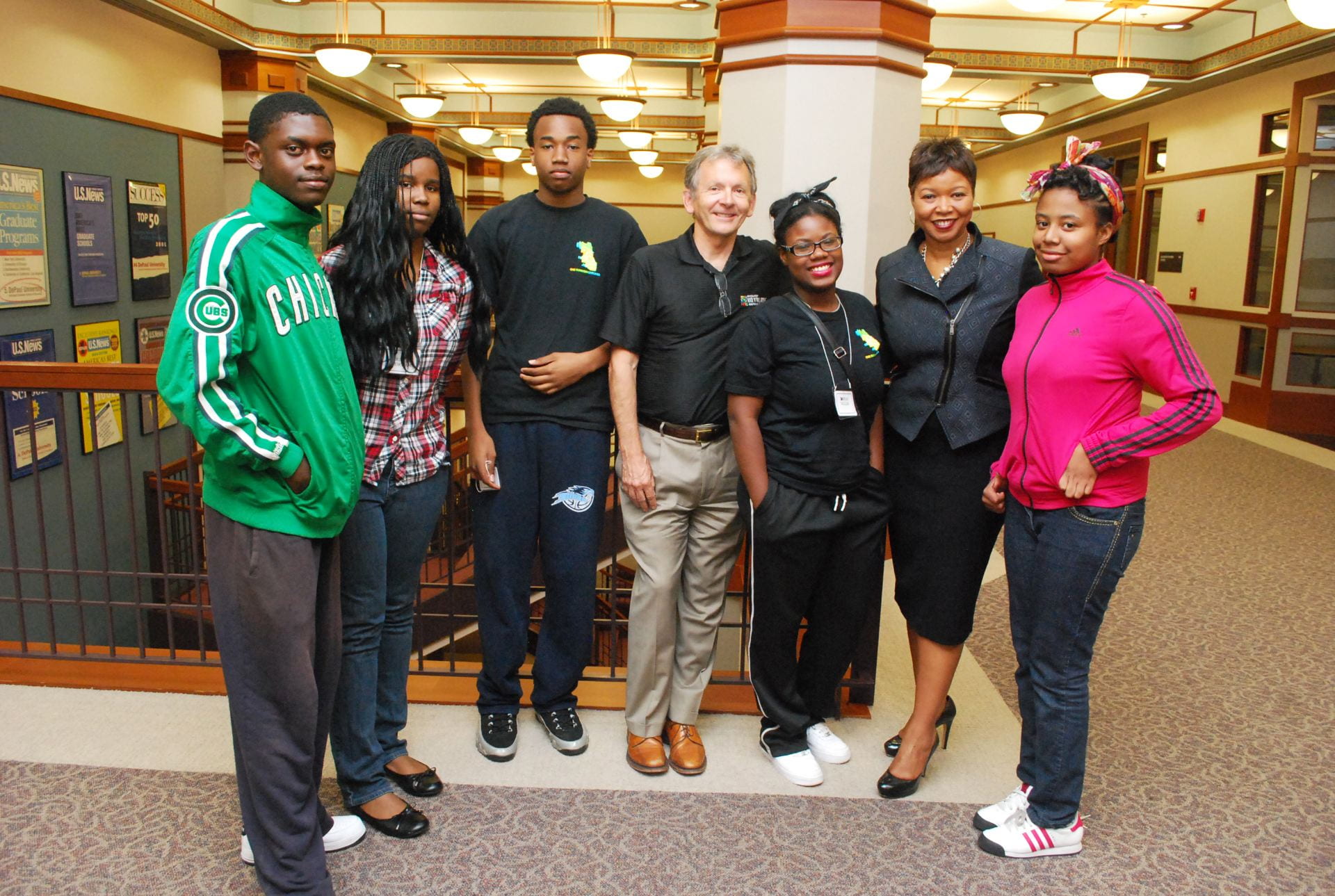
The ability to bring diverse perspectives to the workplace is a superpower, alumna Corliss Garner (second from right) advised Chicago high school students at a DePaul-hosted leadership program. | Photo by Kathy Hillegonds
With our role as a strong corporate citizen, we want to be able to support our partners in doing their best work to the extent that we can.”
– Corliss Garner (BUS ’06)
Seven years ago, Corliss Garner (BUS ’96) returned to DePaul to address a group of high school students from underresourced communities as part of the university’s partnership with the Chicago Housing Authority. A Chicago native, Garner grew up in a West Side neighborhood, and wasn’t exposed to a diverse group of people until she entered high school. When she enrolled in DePaul to study finance, her exposure to diversity expanded.
As she spoke to the students, she encouraged them to think of their backgrounds as superpowers in their careers. She told them, “Your background and life experiences have taught you resilience and problem-solving skills. These are critical areas that will help you stand out and excel in any career path you choose.”
Now, Garner is in a new role that supports the advancement of employees with diverse backgrounds. After more than 20 years at BMO Harris Bank, Garner recently began working as the senior vice president and head of corporate social responsibility and diversity, equity and inclusion (DEI) at First Midwest Bank, the first position of its kind at the company. For the past year, Garner has channeled her professional, personal and civic experiences into building and executing a DEI strategy. She also oversees the bank’s philanthropic and community initiatives.
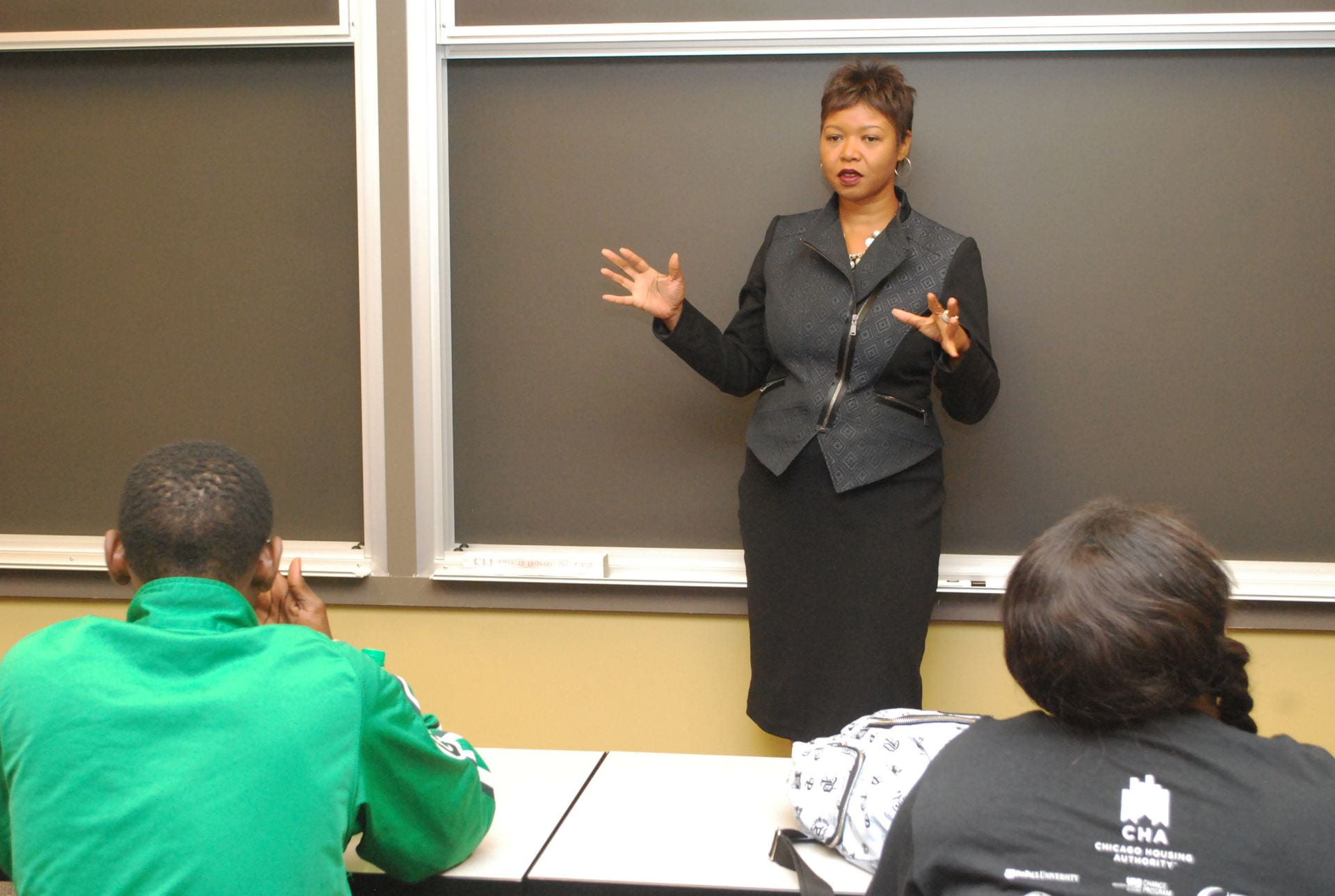
Garner’s community work inspired her passion for promoting diversity, equity and inclusion. | Photo by Kathy Hillegonds
“My work is designed to strategically connect our role as a corporate citizen to support our employees, our clients and the communities we serve,” she says. “As First Midwest continues to grow and expand its footprint, the opportunity to strategically align this important work to our business objectives is a high priority for our company.”
First Midwest Bank recently made a $500,000 gift to DePaul’s John L. Keeley Jr. Center for Financial Services. Over the next five years, this gift will be used to diversify the Keeley Center’s student cohorts through outreach, targeted programming, scholarship support and internship placements at the bank.
“With our role as a strong corporate citizen, we want to be able to support our partners in doing their best work to the extent that we can,” Garner says. “Leading this partnership with the Keeley Center is a full-circle moment for me. It is an honor to work for a company that understands the value of providing more access to opportunity for diverse students.”

Leadership commitment and employee engagement are essential for DEI efforts to succeed, Garner says.
An active member of Chicago’s civic community, Garner has served on the advisory board of DePaul’s Coleman Entrepreneurship Center and is now a life director of the African American Legacy, an initiative that aims to improve the quality of life of African Americans in Chicago. Garner’s involvement in the community helped crystallize her passion for DEI work.
Not long after Garner started her new position at First Midwest Bank, social justice and racial issues began rattling communities throughout the United States. In the summer of 2020, thousands of people protested the death of George Floyd, who died at the hands of a Minneapolis police officer.
“The events of the summer certainly added a layer to my work. In many cases, those moments created the momentum needed to accelerate powerful and courageous conversations on race in America,” Garner says. “Even amidst all of the uncertainty and despair we experienced in 2020, I remain encouraged and hopeful, and look forward to progress.”
Below, Garner offers tips for building an effective DEI strategy:
- Start from the top. Commitment from the CEO and executive leadership team is key. Leaders set the tone, influence the organizational culture and provide the resources necessary to advance the strategy. Sometimes DEI efforts can get overshadowed by other business imperatives. It is important to recognize the DEI strategy as a priority and provide adequate funding.
- Empower champions. Choose individuals who can carry the DEI message throughout the organization. While senior leader messaging is critical, employee engagement is just as important. Employees embody the culture of an organization and can help provide valuable feedback and champion DEI more broadly.
- Overcommunicate. Everyone at the company has a role in driving the DEI agenda. Clearly communicate the goals and objectives of your program and tell people how they can get involved. It is crucial that employees have a stake in the success of the strategy and understand that everyone has a role to play.
- Keep up the momentum. Make sure you have a plan in place to advance your strategy and remember to communicate progress and wins. It’s the small steps and the work behind the scenes that keep the momentum going. Communicate broadly with your organization to help leaders and employees understand there is real work happening behind your public statements.
Want to explore more about this topic? Click here to view videos of virtual events hosted by the college featuring alumni and Chicago business leaders discussing diversity and the business community.
By Jaclyn Lansbery

by jlansber | May 10, 2021 | Online Extras
DePaul business alumnus Marshall Hamilton
DePaul business alumnus Marshall Hamilton may have graduated eight years ago, but he’s still making an impact in the classroom.
“Marshall has been a kind of silent hero in bringing Sprout to students,” says Chris Hjorth, a marketing instructor at the Driehaus College of Business. “This is a unique opportunity students are getting, to be able to walk away from a class with hands-on experience in a tool like Sprout that is used in companies all over the country.
Hamilton (BA ’12) is director of sales strategy at Sprout Social, a Chicago-based software media company that helps brands reach and engage their audiences, manage their social media accounts, and capture and measure digital marketing data.
It’s been a couple of years since Hjorth and Hamilton first teamed up to develop ways to integrate Sprout’s software into Hjorth’s popular social media marketing course for undergraduate and graduate business students, a course that often sees long waitlists when she teaches it every quarter.
Hamilton didn’t know Hjorth back when he was a student at DePaul, but he did know Jacqueline Kuehl, director of the business college’s Digital Marketing Program. It was she who had initially reached out to him inquiring about opportunities to utilize Sprout as an educational tool in the classroom. Kuehl soon introduced Hamilton and Hjorth so they could work together, and the partnership continues to this day.
“DePaul more than a lot of other universities does this well. It recognizes that classroom experience needs to be combined with real-world experience,” Hamilton says. “I feel passionate about helping DePaul bridge that gap and felt this was the perfect two-fold opportunity. I could give back to a community I care about while also help us at Sprout learn more about how we can operate in the educational space, as it’s an area we’re interested in exploring.”
Mining Social Media Data

Senior Instructor of Marketing Christine Hjorth
With Hamilton’s help, Sprout became a part of Hjorth’s marketing course in two important ways. First through its publishing tool, which students use to create, manage and publish social media posts, and second through its listening studies, which, Hjorth says, are critical to effective social media marketing.
Listening studies involve scraping conversations between consumers on social media, primarily off of Twitter since the conversations need to be public. Then Sprout organizes those conversations into metrics from which companies can pull insights for their brand. “It’s like the world’s biggest focus group because you’re listening to conversations that allow you to pick up trends that can give you ideas about content and strategy,” Hjorth says.
Using Sprout, students in Hjorth’s course have been able to conduct listening studies as part of class assignments. “I can tell them: do a listening study on something general like coffee, or I can be more specific and ask them to do a study on how Dunkin Donuts’ new marketing campaign is doing. Either way, students get this great first-hand experience in listening studies and also in data analytics,” Hjorth says. “There’s so much data out there, and its huge for students to have access to it and learn how to develop insights that are actionable.”
Students see the value in it, too. “I definitely enjoyed the Sprout Social listening work,” says Lauren Morten, a Kellstadt Graduate School of Business student who took Hjorth’s class in fall 2020. “It was so valuable to practice my social listening skills in real-time and on a real-life dashboard that I will likely use in my future career.”
The second element of Sprout’s platform that students are using is its publishing tool. Learning how to create content calendars and craft social media marketing content, students have been able to take it a step further and learn how to publish their posts using Sprout’s platform.
“It’s practical hands-on experience, but it’s also more than that,” says Hjorth, “Knowing that this type of software exists in the first place and understanding its power and potential is just as valuable.”
Hamilton agrees: “Social media used to be an afterthought within businesses, but now its role is more complex because it’s tied directly to revenue. Helping students understand that is important because your experience with social media as a regular user is different from your experience with social media within a professional business context.”
“I could have talked about listening studies or explained how publishing works on a social media management platform,” continues Hjorth. “But I could have never shown students how it works, or had them practice it themselves, without Hamilton’s help. I’m grateful DePaul has such a large and active alumni network we can tap into to open these doors for students.”

