by jlansber | Oct 11, 2019 | Professional Development
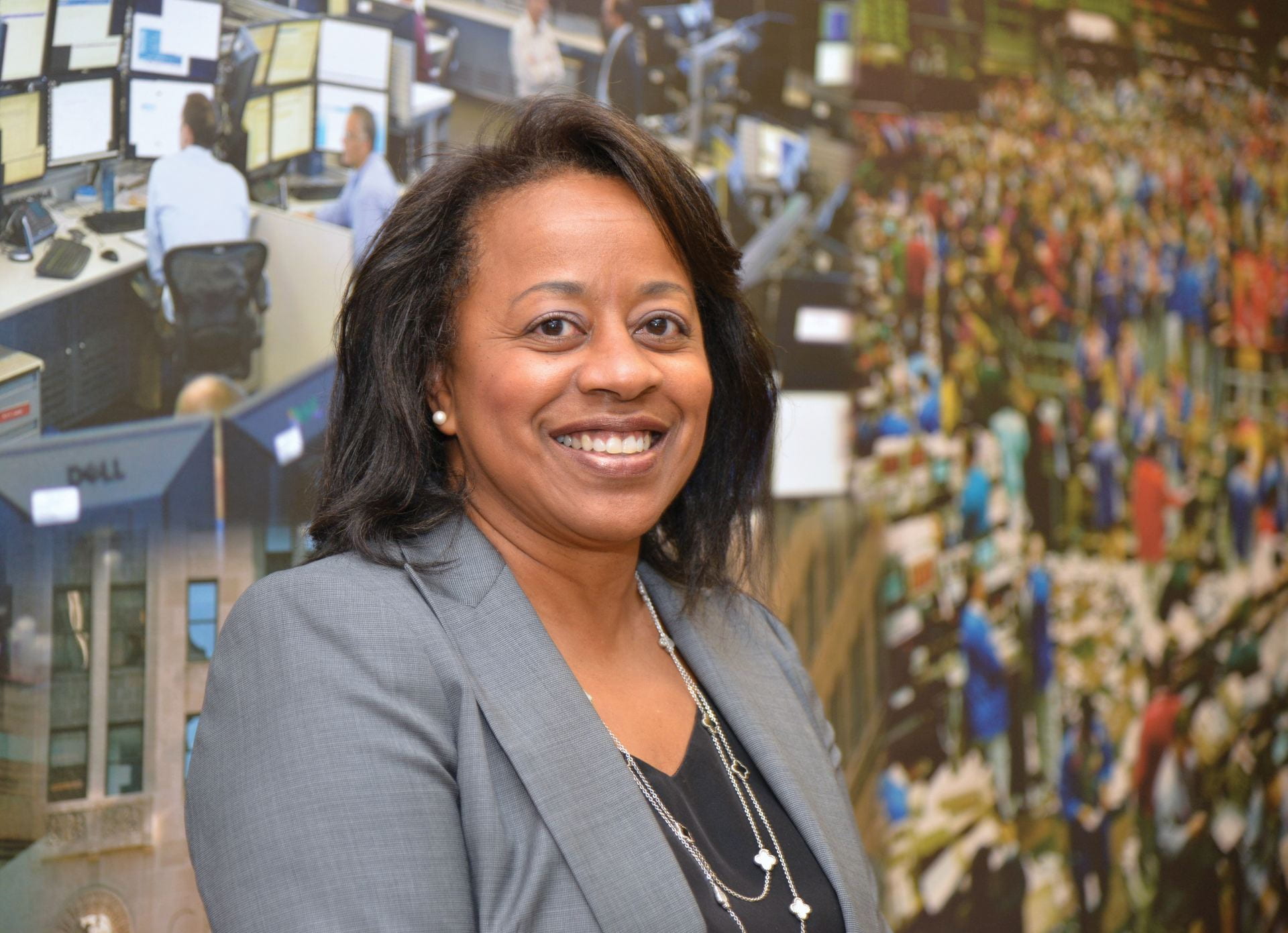
Stephanie Smith DBA ’19
“Sponsorship and mentorship are often used interchangeably, but they are two different things,” says Stephanie Smith (DBA ’19), vice president and chief human resources officer at DePaul. Making the distinction between the two is a big part of Smith’s recently completed dissertation, which examines racial and gender differences in the executive sponsorship of black women.
Smith is a recent graduate of the Doctorate in Business Administration program at DePaul’s Kellstadt Graduate School of Business. She managed human resources organizations for big corporations, including Kraft Foods, before joining DePaul’s executive leadership in 2012.
“Sponsorship as a vehicle for career advancement resonates with me because it made a big difference in my own professional journey, especially as a first-generation corporate professional,” she says. “Over the course of my career, I’ve been fortunate to have people take an interest in my growth, [people] who have helped identify and provide opportunities for me to move forward.”
People tend to seek out mentorship when they want a professional relationship that provides career guidance and development. A mentor is a valuable resource but, according to Smith, can only take you so far, particularly if your goal is to sit at the executive table or get to the role of CEO.
According to research, 95 percent of all white males who are in CEO positions said that there was someone who helped them get there. “Those are sponsors, not mentors, who are lifting them up,” says Smith.
Mentors provide coaching and counseling around a certain issue or career choice. They offer psychosocial support, helping you navigate through organizations or difficult situations, but they can fly under the radar. No one may know you have a mentor. Sponsors, on the other hand, provide strictly career-oriented support that helps open doors to top positions. “They are the people who sit in the rooms where key decisions are made, especially decisions around succession planning,” Smith explains. “They possess the influence, leadership and reputation that allow them to advocate for others. That’s the key difference between mentors and sponsors.”
Conducting a study on sponsors and their proteges, Smith set out to investigate why black women are not represented in the CEO landscape of Fortune 500 companies. “With so much emphasis that companies place on diversity and inclusion initiatives, I find it problematic that the 5% of women CEOs today are all white,” she says. “That’s a weak number for women in general, but it’s bleak for black women in particular. I wanted to find out how and why sponsorship is playing out differently for them.”
They are the people who sit in the rooms where key decisions are made, especially decisions around succession planning…They possess the influence, leadership and reputation that allow them to advocate for others. That’s the key difference between mentors and sponsors.”
– Stephanie Smith
One theory Smith explores in her research is the similarity-attraction paradigm, which posits that people tend to be drawn to people who are similar to themselves. “I found that a number of black women out there do have sponsors to help get them to the top positions, in addition to the education, experience and intellect. But the missing piece had to do with similarity-attraction. White males are still primarily in charge, so part of the issue is that there aren’t enough people of other backgrounds or races with whom to confer on who gets into those executive board rooms.”
Based on these findings, Smith has some advice to share with sponsors: “I think you have a duty to develop a diverse talent pipeline and break the similarity-attraction paradigm. It’s important to see beyond just white males as the prototypical CEO or senior executive. Other people can succeed in those roles, too.”
Smith has these three tips to share for anyone interested in being sponsored:
- Do excellent work
It may sound simplistic, but the best way to gain a corporate sponsor is to perform with excellence. Sponsors tend to take someone under their wing because they see a person’s potential, so how you get noticed is through your work. Particularly once they become senior, sponsors want to leave a legacy by developing a talent pipeline for their organization, so they are on the lookout for people who shine.
- Assume work that increases your visibility
Of course, you can’t get noticed unless your work is visible, so it’s important to take on responsibilities and projects that will put you in front of the key players in an organization, even if it means going outside of your job’s main duties. You can volunteer to lead a task force or take on a challenging assignment. The quickest way to get noticed, however, is to have a job that is responsible for decisions that contribute to whether an organization/brand fails or succeeds, such as jobs that are responsible for profit and loss. You can ascend to high positions in just about any field, but if the CEO role is your goal, you definitely need experience in profit and loss.
- Seek access to senior leadership
The best kind of sponsor-protege relationships happen organically. It’s something that can’t be forced. But to start, you need to be comfortable with introducing yourself to senior leaders when the opportunities present themselves. Whether at networking events or company meetings, don’t be afraid to approach them. Start a conversation and put yourself on their radar. This ability to advocate for yourself, to use political skill to influence people, is key to navigating and leveraging powerful relationships within an organization.
By Nadia Alfadel Coloma | Photo by Kathy Hillegonds

by jlansber | Oct 11, 2019 | Alumni Profiles
Nestor Eliadis MBA ’10
Nestor Eliadis, senior director of real estate at Walgreens
I chose DePaul because it best combined a world-class education, alumni network and location that provides a gateway to the marketplace.
Residence: Orland Park, Ill.
Occupation: As senior director of real estate for Walgreens, I lead the real estate program in the Southern United States, which includes asset development and portfolio management, as well as direction of the surplus idle property program across the country through disposition and subleasing activity. Since joining the organization in 2011, I have held various roles and responsibilities within the real estate and finance divisions. I serve as the real estate conduit between business, operations, finance, accounting, treasury, law and tax divisions.
Education: I was raised in the southwest suburbs of Chicago and graduated from Brother Rice High School in 1995 with aspirations of becoming an architect. I attended the University of Wisconsin-Milwaukee as a collegiate athlete in men’s soccer for two years prior to transferring to the University of Illinois at Chicago to focus on my architecture degree, which I earned in 2000. After an eight-year professional career in architecture, construction and real estate, I sought to enhance my business and financial acumen through additional education. I chose DePaul because it best combined a world-class education, alumni network and location that provides a gateway to the marketplace. I received an MBA with distinction in real estate finance and investment in 2010.
Vital stats: My formal real estate career began in 2003 when I earned a real estate brokerage license in order to become a more informed home buyer for my personal Chicago residence. I transitioned to corporate real estate in 2006 and joined Walgreens in 2011. Since joining, I’ve had the opportunity to drive real estate decisions for more than 10,000 retail and office properties, execute $2 billion of sale-leasebacks and manage annual budgets of $4 billion in operating expenses and $1 billion of capital expenditures.
What I like best about my job: My job offers me an amazing national real estate platform to identify opportunities, create solutions and implement strategies to deliver results at scale. Additionally, I thoroughly enjoy collaborating with people to develop systems that empower them to execute efficiently.
The biggest challenge I face in my job: Retailers strive to deliver relevant solutions for changing consumers. Flexibility and agility are paramount to our success. The greatest challenge exists in the continual effort to preserve operational flexibility while delivering the maximum real estate value for the lowest costs, which is a conflict in most negotiations.
How and why I stay connected to DePaul’s business college: I owe a lot in my career to the education I received at DePaul. It was a fantastic educational experience for me. I keep in touch with many of the professors who influenced my career and journey since my graduation. I guest-lecture in real estate classes by presenting a case study that connects financial and business theory with real practice. I also participate in two or three real estate department events annually. For me it’s a way of giving back, influencing and challenging students in different ways, and impacting the next generation of DePaul graduates.
By Robin Florzak | Photo by Kathy Hillegonds
by jlansber | Oct 11, 2019 | Giving Back
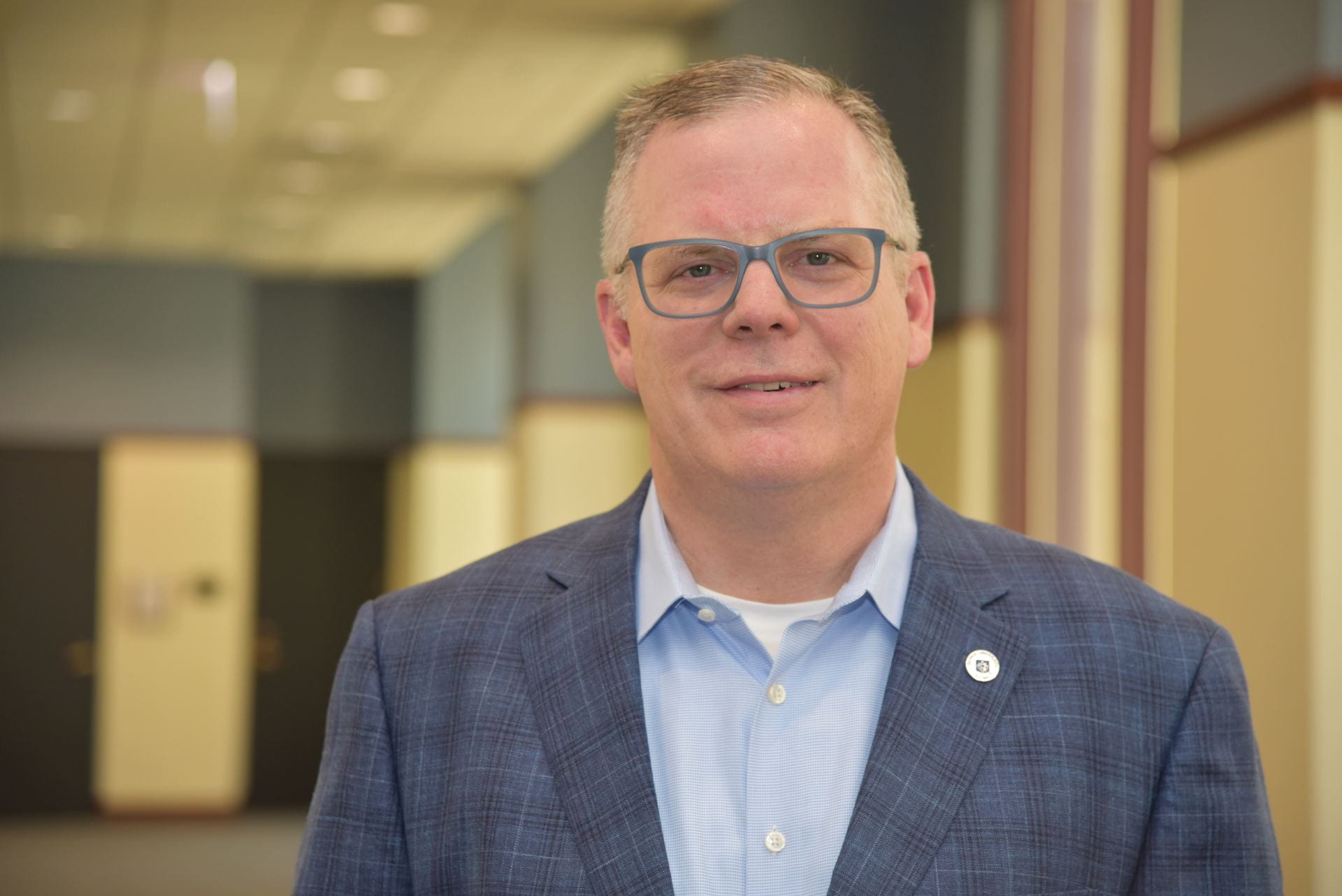
John Mann MST ’83, MBA ’01
My professors had tremendous business and tax experience from accounting firms, corporations and the IRS. They brought their experiences into the classroom, giving us a practical and impactful education.”
When John Mann (MST ’83, MBA ’01) was in high school, he accompanied his mother on an appointment to have her tax return prepared. The meeting would plant the seed for his successful career in the tax field. “For some reason, the experience left an impression on me,” Mann says. “I was intrigued by the questions the tax advisor asked and the calculations that were made. It made me think about finance in a new way.”
Most recently, Mann was vice president of global tax planning at Abbott Laboratories. He holds an MS in taxation and an MBA in finance from DePaul, which he says helped launch his career and connections in the field. “My professors had tremendous business and tax experience from accounting firms, corporations and the IRS,” Mann says. “They brought their experiences into the classroom, giving us a practical and impactful education.”
After completing his MS, Mann went on to lead the tax function at notable corporations, including Dean Foods, ServiceMaster and Walgreens. “A key mentor to me at the start of my career was Bill Zink (BUS ’70, MST ’77),” Mann recalls. “I later learned that Bill had started a scholarship fund at DePaul, so I began to contribute to it. It felt good to support a mentor who I admired and appreciated, while at the same time give back to a cause that I cared about.”
Giving back has always been an important part of Mann’s life, something his mother instilled in him. When he was a teenager, he volunteered with his church youth group to help families in need. “We would do simple things like plant flowers or put together a wagon full of toys for households that may have otherwise had a frugal Christmas.”
As an adult, Mann has continued to give back. He serves on the advisory board and volunteers for the nonprofit organization Ladder Up, which provides free tax and financial assistance to low-income families in Chicago. He leads a prison Bible study group, stays involved with the American Diabetes Association Tour de Cure and donates to DePaul regularly.
“Giving back was modeled to me growing up, but it wasn’t until my 30s that I began to recognize the impact it can make and why it’s so important,” he says.
In 2017, Mann generously established, with his wife, the John and Sharon Mann Scholarship fund in the MST program, to which they recently renewed their commitment with a second significant gift.
“I’m impressed by the MST program, especially under [Faculty Director] Ron Marcuson’s leadership. The expanded online offerings and partnerships with MST programs across the country strengthen the program, which strengthens our tax community. I’ve seen firsthand many graduates go on to achieve major things,” he says. “I wanted to do something that would help students who might not otherwise be able to afford it obtain the same valuable education and mentorship that I did, so they, too, can have fulfilling careers.”
By Nadia Alfadel Coloma | Photo by Kathy Hillegonds

by jlansber | Oct 11, 2019 | Online Extras
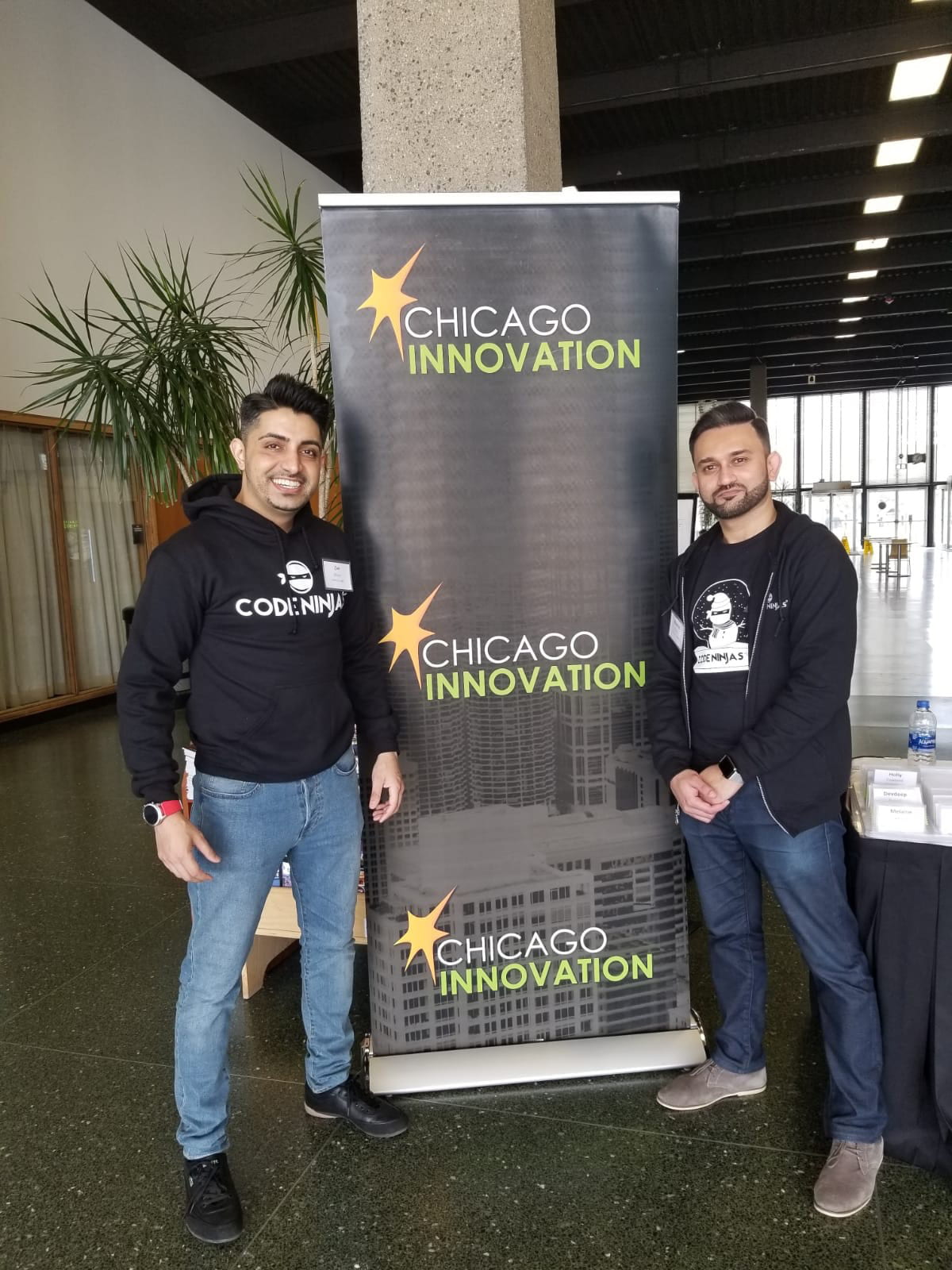
From right to left: Nawroz Pirani (BUS ’07) and Zeeshan Bhimji (BUS ’09)
Nawroz Pirani (BUS ’07) and Zeeshan Bhimji (BUS ’09) may not be coders, but they’re using their business smarts to teach kids how to code at their Code Ninjas learning center, which they opened last May in Long Grove, Ill. The center teaches children ages seven to 14 how to build video games using computer programming in a fun, interactive environment.
“We’re arming kids with foundational computer science skills, and the best part is, they have no idea how much they’re learning because for them it’s all fun and games,” shares Pirani.
“And it’s not just about coding,” adds Bhimji, “It teaches kids the value of persistence because when you code something, it rarely works the first time. You have to continually troubleshoot before you’re rewarded with something that works.”
One could say the friends are living the American dream. Both moved to the U.S. as teenagers—Pirani from Pakistan and Bhimji from Kenya—to pursue their education and build careers. Both graduated with bachelor’s degrees in finance from DePaul’s Driehaus College of Business.
“DePaul taught me the importance of constantly learning and constantly looking for the void in the market,” shares Bhimji, who started his first business, a residential property management company, after graduating from DePaul at age 24. “I would have not had the confidence to go out there and pursue my business interests were it not for my DePaul education.”
Bhimji has been running profitable franchises for more than 10 years, with Code Ninjas being his newest venture. He grew his property management company from one to two franchises before going on to start a software company, ShowingHero, which was recently nominated for the 2018 Chicago Innovation Award.
“I had to hire developers for my software company, and the experience made me realize how much I didn’t know about coding. I thought, if only I had had more exposure to this growing up,” says Bhimji. “Then when my wife and I had our first child a year ago, I starting looking into educational programs for kids related to coding, and I found Code Ninjas.”
Pirani’s motivations also stemmed from something personal: “I didn’t have good experiences with coding growing up, so I wanted to provide a positive experience for the next generation to learn and excel in this arena. Not everyone is going to be a coder, but no matter what you do in the future, technology is going to be a part of it, so learning these skills early on is critical.”
Prior to opening the center, Pirani spent 10 years building a successful career in the higher education industry. He managed finances and long-term strategy for a $150 million professional education business and worked in IT consulting for top research universities.
“It was through DePaul that I landed my first job after graduation, at Huron Consulting Group,” says Pirani. “DePaul prepared me to go out into the workforce and apply my knowledge with confidence. I learned how to analyze problems and situations from different perspectives, which is an essential skill to have when starting a business.”
The duo has plans to open two more Code Ninja center locations in 2020, one in Arlington Heights and one in Chicago’s Lincoln Park neighborhood, and their business was recently featured on WGN-TV News.
“When it comes to business, you have to keep your eyes open to where the needs are,” says Bhimji. “Where there is a need, there is an opportunity for business. I’m grateful to DePaul for teaching me that.”
By Nadia Alfadel Coloma
by jlansber | Oct 11, 2019 | Online Extras
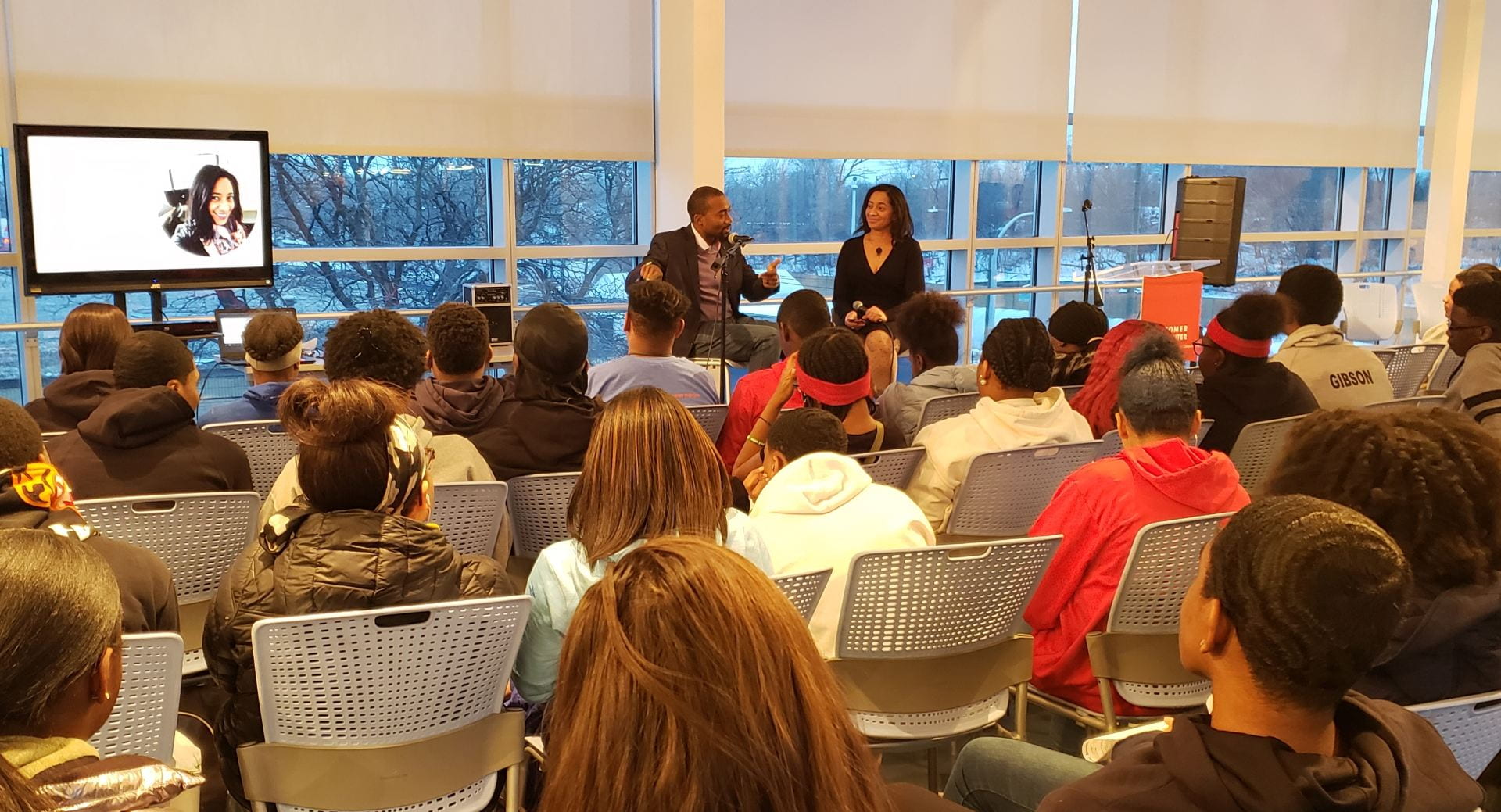
JinJa Birkenbeuel, who serves on the advisory board of the Coleman Entrepreneurship Center, leads a discussion on entrepreneurial thinking with Linal Harris (left), founder and principal coach at Insights 4 Life Coaching, LLC.
DePaul University’s Coleman Entrepreneurship Center (CEC) summarizes its mission in four words: do good, do well. It’s a message teenagers embraced last spring at the Gary Comer Youth Center on the South Side of Chicago, where the CEC taught them how to develop their entrepreneurial skills to do good and do well.
A series of CEC faculty and board members, including DePaul alumni, visited the youth center from February to May to share their experiences as start-up founders and facilitate hands-on learning about entrepreneurship. Part of the youth center’s High School Smarts program, the initiative aligns Comer’s mission to develop the full potential, talent and skills of young people and DePaul’s Vincentian mission to engage and empower people in underserved Chicago communities. Frances Comer, wife of the late Gary Comer, the founder of Lands’ End who launched the youth center, suggested the educational partnership to show teens how entrepreneurship can create opportunity.
Fredricka Holloway, youth employment manager at the Comer Youth Center, says the center pursued the partnership because it’s important for young people to learn about entrepreneurship as a potential path to success. “Entrepreneurship fosters creativity, the ability to address community and societal problems, and access to wealth and opportunities,” she says. “Our children must have a foundation and understanding of this to navigate the advances of today. Having the ability to create one’s own business is key for youth and for developing our future business leaders.”
The CEC speakers discussed economic opportunity and the community, developing an entrepreneurial mindset and the types of businesses that entrepreneurs found, among other topics. The teens also participated in hands-on activities that introduced them to the real world of financing, marketing and sales for start-ups. A field trip to Tastytrade, an online financial media company co-led by CEC board member Kristi Ross, allowed them to see these concepts up close.
Four DePaul alumni were among the volunteers who shared their experiences and knowledge with the teens. Bruce Leech (MBA ’81), executive director of the CEC, was among them.
“When we first heard about the Comer opportunity, we jumped at the chance to expand our community outreach and leverage our entrepreneurship programs at the CEC,” he says. “It was a tremendous experience for our board members and mentors, who were very impressed with the students.
“While our team was there to provide their insights to these students, I know we all received much more in return by appreciating their commitment to this program. I was also very inspired with the purpose-driven business ideas the Comer students developed, like addressing the food desert on the South Side of Chicago by starting a healthy grocery store in the neighborhood.”
The program taught teens valuable skills—brainstorming, decision-making and presenting business ideas—that can be applied to entrepreneurship or any career, Holloway says.
“They enjoyed the opportunity to work on a real-life business and be able to present it as a future opportunity,” she adds. “They also were very enthusiastic and excited about the guest speakers – they appreciated talking with them and the interest speakers took in their ideas.
“Not only do they express that they want to be entrepreneurs,” she adds, “some already are working on businesses of their own.”
The CEC and Comer plan to continue the program at the youth center this academic year.
By Robin Florzak