
by jlansber | Oct 11, 2019 | Notes from the Dean

Dean Misty Johanson | Photo by Kathy Hillegonds
The Driehaus College of Business has always been entrepreneurial, in both what it teaches and how it approaches business education. Our college is recognized among the nation’s best for entrepreneurship study by the Princeton Review, which ranks both our undergraduate and graduate programs in the top 25. We earn these rankings because our faculty teaches students to apply theory to practice, providing practical tools and connections for students to turn classroom lessons into real- world business opportunities.
This fall our entrepreneurship faculty became even stronger with the appointment of Maija Renko as Coleman Foundation Endowed Chair in Entrepreneurship. Maija—who is profiled by Business Exchange—is an award-winning teacher and researcher who specializes in social entrepreneurship, an area of growing interest among our students.
I also have named Professor Lisa Gundry interim chair of the Department of Management & Entrepreneurship, which oversees our entrepreneur curriculum. A member of our faculty for 30 years, Lisa is an expert in business innovation, and she most recently served as faculty director of our Master of Science in Entrepreneurship program. Our programs also are expanding—DePaul will soon offer a new minor in entrepreneurship for non-business majors.
Our academic programs in entrepreneurship are supported by the Coleman Entrepreneurship Center, which recently launched an innovative “start-up” of its own—the Women in Entrepreneurship Institute (WEI). Supported by an impressive committee of Chicago women business owners, WEI is developing the most comprehensive array of academic, research, incubation and public policy programs in the country to support women entrepreneurs. In this issue’s cover story, you’ll learn how WEI’s new accelerator program is helping women business founders, including our students and alumni, overcome barriers to develop new ventures.
Our college is doing more than teaching the entrepreneurial mindset—we also are applying it to our planning for the future. Innovating our academic programs and centers is at the heart of our college’s new 2024 Strategic Plan: Connection, Culture and Commitment. Innovation is necessary for us to create value for students and alumni and to sustain DePaul’s mission in a challenging higher education landscape.
Our strategic plan calls for us to review and redesign our MBA program, expand our career management services, and develop online programs in select areas to ensure our graduate programs are relevant and competitive. We also plan to revise our under- graduate business degree and enhance career preparedness services and experiential learning opportunities for students. Our goal is to empower students with the analytical skills and career savvy they need to succeed in today’s increasingly complex marketplace.
Strengthening the college’s connections to our alumni network and the Chicago business community is imperative for reaching these goals. We want to engage more alumni as guest lecturers and mentors for our students. We also want to expand alumni and business community support for our centers and institutes, which create value for both our students and the business community through programs that produce career-ready graduates, industry- relevant research and business networking opportunities. I encourage you to review our full strategic plan at go.depaul.edu/Driehaus2024Plan.
I look forward to working together with you to begin reaching our plan’s goals. With your support, we can elevate our college’s profile as a top business school of choice for people living and working in the Chicago area.

Misty Johanson
Dean
Driehaus College of Business
by jlansber | Oct 11, 2019 | College News

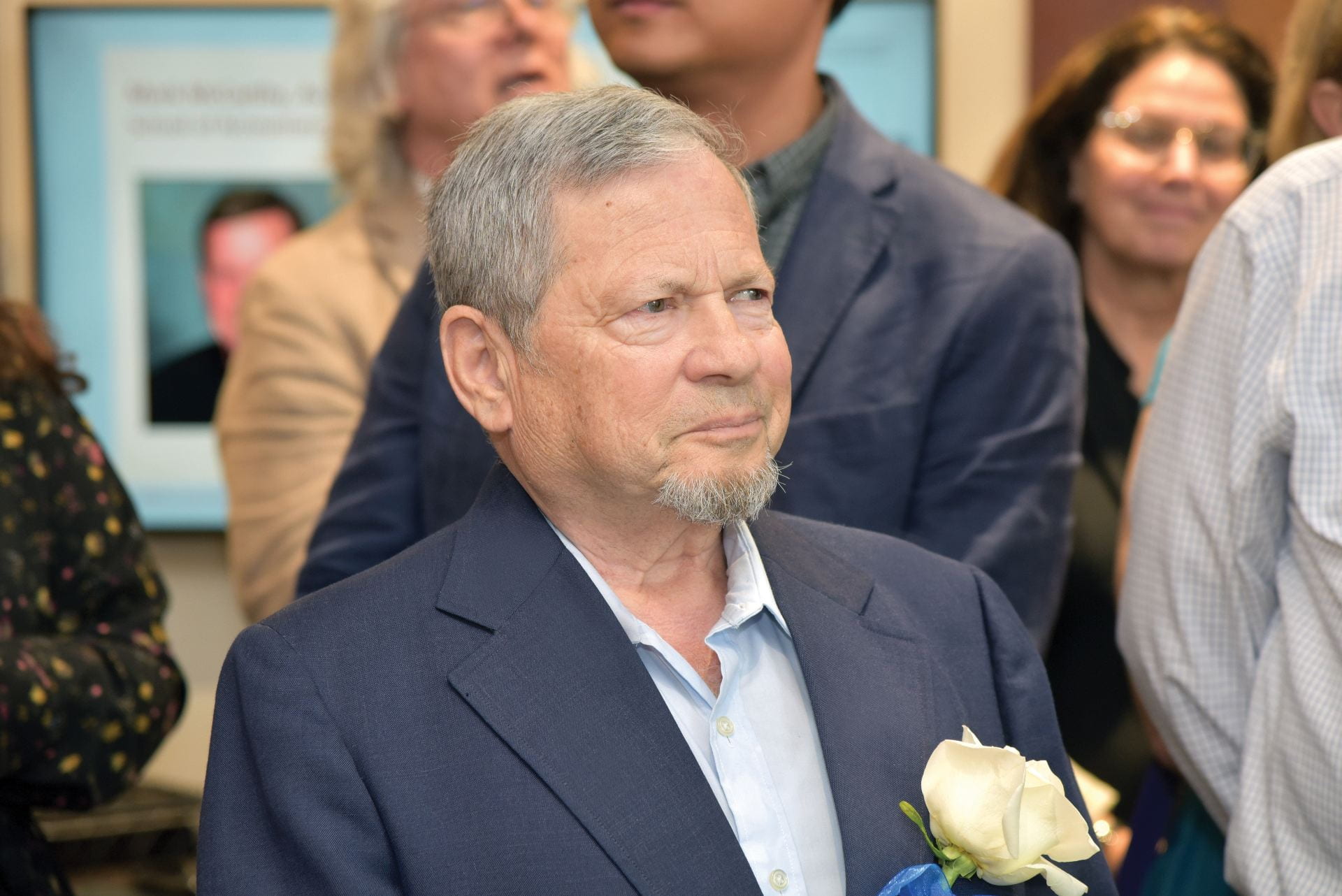
Finance Chair Eli Brewer (right) congratulates retiree Finance Associate Professor Carl Luft.
The Driehaus College of Business held a reception in the spring to honor 14 long-serving professors and two staff members who retired from DePaul June 30, 2019.
Retirees celebrated at the event were Associate Professor John Ahern, Ezerski Chair Mark Frigo, Assistant Professor Mark McCarthy, EY Distinguished Professor Bel Needles and Associate Professor David J. Roberts from the School of Accountancy; Professors Bala Batavia and William Sander from the Department of Economics; Associate Professor Carl Luft and Professor Werner F.M. De Bondt from the Department of Finance; Professors Dan Koys, Kenneth Thompson and Harold Welsch, Associate Professor Margaret Posig and Program Administrator Ilya Meiertal from the Department of Management & Entrepreneurship; Associate Professor Roger Baran from the Department of Marketing; and Admissions Associate Petrina Tignino from the Kellstadt Graduate School of Business.
Dean Misty Johanson thanked the honorees for collectively contributing more than 500 years of service to DePaul. “You have transformed the lives of thousands of students through your teaching, advising and program administration,” she said. “You have advanced business thought and practice through your research and industry outreach. You have been our faithful friends, mentors and champions. You embody the Vincentian values we hold dear.”
Two faculty members who accepted deanships at other institutions also were recognized at the reception. Marketing Professor and Associate Provost Lawrence Hamer has been appointed dean of Purdue University Northwest’s College of Business, and Department of Management & Entrepreneurship Chair Dan Heiser has been named dean of the Schneider School of Business & Economics at St. Norbert College.
-
-
Staff member Ilya Meiertal retired after a 26-year career at DePaul.
-
-
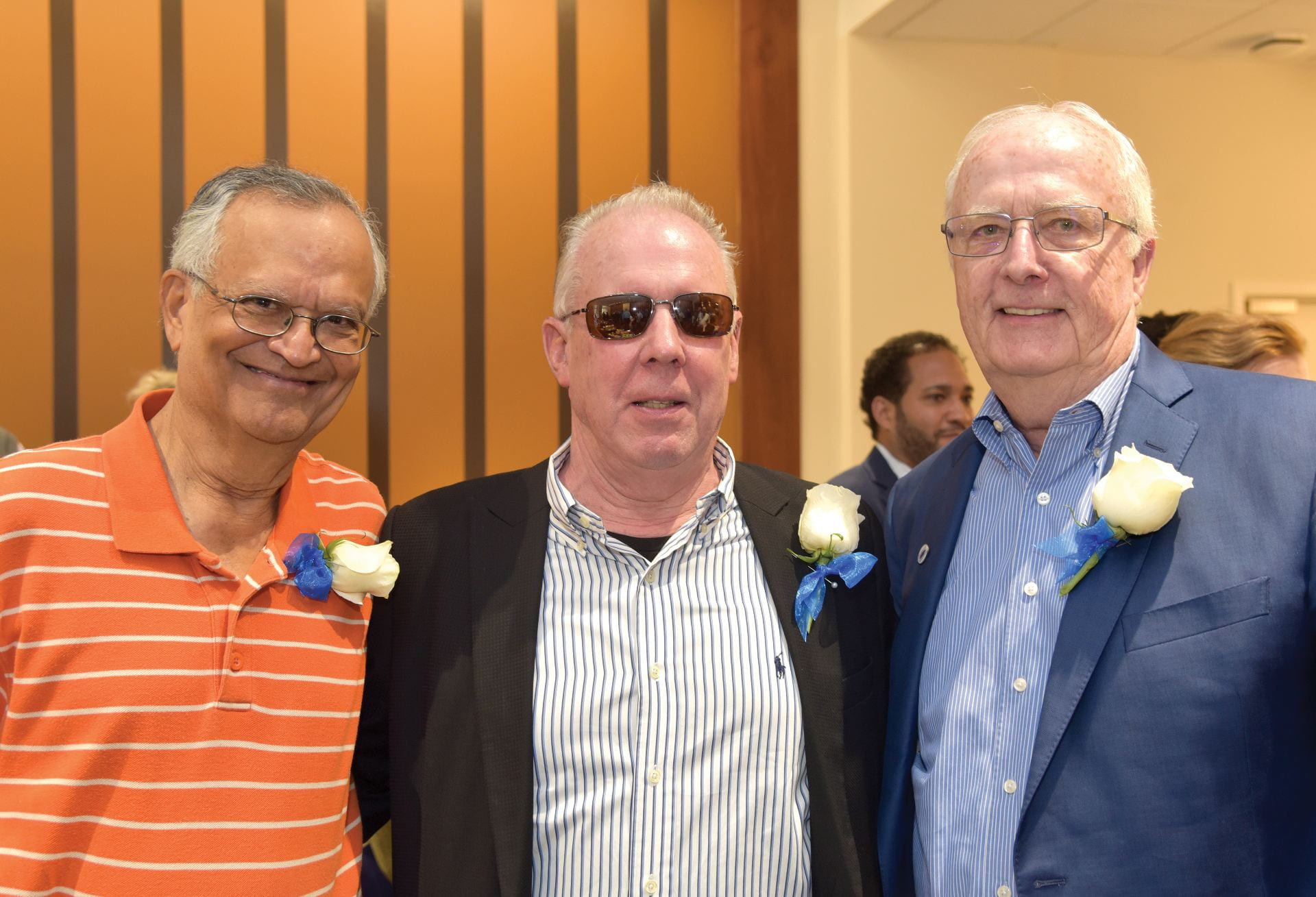
Economics Professor Bala Batavia, Marketing Associate Professor Roger Baran and Accountancy Associate Professor John Ahern were among the longtime faculty members honored.
-
-
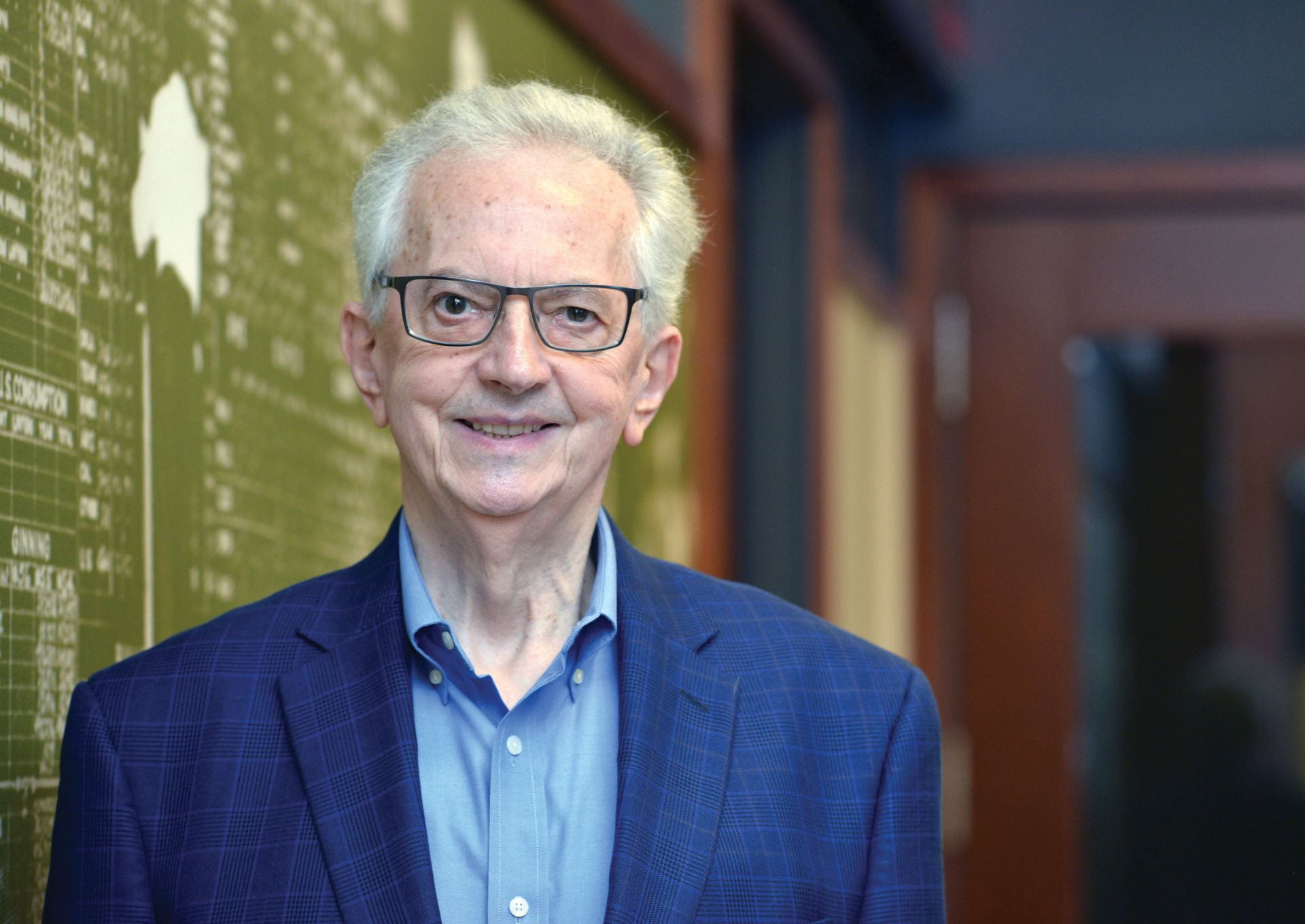
Management Professor Harold Welsch, founder of the college’s entrepreneur program, was among faculty feted at the college celebration.
-
-
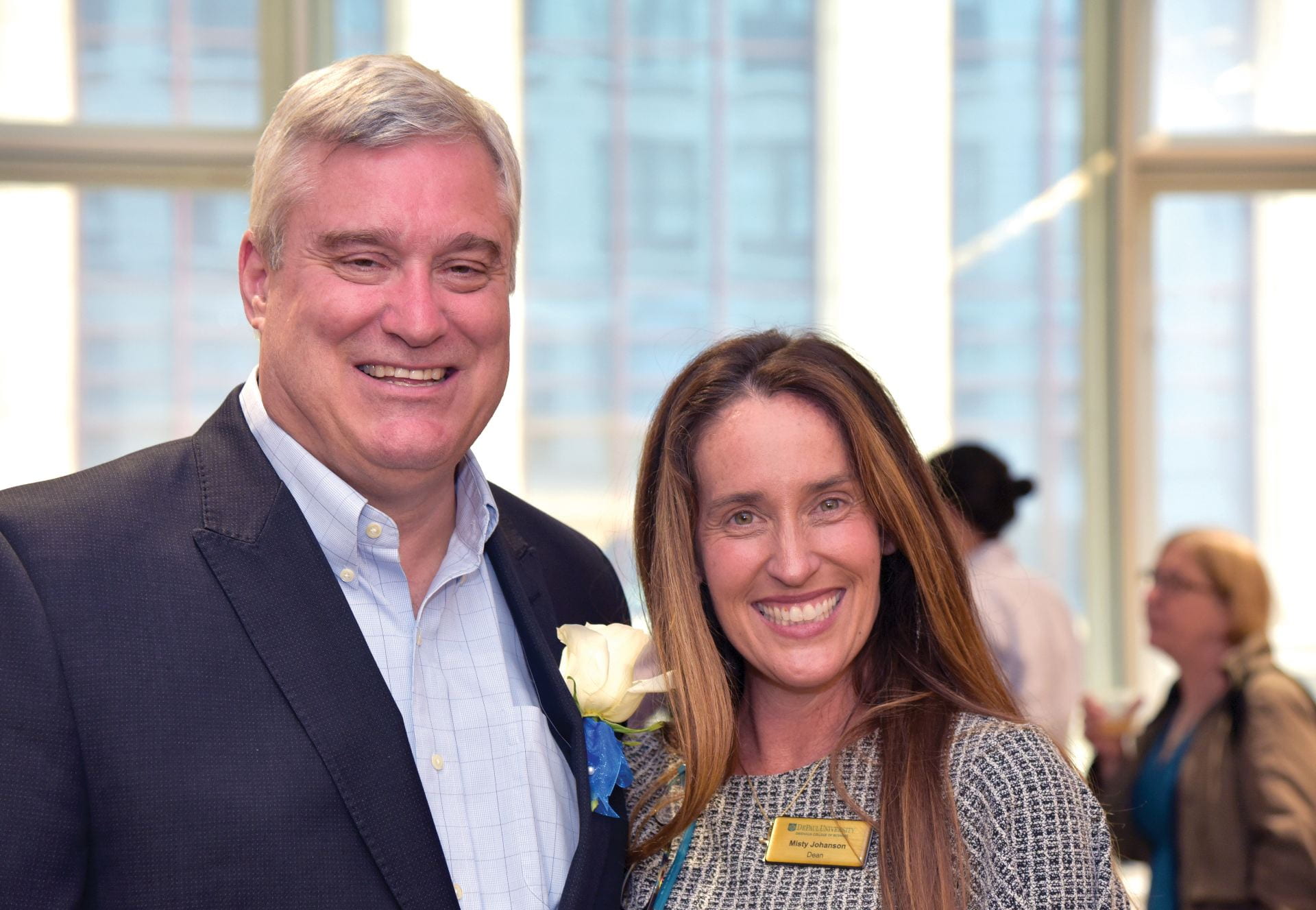
Management Chair Dan Heiser celebrates his appointment as St. Norbert College business dean with DePaul Business Dean Misty Johanson.
By Robin Florzaki | Photos by Kathy Hillegonds
by jlansber | Oct 11, 2019 | College News
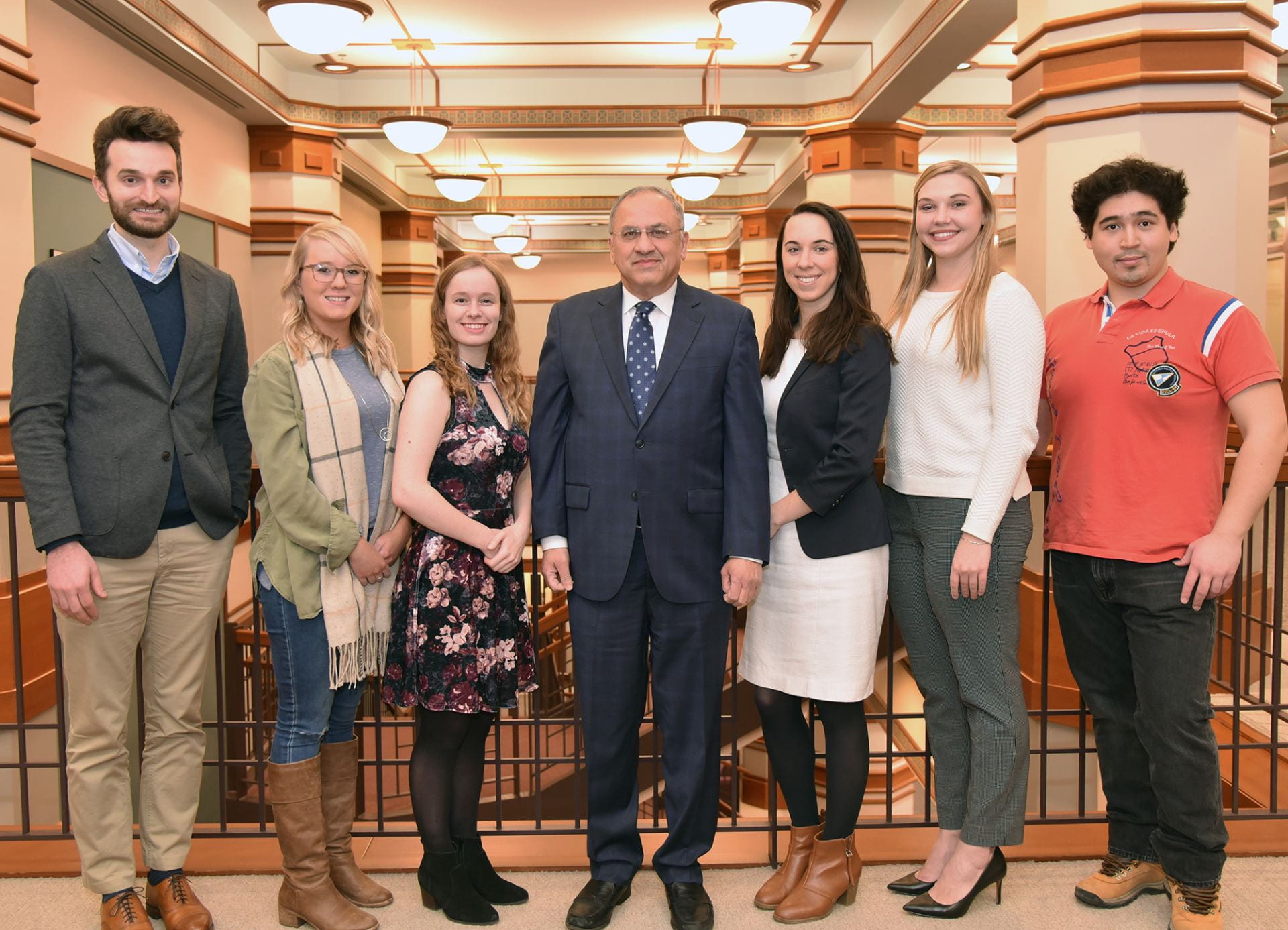
Marketing Clinical Professor Roger Lall (middle) with students and alumni involved in the new Marketing Leaders Community: (left to right) Nick Schmitt, Kennedy Conn, Margaret Wolfe, Jenna Rummelhart, Raleigh Meier and Abay Sarsenov. | Photo by Kathy Hillegonds
Faculty directors of Kellstadt Graduate School of Business Master of Science degree programs are launching social media groups online and hosting industry-related events on campus to create new communities of students and alumni associated with these specialized master’s degrees.
“We are forming these communities because we recognize that our master’s students have an affinity for their programs,” says Christa Hinton (MBA ’98, EdD ’12), assistant dean and director of the graduate business program. “We want to create ways for students, alumni and faculty in these programs to connect with each other, share what’s going on in their industries, and network. For alumni it’s a great way to give back by sharing advice with students, who also represent a pipeline of talent for them.”
One such effort, called the Marketing Leaders Community (MLC), is bringing together students and alumni from the Master of Science in Marketing (MSM) program. “We want to differentiate our MSM program from other universities’ programs by enhancing the student experience both inside and\ outside the classroom,” says Clinical Professor and MSM Program Director Roger Lall. MLC hosts two events focusing on industry trends annually for members.
We wanted to create ways for students, alumni and faculty in these programs to connect with each other, share what’s going on in their industries, and network.”
Raleigh Meier (BUS MS ’19), who served as MLC’s first president, says the group is seeking to broaden alumni connections and promote student engagement. “We hope to get MSM students involved while they are current students [to] make the most of their time at DePaul and then be willing to return [as alumni] in the future to provide advice to incoming students.”
Associate Professor Jaclyn Jensen, faculty director of the Master of Science in Human Resources (MSHR) program, formed a LinkedIn group, DePaul MSHR Program, where 141 MSHR students and alumni share job postings and HR industry-related news. She and the DePaul student chapter of the Society for Human Resource Management also host panel discussions. One recent event focused on innovations in human resources and featured four alumni speakers who are senior HR leaders.
“The MSHR LinkedIn community helps to showcase the career events we hold and alumni who are giving back,” says Jensen, “all while helping link current students with industry professionals.”
To find out more about Kellstadt’s student-alumni MS communities, go to go.depaul.edu/MS-Communities.
By Robin Florzak | Photo by Kathy Hillegonds

by jlansber | Oct 11, 2019 | College News
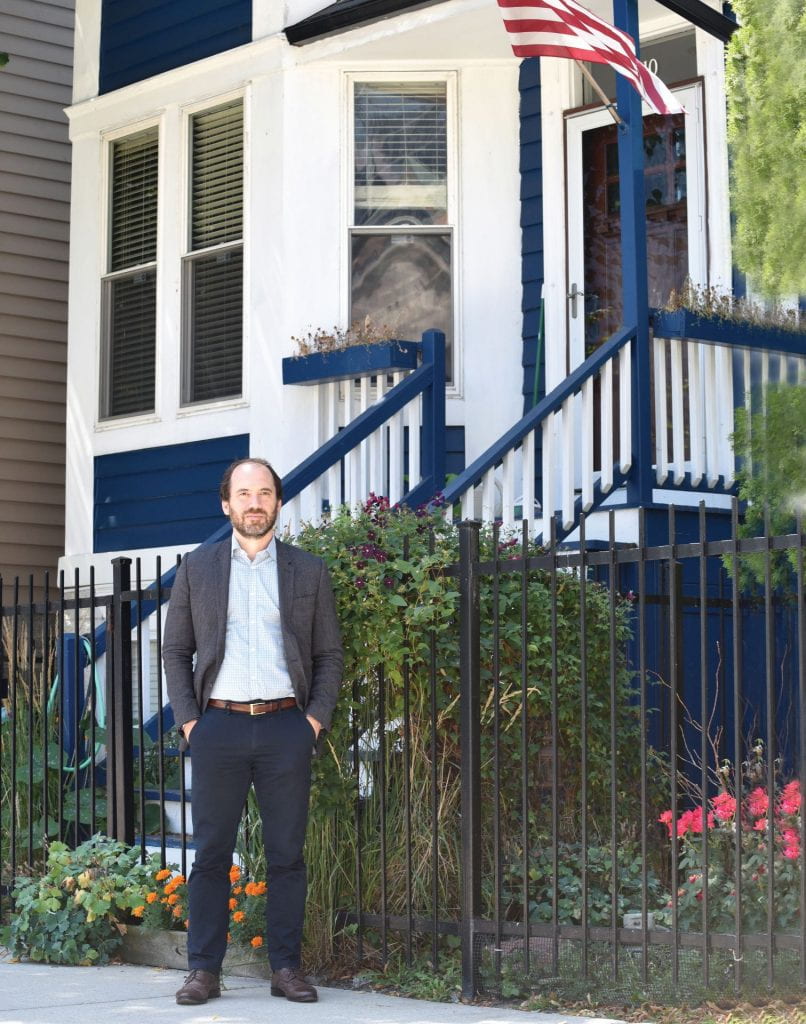
Geoff Smith, executive director of the Institute for Housing Studies at DePaul.
The city needs to align planning for future large projects with affordable housing strategies. Otherwise the market will respond accordingly, and the city will lose affordable housing.”
Last spring, when Chicago Mayor-elect Lori Lightfoot outlined her agenda for her first 100 days in office, her priorities included increasing affordable housing to stem population loss in the city. Lightfoot named a 44-member Housing Transition Committee to help her team shape strategies for achieving this goal. Geoff Smith, executive director of the Institute for Housing Studies (IHS) at DePaul, was among the experts tapped to serve on the committee.
Smith participated in two meetings with the mayor-elect’s transition team and the committee to discuss policy ideas and provided a memo with recommendations for preserving affordable housing in the city. “In general, we suggested that the new administration use data to be proactive about targeting strategies for affordable housing, especially in neighborhoods near large, planned city investment projects,” Smith says.
The institute, a research center in the college’s Department of Real Estate, analyzes complex housing data for trends that affect affordable housing in the Chicago area. Its 2016 study of the city’s 606 linear park project, for example, found that one of the unintended consequences of the city turning a defunct elevated rail line into a park was an increase in property values that reduced the availability of affordable housing in some adjacent Northwest Side neighborhoods.
“These data indicate that the city needs to align planning for future large projects, such as the Obama Presidential Center and new trails [similar to the 606], with affordable housing strategies,” Smith says. “Otherwise the market will respond accordingly, and the city will lose affordable housing.”
In his memo to the transition team, Smith wrote that “a data lens can help stakeholders understand local conditions and potential vulnerability; convene diverse audiences around solutions; help develop, prioritize and implement strategies; and track outcomes.”
Although Smith’s work on the transition team has concluded, he says the IHS has strong relationships with local and national policymakers that inform housing policy decisions on an ongoing basis. The institute produces annual reports on the state of rental housing and a quarterly home price index for Cook County, among other research, and posts this information on its website, housingstudies.org.
By Robin Florzak | Photo by Kathy Hillegonds
by jlansber | Oct 11, 2019 | Faculty Focus
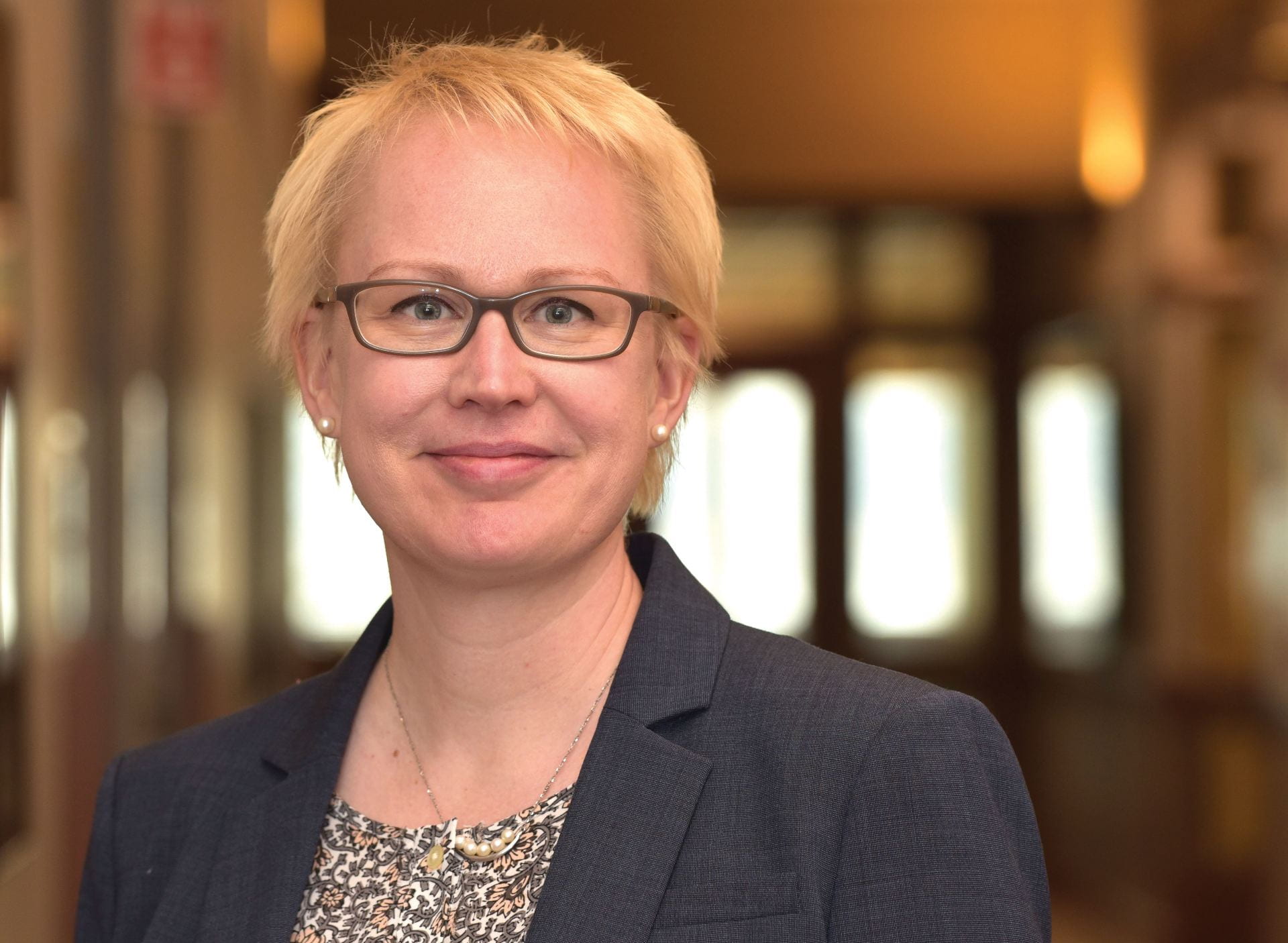
Maija Renko, Coleman Foundation Endowed Chair in Entrepreneurship
Living in Miami in the 2000s, Maija Renko found herself surrounded by small business activity. She was there as an exchange student from Finland, completing her doctorate of science in international business. “At the time I was interested in the internationalization of technology-based companies, but my experience in Miami immersed me in a culture of start-ups,” says Renko, a professor who teaches graduate and undergraduate courses in management and entrepreneurship.
“The economy there is largely driven by small- and medium-sized businesses,” she says. “That exposure, combined with encouragement from a mentor, inspired me to take a closer look at the entrepreneurial side of business.”
Renko joined DePaul in July as the Coleman Foundation Endowed Chair in Entrepreneurship at the Driehaus College of Business. She succeeds longtime chair and founder of DePaul’s entrepreneurship program Harold Welsch, who retired from the university in June.
There are so many issues that entrepreneurs can address not only to make an impact on other people’s lives, but to better their own lives as well.”
An award-winning teacher and scholar on entrepreneurship, Renko joined DePaul from the University of Illinois at Chicago (UIC), where she was voted best MBA professor by students and was instrumental in developing a certificate program to help entrepreneurs and nonprofits build effective social enterprises.
“I love the idea that you can start a business for the purpose of creating social change,” says Renko. “There are so many issues that entrepreneurs can address not only to make an impact on other people’s lives, but to better their own lives as well. I see that more and more in communities throughout Chicago—entrepreneurs building businesses for the primary purpose of making a difference in society.”
One population of entrepreneurs Renko has recently turned her attention to are people with disabilities. “Studies show people with disabilities are significantly more likely to be self-employed than those without, yet there is little research on how and why they pursue business ownership, and the needs and barriers they face along the way,” she explains. Earlier this year, Renko and colleagues from UIC received a $2.4 million grant from the National Institute on Disability, Independent Living, and Rehabilitation Research to study entrepreneurship among disadvantaged and disabled youth in Chicago.
“For those in younger age groups, the transition from school to working life can be a real challenge,” says Renko. “In this new project we want to develop and test best practices for entrepreneurship training that can help in that transition and beyond.”
It was never her plan to leave Finland for good, but after earning her PhD in entrepreneurship from Florida International University, Renko’s career in academia took off and changed her life’s trajectory.
“Living in the U.S. has opened my eyes to many different social issues and barriers to success that do not exist in Finland,” she says. “This has fueled my passion about the role entrepreneurship can play in bringing about social change. I’m excited to bring my research to DePaul and find out what business interests DePaul students have. Entrepreneurship is a powerful force in today’s society, and the U.S. business community—and Chicago in particular—is an exciting and energizing place to be.”
By Nadia Alfadel Coloma | Photo by Kathy Hillegonds

