by jlansber | Apr 25, 2018 | Notes from the Dean
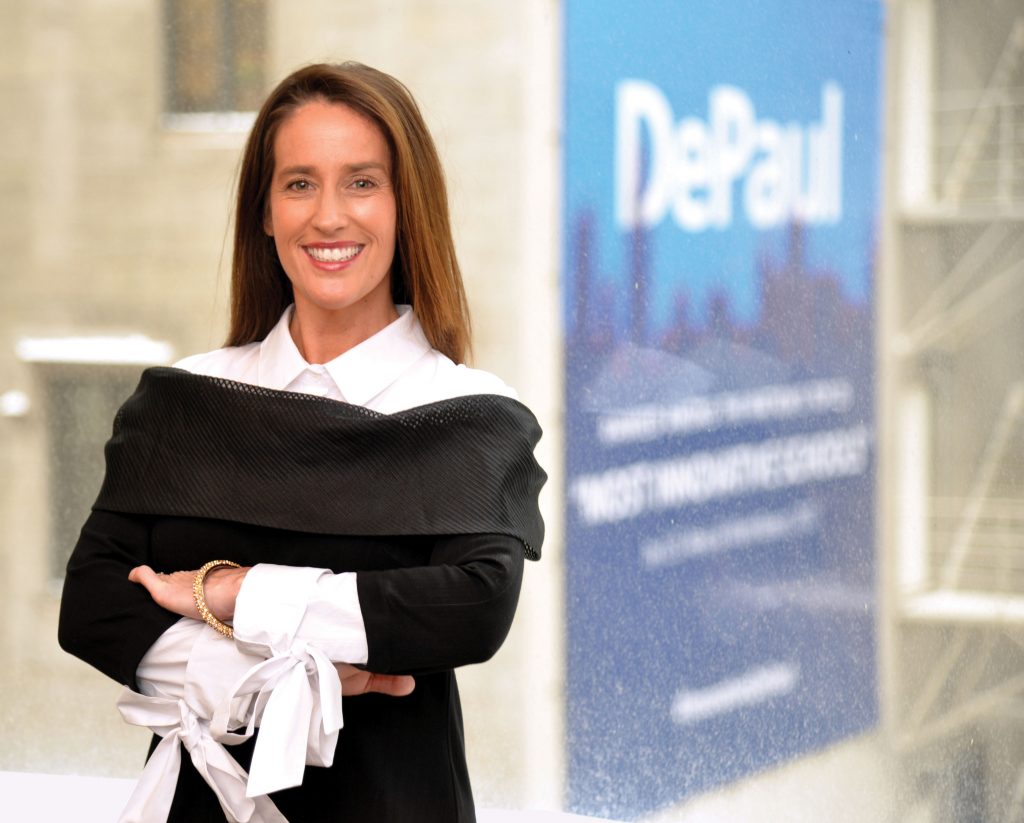
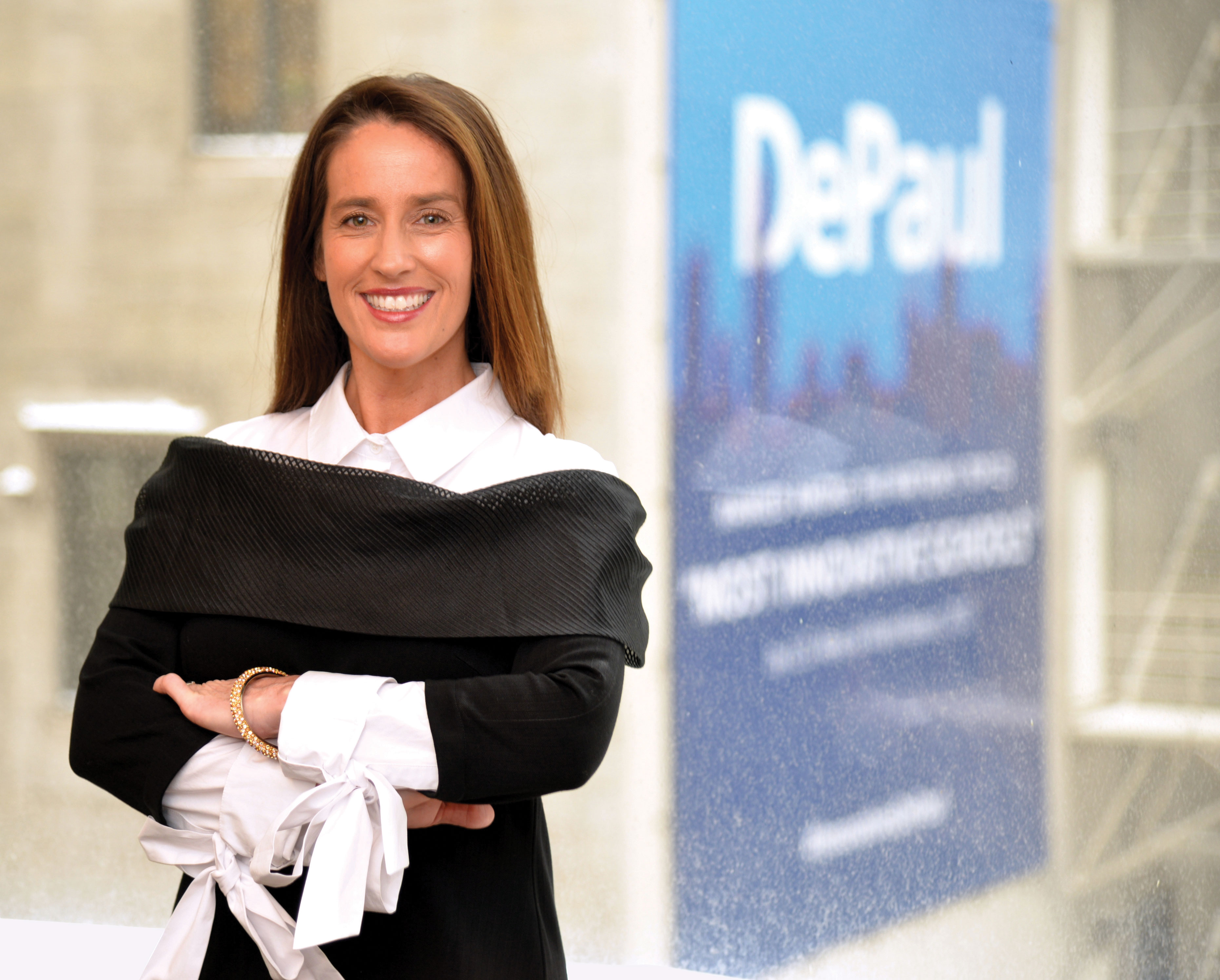
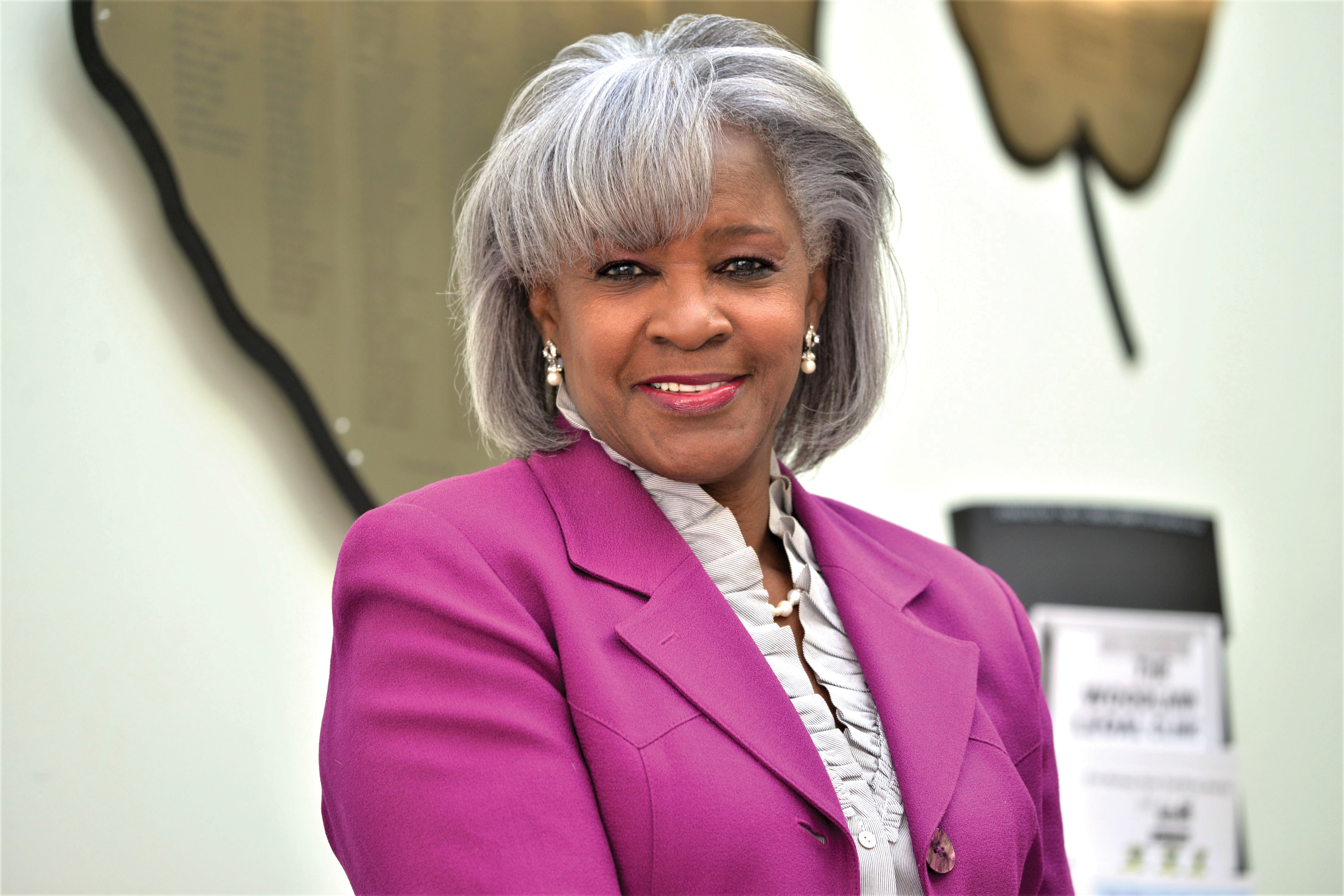
Dean Misty Johanson | Photo by Kathy Hillegonds
Together, we can strengthen our mission to transform students into socially responsible leaders ready to thrive in a diverse and global business environment.
What should the Driehaus College of Business Achieve by 2024?
Over the next few months, our college community will answer this question by creating a new strategic plan that will define our vision and goals for the next six years.
Our college’s path forward will be guided by the priorities set by the university’s 2024 strategic plan, which will be finalized soon. Shaped by insights contributed by faculty, staff and students across campus, the draft plan is scheduled to be presented by DePaul President A. Gabriel Esteban, PhD, to the university’s Board of Trustees for their approval this month. I encourage you to visit president.depaul.edu to read more about this strategic plan.
While the university’s road forward is still being mapped, it’s clear that both our university and college strategic plans must embrace change. Our institution’s business model is facing unprecedented challenges caused by national demographic and competitive trends that are depressing enrollments and revenues. At the same time, stagnant family incomes and government funding uncertainties are threatening college affordability. In this environment, we must make bold plans to ensure the long-term sustainability of DePaul’s mission.
I believe we must emphasize strategies that improve the value proposition and mix of the academic programs we offer. We must create new programs that address market demands and contribute revenues that sustain our future, while also seeking efficiencies that free resources to invest in our most successful initiatives. We must expand our efforts to promote student academic achievement, retention and career readiness. We must continue to develop faculty excellence in teaching and research.
We also must strengthen our engagement with alumni, business leaders and the community. These relationships are essential for us to continue offering students a DePaul education grounded in real-world learning and community service, as well as a powerful alumni network they can rely on throughout their careers.
I am excited about my appointment as dean and look forward to partnering with our faculty, staff, students and stakeholders to define the strategic direction of our college. Together, we can strengthen our mission to transform students into socially responsible leaders ready to thrive in a diverse and global business environment.
Misty Johanson
Dean
Driehaus College of Business
by jlansber | Apr 23, 2018 | College News
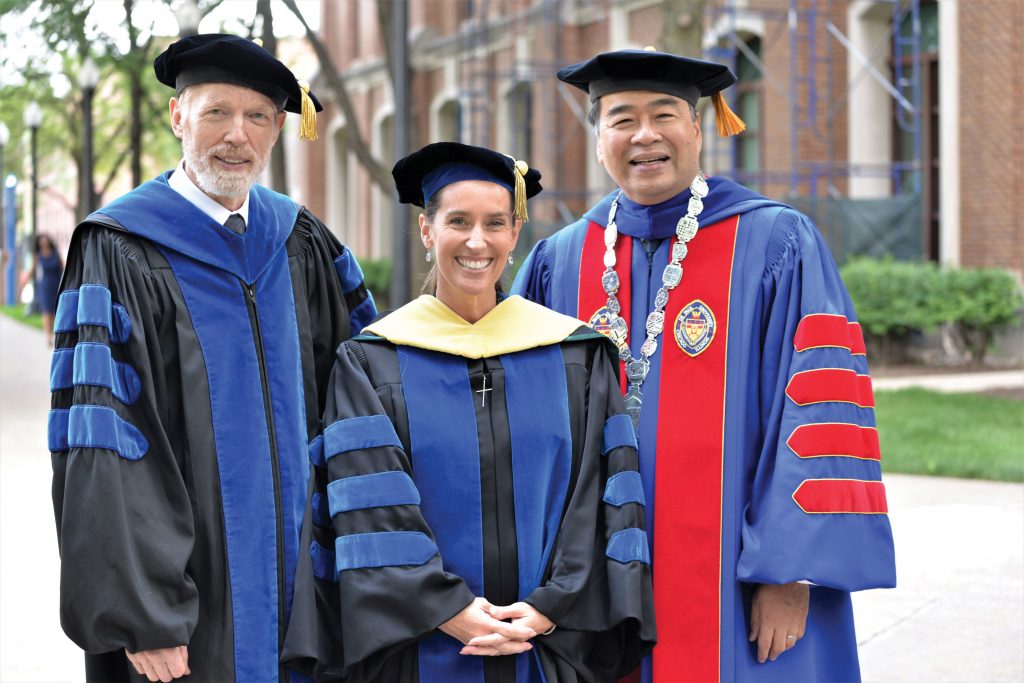
DePaul Provost Marten denBoer, Business Dean Misty Johanson, and DePaul President A. Gabriel Esteban at Convocation.
DePaul Provost Marten denBoer has named Misty Johanson dean of the Driehaus College of Business. Johanson, director of the School of Hospitality Leadership, had served as interim dean for eight months before her appointment as dean on March 1, and she previously served as an associate dean for six years. She is the first woman to serve as dean of DePaul’s business college.
College faculty, staff and industry stakeholders enthusiastically supported her appointment as interim dean last year. At that time, the provost noted that her nearly 20 years of experience in education combined with her out-standing leadership skills, welcoming character and financial acumen would serve the college well.
“That has proven to be the case,” says denBoer, who named Johanson dean following a national search.“Dr. Johanson has done a laudable job, and I’m pleased the college will continue to benefit from her leadership and expertise.”
Under her leadership, the college has focused on strategically growing enrollment, promoting student success, expanding alumni and industry engagement, and enhancing faculty and staff development. Fall graduate business enrollment increased 16 percent, staff roles have been reimagined to enhance the student experience, multidisciplinary collaborations are increasing to support graduate program success and the college is forging stronger connections in the business community. Johanson also launched a campaign with the Office of Advancement to raise $4 million for the college by the end of this academic year and exceeded the goal within the first six months.
“I look forward to continuing this work with the talented faculty and staff within the college as well as our stakeholders, especially as we embark on a new strategic plan,” she says.
Denis E. Springer, chair of the Driehaus College of Business Advisory Council, praises the choice: “Misty is an energetic and innovative leader who connects exceptionally well with the university and business communities and brings a fresh perspective to the role of dean.”
Johanson joined DePaul in 2009 to establish the School of Hospitality Leadership and became its director in 2014. Under her leadership, the school earned accolades for both its innovative teaching and its faculty research. The J. Willard and Alice S. Marriott Foundation awarded the school a $1.8 million grant in 2016 to create and endow a new Center for Student Development and Engagement.
In addition to receiving multiple excellence-in-teaching awards, Johanson, a graduate of Michigan State University’s hospitality business and tourism program, is recognized as one of the most prolific authors in her field. She started her hospitality career with Marriott International and later served as a faculty member in the hospitality programs of both the University of Hawaii and Georgia State University.
by jlansber | Apr 23, 2018 | Alumni Profiles
Jared Smith and the Startup that Became a $600M Game-Changer
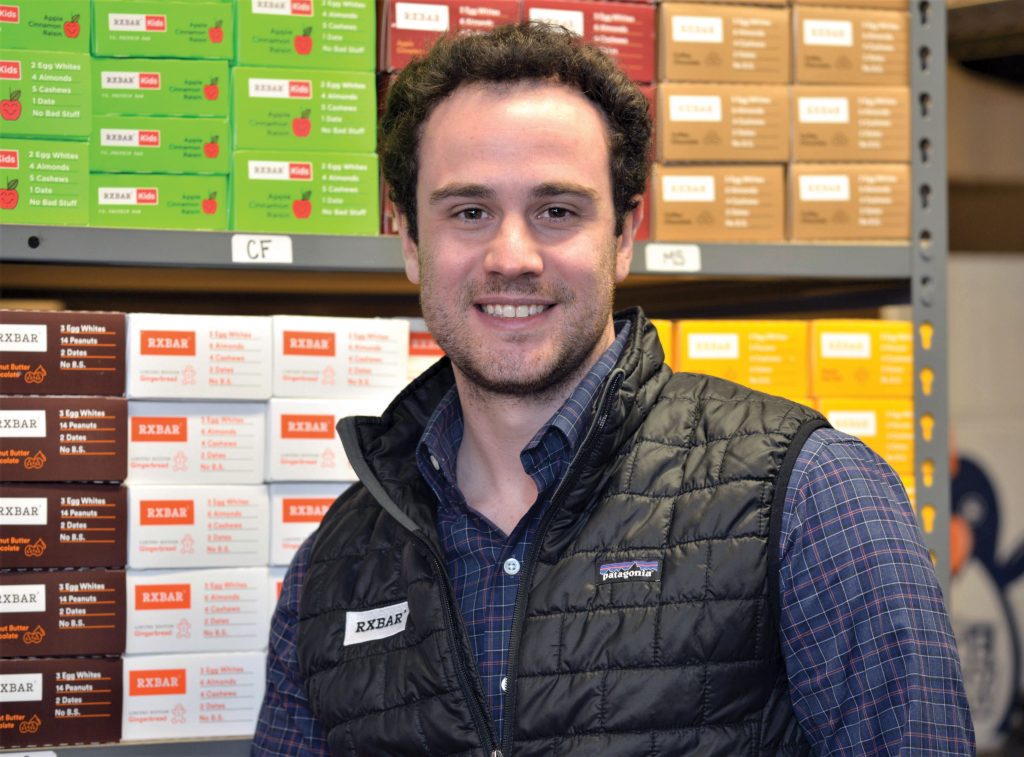
Jared Smith (BUS ’08) co-founded RXBAR in the basement of his
business partner’s parents’ home. Last fall Kellogg bought the venture for $600 million.
When Jared Smith (BUS ’08) began attending DePaul University, he thought he wanted to be a math teacher. His passion for business quickly led him to transfer to the Driehaus College of Business, where he double majored in economics and finance before graduating.
Now, Smith is co-founder of the nutrition bar company RXBAR, and he’s clearly mastered both math and business. Last October, Kellogg Co. acquired RXBAR for $600 million, calling the startup “a unique and innovative company” with “values, people and a cutting-edge approach (that) represent an exciting opportunity for our business.” Smith has stayed on with the company.
Headquartered in the River North neighborhood of Chicago, the company is the fastest-growing nutrition bar brand in the U.S. The acquisition is allowing RXBAR to expand its resources, break into new food categories and take advantage of Kellogg’s research and development resources while operating as a standalone business.
We don’t want to change the way we work, we don’t want to change the way we operate,” Smith says. “We wanted to be able to leverage their resources and their experiences where and when we need them.”
At DePaul, Smith took a range of classes, including an entrepreneurship class he says changed the way he thought about his career.
“What it really taught me was a different way of thinking and that there is more than one way to make a living, rather than going to work at a big financial firm,” he says.
Before he became an entrepreneur, however, Smith gained experience through a more traditional path in finance. He completed internships at three different financial services companies in Chicago, including an unpaid internship at what is now Morgan Stanley Wealth Management.
After graduating at the height of the financial recession, Smith took a job at Jackson National Asset Management, where he worked in various departments for the next four years. During his last year of working there as an operations analyst, he began collaborating with Peter Rahal—his childhood best friend—on creating a minimal-ingredient protein bar in the basement of Rahal’s parents’ house in Glen Ellyn, Ill.
Rahal, CEO of RXBAR, and Smith shared a passion for health and fitness. They would head to the gym together every day after work and were huge bar consumers themselves. They were unable to find an all-natural, clean, minimal-ingredient protein bar.
“If you look at the protein bar category, it’s either all fruit and nut all-natural or granola bars,” Smith says. “On the other side of the spectrum is body builder (bars) high (and) heavy in protein with tons of ingredients. There was nothing in the middle.”
 Smith and Rahal came up with the concept for RXBAR in August 2012, then spent the next eight months developing the recipe and designing the label themselves in PowerPoint— a label that, however ugly, successfully displayed their value proposition to offer whole food protein bars. In March 2013, Smith and Rahal quit their day jobs and officially launched RXBAR.
After going all in, they each invested $5,000 of their own money and rented a 1,000-square-foot manufacturing space on the West Side of Chicago. Over the next 18 months, their production and staff grew to the point where they eventually rented the entire 7,000-square-foot facility.
“Every single weekend, especially during the first couple of years in the business, we’d go out and sample our demo at any type of event we could find, whether it was a gym or a grocery store, literally anywhere,” says Smith. “We’d go out and sell the product directly to consumers to figure out what resonated and what didn’t, and eventually we’d start telling customers, ‘This is like eating a handful of nuts and some fruit and protein.’ This really hit home for our customers.”
This led Smith and Rahal to create RXBAR’s current packaging, which features its core ingredients on the front of the label.
In the first four years at RXBAR, Smith served as chief financial officer. His main focus now is building the company’s philanthropic arm and engaging a variety of stakeholders, including customers, suppliers and vendors.
Smith says he underestimated the work it would take to get to where he and RXBAR are today.
“Everything I read about entrepreneurship before starting the company was always focused on the outcome, the end game. That was something Peter and I never focused on,” he says. “Literally, we’d stay at work all week. Then we’d demo our samples on the weekends. We sacrificed a lot—social life, income, sleep and much more. We just focused on work, and that was it.”
As friends and co-founders, Rahal and Smith make up a perfect partnership. “Our personalities are totally different,” he says. “I’m much more methodical, pragmatic, back end, and he’s much more aggressive, front end, and an incredible visionary. But our relationship from first grade and growing up together proved to be extremely valuable, because who you partner with is everything. We trusted each other from day one.”
How Smith and Rahal work together has led to the business culture at RXBAR, as well as their product’s master claim, “No B.S.,” which is displayed proudly on the front label below the ingredients. “That’s what our product and business is all about, and that’s the definition of transparency,” Smith says. “We’re not trying to hide anything. We’re putting everything out there for the consumer and empowering the consumer to make that decision.”
By Jaclyn Lansbery | Photos by Kathy Hillegonds

by jlansber | Apr 22, 2018 | Features
How DePaul is Fostering Leaders of Purpose-Driven Ventures

Michael Cody (MBA ’13), co-founder of BareItAll Petfoods with his dog Mustache. Cody’s company makes treats that are good for pets and the environment.
After spending years working as a chef throughout the U.S., Michael Cody (MBA ’13) came to DePaul to study entrepreneurship and sustainable management so he could start a business that combined his two passions: animals and the environment.
Cody, an avid fisherman, learned about the increasing number of Asian carp in U.S. waterways in an environmental science class he took while seeking his MBA. Asian carp, an invasive species, endanger native fish by eating their food sources. They are now making their way to the Great Lakes.
With this environmental problem in mind, Cody and his business partner, Logan Honeycutt, began devising pet food recipes using Asian carp. They quickly found their own dogs loved the treats.
“Turning something that people perceive as trash into a moneymaker was a really appealing idea to me,” Cody says. “I hadn’t heard about (doing) that until I took the sustainability classes.”
In 2015, Cody and Honeycutt launched BareItAll Petfoods and now offer one- to seven-ingredient treats for both cats and dogs. They employ fishing crews to catch the Asian carp, and they donate a portion of BareItAll’s profits to local animal shelters.
Cody is one of a growing number of DePaul students and alumni who are starting entrepreneurial ventures driven by a purpose. Bolstered by DePaul’s entrepreneurship program and resources, and grounded in Vincentian values, these entrepreneurs are creating businesses and nonprofits that are solving problems in Chicago and beyond. As social responsibility becomes an increasingly important part of business, the Driehaus College of Business is fostering these leaders to become innovators for good.
Do Good. Do Well.
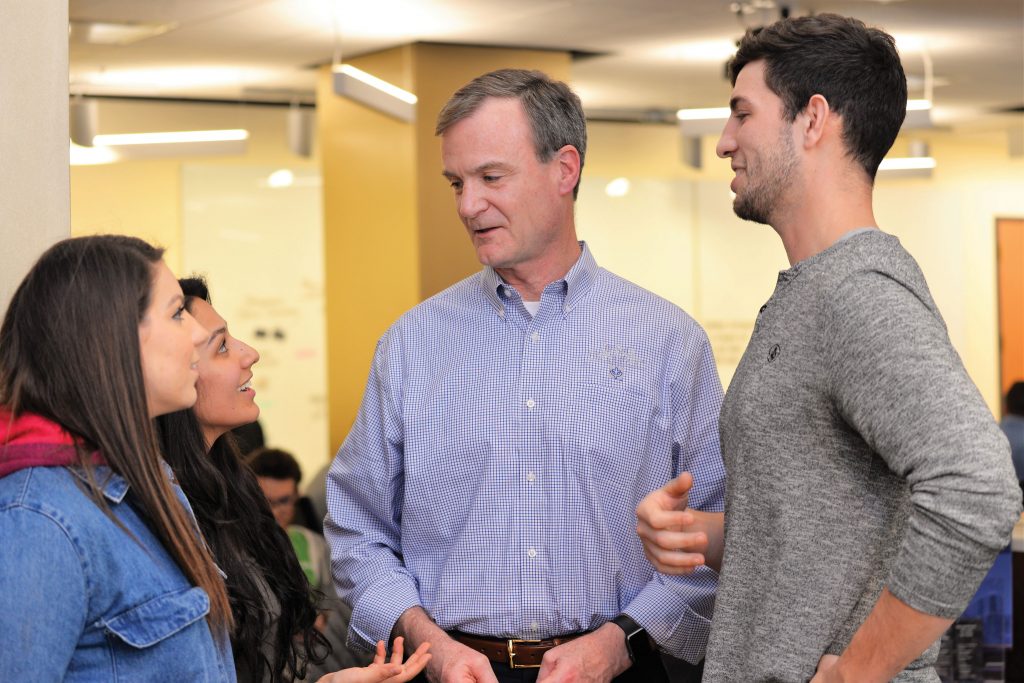
Coleman Entrepreneurship Center Executive Director Bruce Leech (MBA ’81)
We wanted to change the conversation from ‘How much money can I raise?’ to ‘What problem am I solving?’”
Since opening its doors in 2003, the Coleman Entrepreneurship Center has been helping DePaul students and alumni start and grow businesses. The center hosts year-round business development workshops, programs and events. In 2017, the center created the Purpose Pitch Competition for DePaul students and alumni.
“Our biggest event of the year has purpose right at the beginning of the name,” says Coleman Executive Director Bruce Leech (MBA ’81). “When we started our competition last year, we wanted to change the conversation from ‘How much money can I raise?’ to ‘What problem am I solving?’”
The competition fits the center’s new focus. Following a daylong retreat last year involving constituents and board members, the center’s leadership developed a strategic plan and mission statement that is reflected in its new tagline: Do Good. Do Well.
Drawing from that mission, Leech tells students and alumni that it’s important for entrepreneurs to have a sustainable, goal-directed business idea that aims to solve an existing problem. “Helping the community is in the very fabric of what DePaul is all about. We’re here to make a difference in our community,” Leech says. “We’re one square mile from anything our students would need in the way of resources to get their businesses started.”
Creating Positive Impact
How can organizations achieve purpose?
That’s the question Adam Fridman (BS ’99, MS ’03), founder of the digital marketing agency Mabbly, is attempting to answer through the ongoing research project and online platform ProHabits.
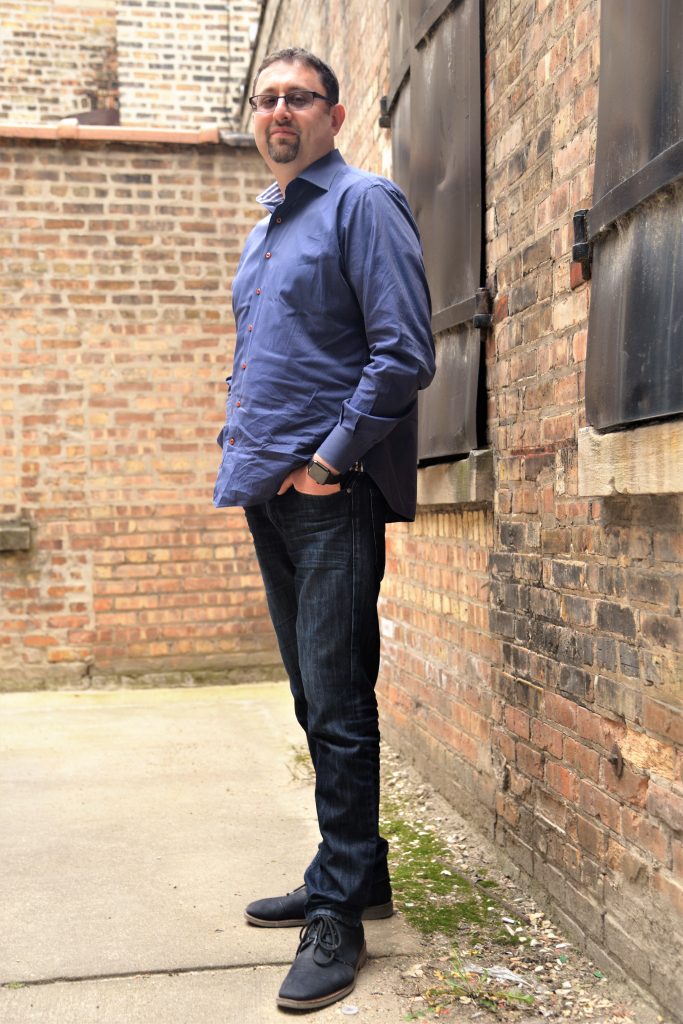
“We want to prove that if you are your best self, business outcomes will be improved,” says Adam Fridman (BS ’99, MS ’03), co-founder of Mabbly.
Now in the alpha stage, ProHabits offers three types of habit-forming activities that align with organizations’ values: ProLeadership, ProInnovation and ProFeedback. Each activity is sent via email to employees to encourage their self-actualization in hopes of improving business outcomes. The recommendations are the result of more than 500 interviews with thought leaders and entrepreneurs from around the world on their daily habits and personal growth activities.
We want to prove that if you are your best self, business outcomes will be improved,”
says Fridman, who prefers to use the word “tribe” instead of employees. “Companies will make more money, and there will be better customer service and better sales.”
The research project also informed the book “The Science of Story,” which Fridman co-wrote with Mabbly CEO Hank Ostholthoff. The book is “by and for those dedicated to building inspired organizations,” according to the Mabbly website, and outlines steps for organizations to find their purpose, ignite their tribe and create a positive impact on the world while running a successful business.
Fridman’s business philosophies stem from working in investment banking for several years before leaving to start his own business.
“I wasn’t built to sit in front of a computer for 12 to 15 hours a day, crunching numbers so that I could work to make more money,” says Fridman, who helped the Coleman Center organize the first Purpose Pitch Competition.
Now, Mabbly is committed to helping organizations tell their story through purpose-first marketing. “I think that if organizations figure out a path to help people self-actualize at work, which includes not just purpose but other aspects, they will move the world in a more positive way,” Fridman says.
Social Enterprise at DePaul
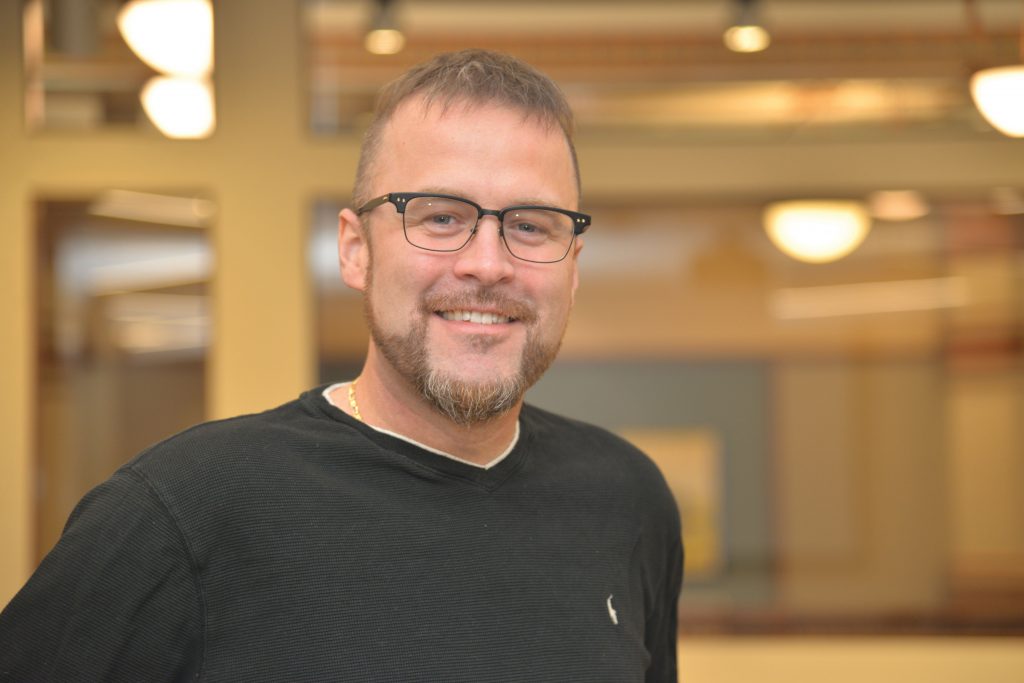
Patrick J. Murphy, professor of management and entrepreneurship at the Driehaus College of Business.
For Management and Entrepreneurship Professor Patrick J. Murphy, improving the world starts in the classroom.
Murphy, who has published six scholarly articles on social enterprise, developed the college’s first social enterprise course, which is offered in the DePaul MBA program. The course, Social Enterprise, examines the differences between social enterprise businesses and for-profit and nonprofit businesses.
Social enterprise models, Murphy says, maximize social impact while generating revenue. He offers as an example Sweet Beginnings LLC, a Chicago-based organization that employs men and women returning from incarceration to produce honey-infused and all-natural body care products.“Social enterprises are necessary because they denominate value in different kinds of ways,” says Murphy.
Just as we can measure economic value over time, we can measure social value objectively over time. We can track lower crime rates, higher education rates and other community-related data.”
In 2017, Murphy organized DePaul’s first Social Enterprise Pitch Competition, where students pitched business ideas that supported a social good. Three DePaul student winners received $8,000 in scholarships, as well as $1,800 worth of website development services.
Murphy pointed to DePaul’s Vincentian values as fostering business students who want to do good for the community. “Our culture at DePaul is almost like a strategic weapon for doing world-class work in this area.” He also ties the popularity of starting social enterprises to generational shifts. “Doing good for the community today often starts with young people researching the world around them based on personal interests and eventually finding unique ways to embed what inspires them into their university education.”
Doing Good in the Nonprofit Sector
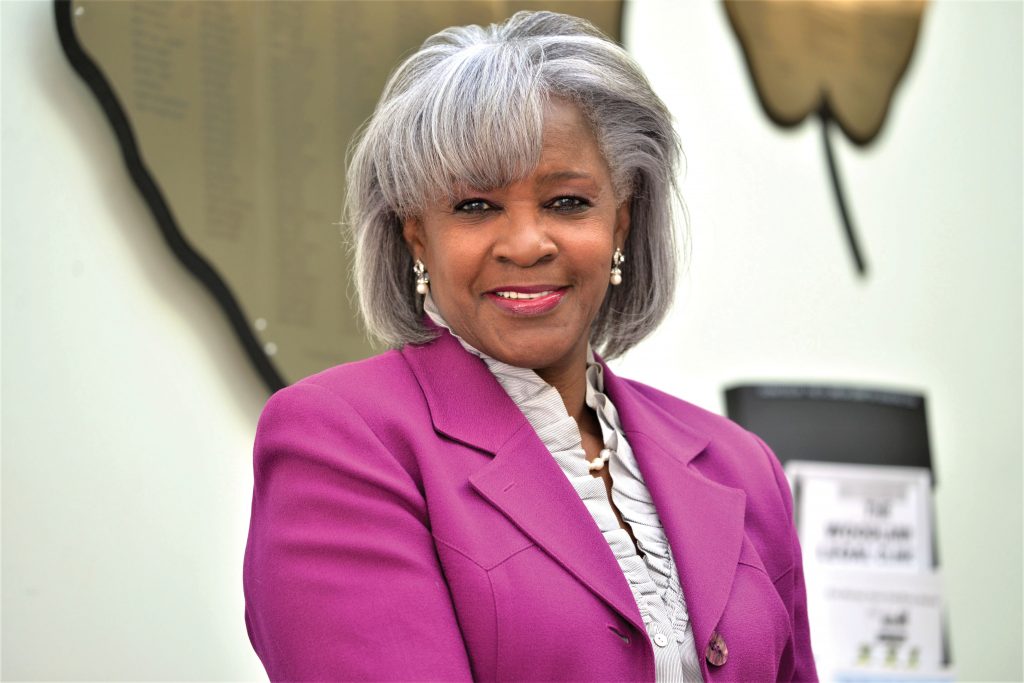
Helen Hammond Redding (MBA ’78)
Helen Hammond Redding’s (MBA ’78) purpose for doing good in the community stems from a personal tragedy.
In 2003, Helen’s youngest son, Christopher Redding, went jogging while visiting home during Thanksgiving break from college. His parents had learned he suffered from exercise-induced asthma one year before, but never knew how important it was for him to carry his inhaler. That morning, Christopher died from an asthma attack.
Years later, Redding retired from a long career in banking and founded the Christopher D. Redding Youth Asthma Foundation.
“When Christopher died of the asthma attack while he was jogging, it just hit us that we were not educated enough to know that Christopher potentially had a deadly disease,” Redding says. “So we started our foundation to educate other parents and the community so that they would not have to suffer the same tragedy.”
The foundation, which Helen operates with a nine-member board of directors, including her husband and middle son, primarily educates people in under-served Chicago-area communities about asthma management practices. It partners with Mobile Care Chicago to bring asthma vans to schools and community centers. The foundation also works with the Respiratory Health Association to support an asthma management curriculum in those schools and communities.
When I go and talk to community groups, I impress upon these parents and caregivers how critical it is that they, as well as their children, get educated,” Redding says.
“That’s why we go out and try to do as many seminars and workshops as we can, even if there are only 10 or three people there. We just want to get the word out that asthma can kill if it isn’t managed, and there are some things you can do personally to help your child or relative who has asthma.”
Redding’s foundation also has awarded 17 scholarships and educational grants totaling about $25,000 to student-athletes with asthma across the country and has provided sponsorships to allow young children to attend asthma camps. She hopes one day to own and operate a summer camp for kids with asthma, as well as a mobile asthma van that will serve athletic and recreational venues in under-served communities.
“It’s a tragic disease, and compared to violence in Chicago, (asthma) doesn’t really get the attention that it deserves,” says Helen, who previously worked as the state director of community development for Citibank Illinois, where she helped secure funding and grants for Chicago nonprofits. “We’re a small foundation, but we’re doing some good.”
Innovation in the Special-Needs Community

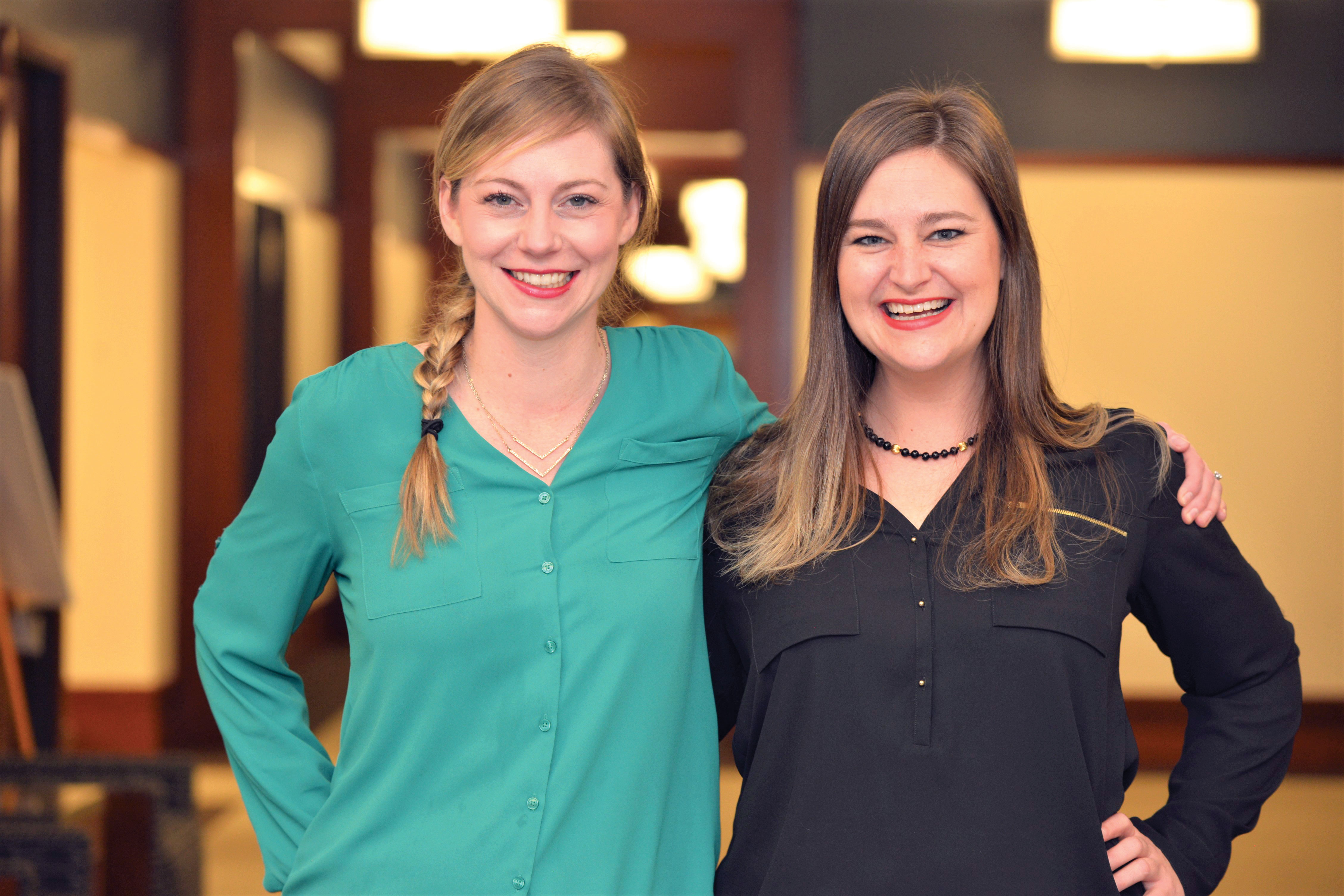
Elizabeth (MBA ’15) and Melissa Ames
We’re creating an ecosystem of impact by providing value to three different customer bases. Our products and the way we do business are purpose-driven.”
As winners of the 2017 Purpose Pitch Competition, Elizabeth Ames (MBA ’15) and her sister Melissa’s goal is to help children and adults with special needs, one subscription box at a time.
Their for-profit business, EarlyVention, is a monthly subscription service that sends a box of adapted activities designed to help parents engage with their children who have autism and different abilities.
A special education teacher and autism home therapy consultant, Melissa knows firsthand the challenges parents face as they try engaging their children. “There are a lot of materials for parents,” Melissa says. “But everything I could find was downloadable, not ready-made, so I would send links to parents and say, ‘This is a great worksheet, try using this with your child or these visuals.’ Then I’d follow up and ask, ‘How did it go?’ And they’d tell me, ‘Well, I never got to do it, and I didn’t have time to make the materials.’”
To answer this need, Melissa began designing materials for parents at home in the evenings. The sisters’ mother, who worked as director of special education for LaGrange Highlands School District 106, based in LaGrange, Ill., suddenly passed away from cancer. She had always encouraged them to start a business like EarlyVention.
Elizabeth began working on a business development plan with her sister after enrolling in the DePaul MBA program. They received guidance from business professors, classmates and the Coleman Entrepreneurship Center. The sisters continued to raise funds through several pitch contests before winning the Purpose Pitch Competition.
“Purpose Pitch gave us enough security to know that we can keep going with some extra cushion,” Elizabeth says. “It provided a great safety net, and it will provide us with a better website, which is our storefront, so it’s only going to enhance our business.”
EarlyVention also engages adults with autism and special needs to help create the materials in the boxes. The sisters would like to ship the boxes internationally and create YouTube videos that demonstrate how parents can use the materials with their children.
“Not only are our products directly benefiting children and their parents, as well as caregivers, therapists and teachers who love and care about them, but we also have the purpose of providing vocational opportunities to adults with special needs,” Elizabeth says. “We’re creating an ecosystem of impact by providing value to three different customer bases. Our products and the way we do business are purpose-driven.”
By Jaclyn Lansbery | Photos by Kathy Hillegonds