by jlansber | Sep 12, 2017 | Online Extras
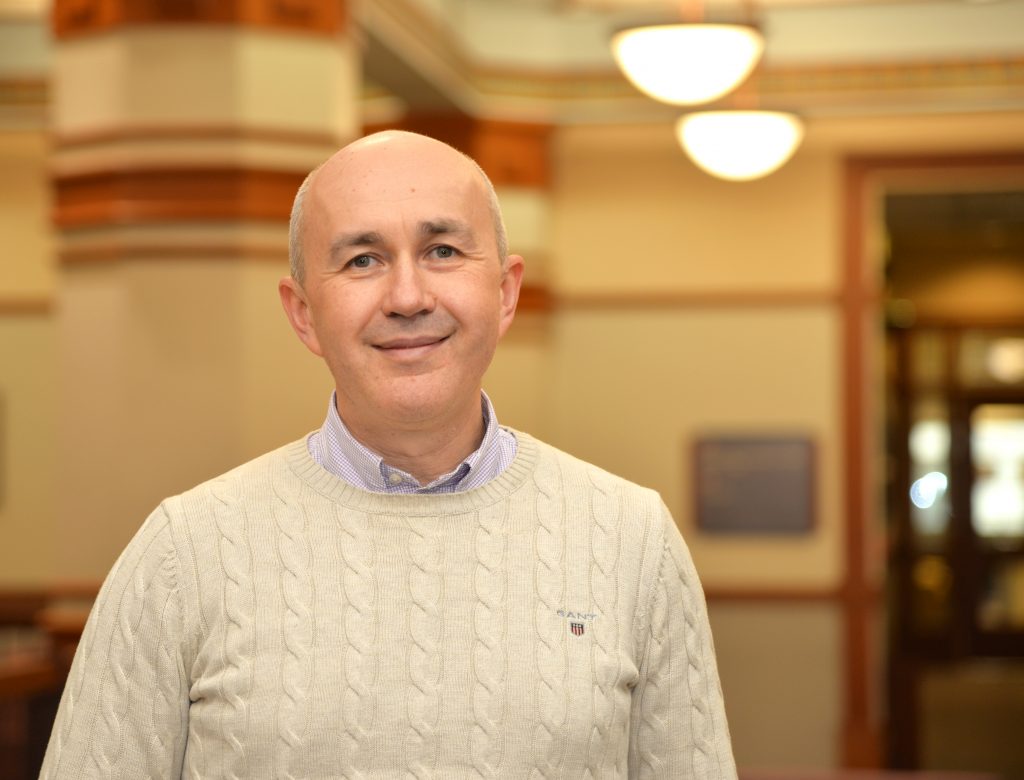
Michael Friedrich (MBA ’95) began his career as a McDonald’s executive abroad with a finance internship he completed while studying at DePaul.
Like many DePaul business alumni, Michael Friedrich’s journey to career success began with an internship he landed while he was a student at DePaul.
Friedrich (MBA ’95) studied finance and marketing and, through DePaul’s connections to the business community, earned an internship at locally based McDonald’s Corp. This opened the door to a full-time job in the global food retailer’s finance department after graduation, which then led to a series of executive positions with McDonald’s in Europe.
Friedrich has served as financial controller for Western Division of McDonald’s Europe and chief financial officer of McDonald’s Italy, among other c-suite posts. He is currently a multiple franchisee who owns the biggest McDonald’s restaurants in and around Prague, his hometown. He also stays connected to DePaul by sharing his knowledge with current DePaul business students who visit the Czech Republic while on study abroad trips to find out about European business practices first-hand.
Below, Friedrich discusses how his experiences at DePaul prepared him for his career journey.
Why did you choose to attend DePaul’s business school?
I had a dream to study business in the United States. In 1992, when I completed my engineer master’s program at the Prague School of Economics, I started to work with MBA graduates from different business schools across the U.S. at the Entrepreneurship Center, a nonprofit organization based in Prague. We helped small businesses in the Czech Republic to prepare business plans, obtain financing and, in some cases, find strategic partners.
I learned from my colleagues and some future lifetime friends about different MBA programs and passed the required tests. Then I came across a possibility to qualify for the Dean’s International Scholarship at DePaul University. The program was administered at the time by Peter Chadraba, the DePaul professor of marketing, who was then working closely with the Prague School of Economics. And thus started a relationship with DePaul that lasts until now.
How did your DePaul business education help you with your career?
DePaul and Chicago are very influential in my life. In the MBA program, I chose a finance major with an additional emphasis on marketing, which provided me with a sound knowledge of finance, marketing, economics and accounting.
A big advantage was the fact that DePaul’s business school classrooms are located in downtown Chicago, at the heart of real business. Many of my fellow students worked a few blocks from our school. It brought a very hands-on approach to our classroom, as often we discussed business cases and situations that where happening just across the street.
At the end of my studies, thanks to DePaul, I was offered an internship at McDonald’s headquarters and thus started another long-lasting relationship. I met several DePaul alumni working at the McDonald’s headquarters and, actually, the CFO of McDonald’s Corp. and future CEO of McDonald’s were DePaul graduates as well.
Finally, I also met my wife in Chicago. We met at a McDonald’s finance training in Oak Brook and to close the circle, she also is a DePaul MBA graduate.
What advice do you have for other international students who may be considering enrolling at DePaul in Chicago?
DePaul University is a very reliable and knowledgeable partner for your studies. It has a great faculty with a lot of experience, and it has a unique location in one of the most beautiful cities in the U.S. It is a strong, large university, but at the same time very personal.
I have created a life-long relationship with the university and its faculty and also with many of my fellow students. I made friends in Chicago and also from different parts of the world while at DePaul.”
You recently met with DePaul business students studying abroad. What was the most important lesson about business that you shared with them?
We discussed how the world is getting more interconnected. Opportunities, challenges and issues that pop-up in different parts of the world become overnight our agenda, too. Constant change is part of our lives.
I personally value long, personal business relationships and consistency, and I tried to convey this message, too.
Finally, I shared one of my favorite quotes from a great Italian movie, “The Leopard.” “If we want things to stay as they are, things will have to change.”
By Robin Florzak
by jlansber | Sep 12, 2017 | Online Extras
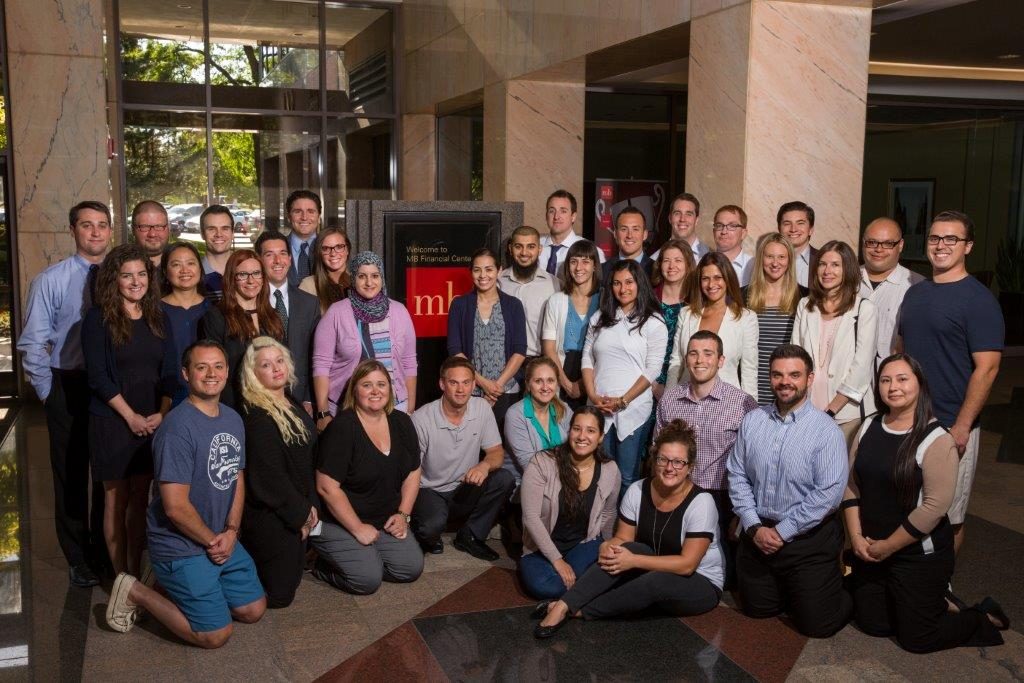
MB Financial employees enrolled in DePaul’s MBA program offered on-site at the bank.
Anthony J. Gattuso always wanted to earn an MBA. Like many working professionals, however, he hesitated to add another commitment to his already busy schedule. “There was always a reason to put it off — personal and professional obligations, etc.,” he recalls.
That changed when Gattuso, a vice president and senior field credit officer at MB Financial Bank, heard about a new partnership between MB and DePaul University to bring DePaul’s highly regarded MBA program to his workplace. Gattuso now attends DePaul MBA classes with 35 of his co-workers two evenings a week at MB Financial Bank’s Rosemont, Ill., offices.
When I weighed the specifics of the program — the benefits of an on-site program with a streamlined enrollment process, and an attractive cost relative to a traditional program — it was an easy decision to enroll,” Gattuso says.
“I view the program as an opportunity to further develop my business, leadership and managerial skill sets,” Gattuso continues, “while growing relationships with others in the organization — all in a location that is convenient and conducive for balancing my professional life with my personal life.”
The DePaul–MB Financial Bank collaboration is one of 25 education partnerships that the university’s Corporate and Employer Outreach (CEO) initiative has forged with companies in the banking, health care and technology fields since DePaul launched CEO in 2013. The partnerships range from tuition discounts and professional development opportunities to MBA and other tailored degree program offerings at company facilities. In seeking partners, DePaul primarily targets Fortune 1000 companies that have headquarters or major hubs in the Chicago area.
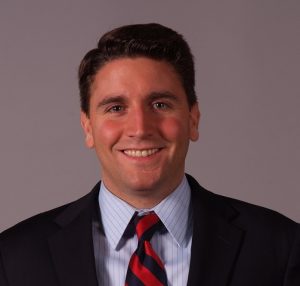
Anthony J. Gattuso is enrolled in DePaul’s MBA program offered at his workplace, MB Financial Bank.
Employers benefit from these partnerships as much as their employees do, says Dara Crowfoot, director of DePaul’s CEO initiative.
“Hiring is returning to pre-recession levels, and companies are looking for benefits that can help them attract and retain employees, especially millennial generation professionals who place a high value on education and training,” she explains. “These educational partnerships help companies keep their best employees from being hired away.”
“Long-term,” she continues, “DePaul wants to be recognized as a solution provider for area businesses and organizations seeking to cultivate and keep exceptional talent.”
Students Expand Networks, Gain Real-World Knowledge
One big benefit of DePaul’s corporate-based degree programs is that they build camaraderie and teamwork among enrolled co-workers, who progress through their studies together as a cohort.
“I’ve found that both the professional and personal connections with my classmates/co-workers are stronger as a result,” says Dan Butterworth, assistant vice president of consumer marketing at MB Financial Bank and a student in the DePaul MBA program there.
Butterworth also appreciates the opportunity to immediately apply what he has learned to his work at MB Financial.
“The first class in our program, Organizational Behavior, has given me tremendous insight into the obstacles decision-makers face. One of my long-term objectives is to develop a skill set that improves my decision-making ability. Needless to say, the program started off perfectly for me.”
For graduates of DePaul’s corporate MBA programs, the career benefits continue to accrue.

Dan Butterworth says DePaul’s onsite MBA program provides decision-making skills he can use on the job.
Matt Ley (MBA ’16), supply chain manager at Medline Industries, earned his DePaul MBA at the global medical supplier’s far north suburban headquarters. Ley sought the degree to enhance his knowledge of business because he had not studied business as an undergraduate.
“Besides the immense benefit of networking with my fellow employees, the program afforded me the opportunity to explore, discuss and engage in multiple business disciplines,” says Ley. “I have gained the ability to discuss marketing, sales, finance, purchasing and management — topics I would have felt ill-prepared for based on work experience alone. This increased knowledge means I have a larger pool of options before me regarding future development and advancement.”
DePaul’s large alumni network in Chicago also has helped boost the success of the university’s corporate education partnerships. Alumni have served as liaisons for DePaul to connect with company decision-makers to discuss collaborations, and also have spoken about their MBA experiences with co-workers who are contemplating enrollment.
At the Walgreens headquarters in Deerfield, Ill., alumnus and product development manager Alexander Rozenbaum (CDM ’00, MBA ’14) has spoken to his co-workers about the merits of the DePaul MBA program offered there, which focuses on health sector management.
“It’s a great and convenient opportunity,” Rozenbaum says, “for our employees to participate with other Walgreens employees in a top-notch MBA program that has a diverse, cross-functional focus and takes place at their workplace on our corporate campus.”
Learn More
For more information about DePaul University corporate education opportunities, contact DePaul’s Corporate and Employer Outreach (CEO) initiative at (312) 362-6911 or corporatepartnership@depaul.edu.
By Robin Florzak
by jlansber | Sep 12, 2017 | Giving Back

Alumnus Tom Blasczyk joins the Rev. Dennis H. Holtschneider, C.M., president of DePaul, in rooting for the Blue Demons.
Tom Blasczyk (MBA ’70) was the first in his family to attend college. Then he earned an MBA at DePaul and enjoyed a successful career at Northwestern Mutual. He has traveled the world, base-camped at Mt. Everest and climbed Mt. Kilimanjaro.
Among his list of achievements is one he finds particularly satisfying: his 40-year unbroken record of annual giving to DePaul.
I believe in supporting education. My DePaul education has given me a life I could barely imagine growing up, and it feels good to know that I, in some small way, can help make that happen for young people today.”
Blasczyk grew up in a large family headed by a single mother on a farm outside Pulaski, Wisc.
“My mother had only a second-grade education, but she never tried to hold me back when I went to college,” he says. “She knew that education was the way to a better life.”
After graduating from the University of Wisconsin with a degree in accounting, Blasczyk joined the U.S. Army Reserve. Following a six-month tour of duty, he moved to Chicago to work for the accounting firm Arthur Young (now EY) and married his fiancée, Monica. He began working toward his MBA at DePaul. “I knew the MBA would be the key to advancing,” he says.
“The MBA program gave me a lot of expertise in business, but it also stressed the importance of working together with people,” Blasczyk continues. He eventually joined Northwestern Mutual as a financial services representative, and he has never looked back.
“I enjoy working on financial plans that help people achieve security and reach their goals. Without DePaul and everything I learned about finance and how to work with people, I would not have been blessed with this great career.”
He is “mostly retired” these days, and spends time traveling, hiking, biking and skiing. He and Monica, known as Todd, are still giving back. In addition to DePaul, they support the University of Wisconsin and a Catholic high school in Wausau, Wis.
“DePaul is a very important part of my life,” says Blasczyk. “Todd and I were lucky back then—it was a great time of expansion in this country. These days it is harder to get through school and get established. That’s why it’s so important to give back to future generations.”
Learn more about giving to DePaul University.
By Chris Anderson

by jlansber | Sep 11, 2017 | Scholarly Pursuits
Minimum Wage Hikes = Automation = Fewer Jobs? Not So, Study Says

Opponents of minimum wage hikes often argue that the move will only cause employers to reduce headcounts in various ways, including through automation.
To find out if this assertion is true, DePaul Assistant Professor of Economics Brian Phelan teamed up with Daniel Aaronson, director of microeconomic research at the Federal Reserve Bank of Chicago, to examine the effects of past state-based minimum wage hikes. Their forthcoming Economic Journal study yielded some unexpected results.
“Minimum wage hikes in the early 2000s did cause employment declines in occupations that involved routine tasks susceptible to automation,” Phelan explains. “Somewhat surprising to us, however, was that states that increased their minimum wages tended to experience employment growth in other types of low-wage employment that largely offset the losses in routinized employment during the first two years after the minimum wage hike.” For example, a grocery chain may cut cashier jobs after introducing self-checkout kiosks, but create new customer service positions to help shoppers navigate the system.
“Thus, while our results suggest that higher minimum wages are expediting the automation of low-wage jobs,” Phelan says, “we found that the costs of this automation on individual low-wage workers do not appear to be particularly large in the short run due to the concurrent growth in other types of low-wage employment.”
The 606 Trail Raises Home Prices and Affordability Concerns

Homebuyers are paying more green to be near the greenery of the new Bloomingdale Trail, also known as The 606, on Chicago’s Northwest Side, according to research by the Institute for Housing Studies at DePaul.
Home prices have risen dramatically around the linear park the City of Chicago opened nearly two years ago on 2.7 miles of disused elevated railroad tracks that span the Logan Square, Humboldt Park and West Town communities. Prices of single-family homes adjacent to the lower-income western half of the park jumped 48.2 percent since the project broke ground and another 9.4 percent after the trail opened. Home prices also went up in the areas adjacent to the higher-income eastern half of the park, but more modestly—13.8 percent since construction started and 4.3 percent after completion.
Rails-to-trails projects like The 606 are growing in popularity internationally because reclaimed green spaces offer many benefits to urban neighborhoods. However, rapid gentrification around linear parks can price lower-income residents out of the neighborhood, caution the study’s authors, Geoff Smith, Sarah Duda, Jin Man Lee and Michael Thompson.
“The lessons from what happened in the neighborhoods surrounding The 606 can help community members and policymakers identify, prioritize and target a balanced set of policies that will allow cities and neighborhoods to benefit from the success of public investment projects,” the study concludes, “while also preserving housing affordability and limiting the potential displacement of lower-income residents.”
The full report is posted at housingstudies.org.
By Robin Florzak

by jlansber | Sep 11, 2017 | Faculty Focus

Even though 98 percent of business organizations have formal policies against it, sexual harassment and other forms of aggression are a persistent problem in the workplace.
It’s a problem that Jaclyn Jensen knows well as someone who has been the target of harassment herself and witnessed its demoralizing effect on others in previous workplaces. These experiences influenced Jensen, an associate professor of management at DePaul, to focus her teaching on human resource management and her research on employee mistreatment and misbehavior.
My interest in this topic is fueled by a real desire for others (mainly women) to never be in a situation where they are treated in anything less than a respectful manner, and to help victims find proper recourse to prevent mistreatment in the future.”
“To that end, my work on incivility and harassment has investigated why employees are mistreated by their coworkers and bosses, how mistreatment affects victimized employees’ job attitudes and behaviors, and what bystanders and leaders can do to try and stop mistreatment from occurring.”
Growing up in Cleveland, Jensen initially wanted to attend medical school and become a psychiatrist. Her career focus changed at Ohio State University after she took an organizational psychology course and, as an undergraduate representative on the university’s board of trustees, saw firsthand the complexity of people management in large organizations. “These experiences opened my eyes to the blend of psychology and business in organizations and the need to be really thoughtful about people and human resources at work. It prompted me to pursue grad school in organizational psychology.”
Jensen earned master’s and doctoral degrees in this discipline at Michigan State University and then taught management courses at George Washington University for six years. She joined DePaul’s business faculty in 2012. This past fall, DePaul honored Jensen with its Excellence in Teaching Award.
Jensen says she strives to teach future business leaders that they have both the “opportunity and the responsibility to set the tone for employee conduct in the workplace.
“This goes beyond having a set of policies in an employee handbook, and is more about setting the right kind of examples both in their own behaviors and in the types of people who are hired, promoted and rewarded,” she says. “If the workplace jerk consistently gets ahead while those who treat others kindly do not, that sends a message about the kinds of behaviors that are valued.”
Leaders need to speak up about harassing behavior, Jensen advises, and hold organizations accountable for enforcing policies against it.
“If you witness this type of behavior, own your responsibility as a role model and do what you can to either help the victim, call out the bully or both. This is often easier said than done, as intervening in someone else’s personal conflict can be risky or difficult to do. However, if you’re trying to create a culture where mistreatment isn’t tolerated, intervening—even when the behavior seems to be subtle—is an important first step in preventing escalation and sends a message to victims and bullies alike.”
By Robin Florzak